Mesa to centralize 911 call-taking and forensics under new Public Safety Support department
Loading...
Summary
Mesa officials announced April 10 that the city will create a Mesa Public Safety Support department to centralize call-taking, forensics and several shared administrative functions for police and fire while leaving operational dispatching under each department's control.
Mesa officials announced April 10 that the city will create a Mesa Public Safety Support department to centralize call-taking, forensics and several shared administrative functions for police and fire while leaving operational dispatching under each department's control.
Scott Butler, the city's assistant city manager, told the council the new organization grew out of a multi-year review of Mesa's 911 system and national best practices. "The city manager has named Kim Mesa to oversee what we have now labeled our Mesa Public Safety Support department," Butler said, describing the change as a move to reduce duplicative work across police and fire and to improve caller experience.
The new department will formally combine call-taking, forensic science, performance and quality assurance, hiring and training, purchasing and other administrative services. Kim Mesa, named to lead the effort, described the department's mission as supporting the activities of the agencies it serves: "A department that's mission is to support the activities of the agencies that we serve. ... a 1 caller experience where when somebody calls regardless of the resources they need, police or fire or medical, they will talk to 1 person."
City officials emphasized that the consolidation is administrative: police and fire will retain "complete operational control" of their dispatching functions so dispatchers remain under each department's chain of command. Butler and others said that arrangement responded to concerns from first responders that maintaining close working ties between dispatchers and their sworn units is important for safety and effectiveness.
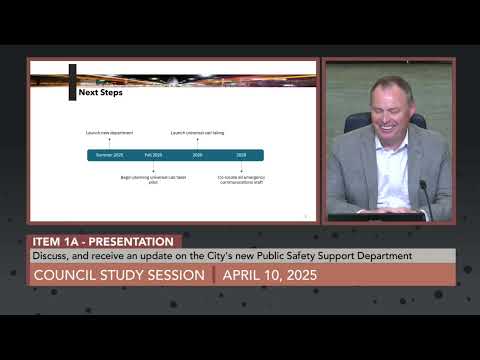
Officials said the city will pilot a single-call-taker model this fall, conduct thorough testing before wider rollout, and expects an official department launch in 2026. A new, consolidated communications center funded by voter-approved public safety bonds is in design now; officials estimated a ribbon-cutting around 2028. The budget office included somewhat more than $1 million in the current plan to stand up the new department, Butler said.
Council members asked for more detail on budget impacts, staffing shifts and governance. Councilmember Pillsbury (transcript: "Miss Pillsbury") pressed for clarity on whether the move would increase costs; Butler replied that setup costs are budgeted now but that leaders expect long-term efficiencies and that the budget includes money for initial administrative staffing. Councilmember Spilsbury asked how positions in both departments will move into the new unit; officials said detailed reassignments and procurement work remain in progress and that some functions now duplicated across police and fire will be consolidated over time.
Vice Mayor Summers asked whether the change would improve the timeliness and accuracy of information sent to crews in the field. Kim Mesa and other public safety leaders said the new model aims to ensure call-entrants enter complete incident data once and transmit that data via CAD to both fire and police dispatchers so responding units will receive continuous information rather than relying on repeated phone handoffs.
Deputy director-level forensic operations currently report outside the police chain of command, and officials said forensics will remain organizationally separate to preserve scientific independence. Staff emphasized the change is intended to improve employee morale and retention in the communications workforce as well as caller experience.
Officials said they will present consultants' findings and operational details to the public safety committee for deeper review. The council did not vote on the reorganization at the meeting; leaders said the council will see related budget items in coming budget cycles and that implementation will proceed with further briefings and committee-level review.
Residents and council members who want more detail can expect follow-up briefings, the city said, including the consultant report and staffing-level proposals at a public-safety-subcommittee meeting.
The city characterized the change as a multi-year implementation: pilot this fall, broader launch in 2026 and a centralized communications center by 2028.