Peoria staff proposes code change to let employees donate vacation hours to union bank after court ruling
Get AI-powered insights, summaries, and transcripts
SubscribeSummary
Peoria city staff presented a proposed code change to allow employees to donate accrued vacation hours into union-specific banks, a new approach prompted by an Arizona Supreme Court ruling that ended the city’s prior paid "union release time."
Peoria city staff presented a proposed change to the city code on April 22 to allow employees to voluntarily donate accrued vacation hours into union-specific banks for use on union business, citing an Arizona Supreme Court ruling that ended the city’s prior practice of providing paid “union release time.”
The change would add a new subsection to city code section 6-5 authorizing voluntary donations of vacation time into a union bank. Human Resources Deputy Director Brianne Nelson said the practice would be strictly voluntary and donor employees must gift their own accrued vacation time.
The proposal comes after the July 31, 2024 Arizona Supreme Court decision in the Gilmore Gallego matter, which found that municipality-provided union release time violated the state constitution’s gift clause because the court determined the prior practice lacked a tangible benefit to the city. “We immediately discontinued the use of union release time,” Nelson said, describing how the city stopped authorizing the banks after the decision and informed labor groups on Aug. 6, 2024.
Teresa Brenholt, HR manager, described the staff-developed alternative: a donation mechanism allowing members to place accrued vacation hours into a pooled bank that union presidents could then authorize for use for union business. Nelson said negotiated MOUs have already been revised to remove references to the old release-time banks and that one remaining union contract will be adjusted later this year.
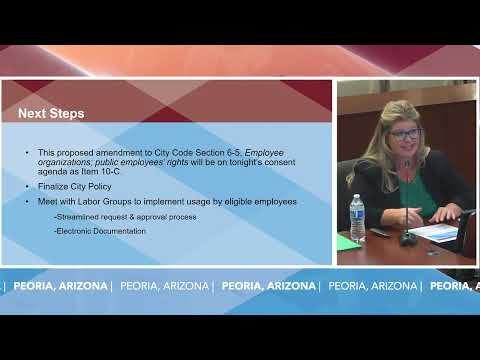
Staff told the council they have worked with the four affected labor groups on policy and process and that the draft code amendment and associated administrative policy would be placed on the consent agenda for formal approval. Nelson said if the code amendment is approved, HR will finalize the policy and implement the program quickly so unions may begin using donated hours.
No formal council vote on the code change occurred at the study-session presentation; staff said the amendment would appear on the next consent agenda for action. The city emphasized that any donated time must be voluntary and that the program would include documentation and approvals to record usage of banked hours.
Staff indicated remaining next steps include finalizing the administrative policy, documenting approval pathways and usage reporting, and coordinating implementation details with each union group.