Mesa council approves modest utility rate increase after heated public hearing
Get AI-powered insights, summaries, and transcripts
SubscribeSummary
The Mesa City Council on Dec. 2 approved new rates, fees and charges for electric, gas, water, wastewater and solid waste services after a public hearing featuring about 25 speakers who expressed strong views both for and against the increase.
Mesa City Council on Dec. 2 approved a package of rate, fee and charge changes for the city’s electric, natural gas, water, wastewater and solid waste utilities after a public hearing that drew roughly 25 speakers from across the city.
The change, adopted unanimously by the council, is intended to help cover rising operating and capital costs, maintain service levels and preserve funding used for public safety and other general-fund needs amid recent state revenue reductions and inflationary pressures.
Why this matters: Mesa relies heavily on utility revenues to help fund city services because it does not levy a primary property tax. Council and staff described the adopted increases as smaller, phased adjustments intended to smooth costs and protect long-term utility reserves while continuing planned capital work, including water infrastructure and public-safety facilities.
The vote and action
The council approved agenda items 9A through 9G, a package covering terms, rates, fees and charges for electric, natural gas, water, wastewater and solid waste services. The motion was made by Councilmember Heredia, seconded by Councilmember Spilsbury, and passed unanimously. The action directs staff to implement the new rates as described in the staff presentation and folded into the city’s multi-year financial forecast.
Public comments: burdens, trust and public safety
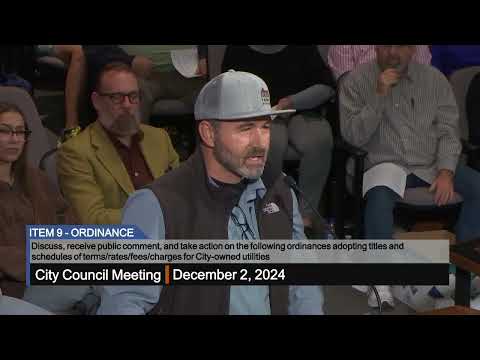
Public commenters split into two broad groups. Many residents urged the council to reject or delay the increase on affordability grounds, saying modest monthly increases still add up for families, seniors and people on fixed incomes. “I am here to ask you to vote no on the utility rate increase,” said Brian Eckley, who told the council the hike would be “an added burden” for many Mesa households. Several speakers referenced petitions, recent attendance at prior meetings and concerns about transfers from utility funds into the general fund.
At the same time, public-safety personnel and some residents urged approval, saying the revenue supports police, fire and emergency services. “On behalf of the United Mesa firefighters, I wanna express our full support for your recommendation of this increase,” said Scott Figgins, who identified himself as a captain-paramedic and president of United Mesa Firefighters Local 2260. Other uniformed public-safety speakers, including paramedics and members of the police department, described recruitment, retention and regional service responsibilities as drivers of funding needs.
Staff response and council discussion
City Manager Mr. Brady and staff outlined the financial and operational drivers behind the proposal: ongoing inflation in operating costs (including maintenance, chemicals and fleet costs), increased debt service tied to ongoing capital projects, and water-supply investments intended to secure lower-cost, higher-priority water for the long term. Brady told the council Mesa’s credit ratings, recent audits and reserve targets factor into the recommendations and that the city has purposely smoothed increases to avoid large, single-year spikes residents might see elsewhere.
Brady also noted the city retains several mitigation measures: a senior discount program for eligible utility customers and a $200,000 assistance fund for low-income residents, and that the transfer from utility funds to the general fund is governed by ordinance and has historically included a portion dedicated to public safety. He advised that declining state-shared revenue and the repeal of a state rental tax are additional headwinds the city must plan around.
Key figures and clarifications from the hearing
- Some public speakers pointed to past surpluses and transfers: commenters cited a reported $12 million governmental surplus and a $127 million business-utility surplus in fiscal 2023, and said the city transferred roughly $120 million from utility funds to the general fund in that period. Speakers asked for clearer line-item allocations of those transfers.
- City staff and others said the 30% transfer mechanism has been part of the city’s financial approach (an ordinance discussed by speakers) and that roughly 25 percentage points of that transfer historically support public safety while the remainder supports other general-fund uses.
- Speakers highlighted other specific pressures and figures mentioned during the meeting: a $32.4 million increase in utility revenue proposed for the year but similar increases forecast in following years; an ongoing multi-year capital program that affects debt service; and an estimated revenue shortfall from the state rental-tax repeal of about $20 million annually.
- Residents described the personal impact of even modest monthly increases, with one speaker calculating a combined utility effect of about $4.69 per month for small users and others noting larger bills for households with pools, larger properties or commercial accounts.
Distinguishing discussion, directions and decisions
Discussion points included whether the city should pursue deeper efficiency cuts; whether bonds recently approved by voters (commenters referenced roughly $260 million in two bonds, including $90 million for public safety) reduce the need for utility-rate revenue; and options for alternative revenue sources such as a primary property tax. Staff repeatedly said bonds and rate transfers serve different purposes: bond proceeds fund capital projects (stations, apparatus, communications), while utility transfers support operations such as salaries and day-to-day public-safety spending.
Direction and next steps noted on the record included continued budget and strategic-planning work: councilmembers referenced a public budget process, a strategic-planning session and a larger budget discussion slated for April 2025 when the council and staff will revisit priorities and potential efficiencies. Staff also said they will continue outreach about assistance programs for low-income customers and provide detailed financial materials to any councilmember or resident who requests them.
What the vote does and does not do
The council’s unanimous approval implements the specific rate, fee and charge changes included in items 9A–9G and authorizes staff to collect the adjusted revenues under the city’s adopted schedules. The action does not change the ordinance governing utility-to-general-fund transfers; it also does not itself enact a property tax or alter voter-approved bonds. Council members and staff repeatedly framed the measure as one step in a multi-year, multi-fund financial plan rather than a final or sole solution.
Ending note
The council’s approval closes a chapter of public hearings and study sessions that began months earlier; it also sets the stage for the April 2025 budget process and further council review of spending and priorities. Residents who opposed the increases said they will continue to press elected officials for alternate cuts and efficiencies, while public-safety supporters said the adjustments are necessary to maintain staffing and service levels.
The full rate schedules, staff presentations and the city’s five-year forecasts are posted on the City of Mesa website and were discussed at public study sessions leading to the Dec. 2 vote.