Get Full Government Meeting Transcripts, Videos, & Alerts Forever!
Get email alerts on the Agriculture Environment topic
No spam. Unsubscribe anytime.
Animal waste ordinance work group meets; stakeholders back nutrient management, buffers and incremental phosphorus targets
Summary
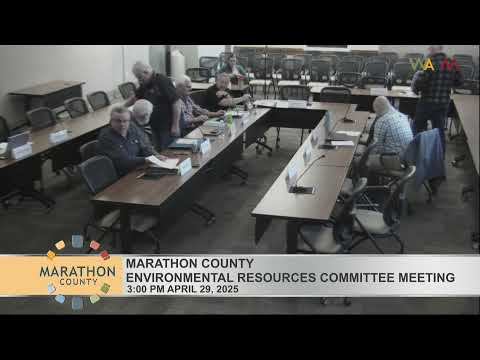
CPZ staff updated the ERC on two work group meetings focused on proposed animal-waste ordinance amendments. About 25 stakeholders, mostly farmers, discussed data sources, winter manure-spreading limits, nutrient-management expansion and buffer or cover-crop approaches.
Marathon County Conservation, Planning & Zoning (CPZ) staff updated the Environmental Resource Committee April 29 on the first two meetings of an animal-waste ordinance work group that includes about 25 stakeholders, predominantly farmers of varying operation sizes.
Matt Repping (CPZ) told the committee the work group spent its first meeting reviewing water-quality data and strategic plans, with emphasis on total phosphorus monitoring in the Big Eau Pleine (Big O) reservoir watershed and other Wisconsin River system watersheds. Participants reviewed DNR TMDL data, local monitoring from the Wisconsin Valley Improvement Company, county monitoring stations and volunteer monitoring results.
Repping said the group is united on the need for better nutrient-management implementation countywide. “We already have a robust nutrient management program — over 60% of cropland acres in Marathon County have nutrient management plans — but the group recognizes we can do better,” he said. Stakeholders discussed alternatives including: - Expanding nutrient-management expectations and implementing a tighter phosphorus-index target (state index ~6 lbs P/acre; the group discussed incremental reductions toward 4 or 3 lb/acre targets for some fields). - Working buffer practices into a compromise solution (streamside buffers or similar measures were repeatedly raised as part of a package). - Limiting winter manure spreading above a defined animal-count threshold, while exploring residue or cover-crop practices that increase surface protection where winter application occurs.
The second meeting focused more deeply on data sources; several participants requested more time on monitoring datasets before agreeing to specific policy changes. Repping said the work group is intentionally diverse — operations with a few animals up to very large farms — and that the initial meetings were notable for respectful discussion across differing viewpoints.
Next steps include additional work group meetings to refine alternatives and more CPZ analysis of data and practicable measures. Repping said CPZ will return to the committee with updates as the work group narrows options and develops draft ordinance language.
Ending CPZ staff requested that ERC members encourage colleagues to attend future work group meetings when possible and noted the committee will receive further progress reports as alternatives move from discussion toward ordinance drafting.