Get Full Government Meeting Transcripts, Videos, & Alerts Forever!
Get email alerts on the Housing And Community Services topic
No spam. Unsubscribe anytime.
Mesa Community Services details housing assistance, homeowner rehab and animal program during budget briefing
Summary
Community Services staff told the City Council about housing voucher funding, a homeowner emergency rehabilitation program that has distributed more than $2 million, a new trap‑neuter‑return initiative and plans for opioid‑settlement and federal grant spending.
Community Services Director Ruth Giese told the Mesa City Council that the department has continued to expand housing and community supports as it prepares the department’s budget.
The department highlighted its homeowner emergency rehabilitation program, its public housing authority operations, a new trap‑neuter‑return (TNR) program for feral cats and city planning for opioid‑settlement and other federal funding.
The homeowner emergency rehabilitation program, funded with Community Development Block Grant dollars, provides grants of up to $25,000 per household for repairs and accessibility work. “So far to date, we have allocated over $2,000,000 for 27 projects,” Giese said. The department reported that 94% of program beneficiaries are elderly and about 45% have a disability. Staff showed before‑and‑after photos of projects such as a repaired safe entrance.
Michelle Durkovic, the department’s senior fiscal analyst, summarized the housing authority’s finances and federal funding flow. The housing authority, she said, receives federal disbursements each month that the city disperses directly to landlords. “We basically every month receive about $2,000,000 in disbursements directly from the federal government,” Durkovic said. She also noted the housing authority retains a HUD designation; Giese described the authority as a “high performing agency” for 13 consecutive years based on HUD’s annual assessment.
Giese and staff cautioned that one temporary source of emergency housing vouchers issued during COVID is scheduled to spend down earlier than originally planned. “We received additional vouchers during COVID… the program is going to spend down its money by 2026,” she said, adding that staff are working with the local HUD representative on a waiver so regular vouchers can be used if the emergency funding lapses.
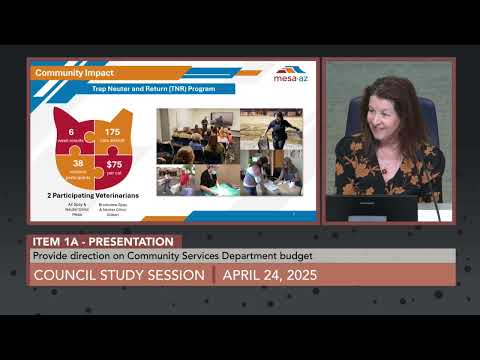
On animal services, Giese said the city launched a TNR program in February. In six weeks the program had altered 75 cats and enrolled 38 resident participants; staff reported adding a third veterinarian in East Mesa to provide more appointment options.
Council members asked about the security of HUD and settlement funding. Durkovic said opioid‑settlement distributions arrive through the state and that Mesa has received about $4.5 million so far, with future disbursements estimated in a range up to $17–$22 million countywide over many years depending on settlements and bankruptcies of defendants. The city plans to return to council next month with a proposed community grant program to allocate opioid funds and additional recommendations for spending.
Ending: Staff said they will return to the council with more detail on funding recommendations and any necessary waivers or intergovernmental agreements.