Get Full Government Meeting Transcripts, Videos, & Alerts Forever!
Get email alerts on the Special Education topic
No spam. Unsubscribe anytime.
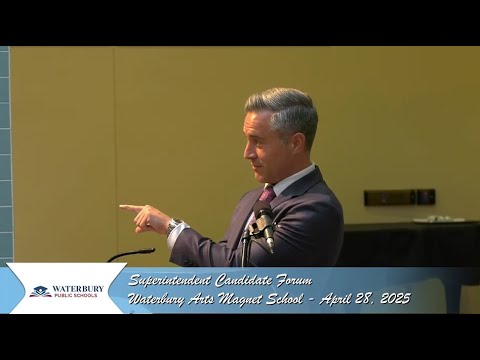
Candidates say special education, mental-health services need urgent staffing and funding boosts
Summary
At a Waterbury Public Schools superintendent forum, three finalists emphasized expanding programs and staffing for special education and student mental health, citing rising costs, local shortages and the need for regional partnerships and a needs assessment.
Three finalists for Waterbury Public Schools superintendent told a community forum that expanding special-education and mental-health services — especially for students with autism — requires an immediate needs assessment, more staff and new funding strategies.
All three candidates framed the issue as both programmatic and fiscal: Dr. Schwartz, the district's interim superintendent, said, “Special education costs have gone up $10,000,000 in 5 years.” The candidates described gaps in staffing, program capacity and coordination that they said leave some students in settings that do not meet their needs.
Why it matters: Candidates said unmet special-education and mental-health needs affect student safety, learning and family stability. Dr. Lewis argued that schools must build “ecosystems of support” and partner with local and regional providers to stretch limited resources. He added that technology and tele-services can expand access for therapy and related services.
Details from the forum: Dr. Schwartz said the district has road maps for mental-health supports and singled out school-based health centers and partnerships with organizations such as Sandy Hook Promise as existing pieces of the network. He also said the district has worked to clarify program expectations and recommended written program handbooks for special-education pathways.
Dr. Lewis advocated a two-step approach: first a needs assessment to document current capacity and gaps, then asset mapping to identify community partners and regional collaboration opportunities. “A lot of mental health resources are available, through technology,” he said, drawing on his experience providing virtual speech and occupational therapy in a prior district.
Dr. White said he would begin with a needs assessment and expand social-emotional learning within curriculum and training for staff, and that some budget trade-offs would be necessary because “it does cost more to do proper programming, but children deserve those things.”
Candidates also described staffing shortages. Dr. Schwartz noted the district had been “down 40 staff almost all year in special education,” saying that number was reduced from 60 after recruitment efforts. Dr. Lewis and Dr. White urged investing in staff recruitment, retention and professional development — and in supports for staff mental health — to stabilize programs.
Funding and advocacy: All three said the superintendent must press state and federal lawmakers for sustained resources. Dr. Lewis highlighted the loss of one-time federal ESSER funds and said district leaders should combine advocacy for state funding with regional collaboration to serve students more efficiently.
What was not decided: The forum was a candidate interview; no board action or commitments were made. Candidates offered different emphases — regional hubs (Lewis), program handbooks and PSAs (Schwartz), and embedding social-emotional learning in curriculum (White) — but all framed the next step as assessment, staffing and targeted investment.
Next steps flagged by candidates included conducting a district-wide needs assessment, developing program handbooks that define entry and exit criteria and expected outcomes for special-education programs, and pursuing legislative and grant funding to expand services.