Citizen Portal

Mesa council continues zoning decision on Lofts at 121 North Beverly after resident concerns about density and traffic

3153615 ยท April 30, 2025

Get AI-powered insights, summaries, and transcripts

Subscribe
AI-Generated Content: All content on this page was generated by AI to highlight key points from the meeting. For complete details and context, we recommend watching the full video. so we can fix them.

Summary

The Mesa City Council voted to continue a rezoning request for a proposed 68-unit development at 121 North Beverly to give the developer, staff and neighbors time to work on density, ownership mechanics and traffic concerns raised at the April 7 meeting.

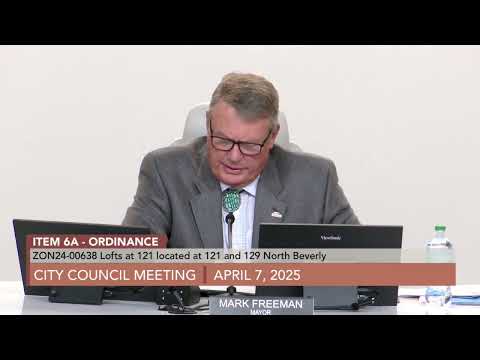
The Mesa City Council on Monday voted to continue consideration of a rezoning and planned area development (PAD) request for the proposed Lofts at 121 North Beverly, saying staff, the applicant and neighbors should have more time to address concerns about density, traffic and whether the project will be sold as homes or operated as rentals.

Mayor John Freeman and council members heard more than a dozen residents during a lengthy public comment period about the 68-unit proposal directly adjacent to Beverly Park. Councilmember Rich Adams moved to continue the item; Vice Mayor Scott Summers seconded the motion and the continuance passed.

The decision came after neighbors and longtime residents described the area as a historic, low-scale neighborhood and said the project as proposed would introduce too much traffic and height overlooking back yards. "The Lofts at 121 proposal is incompatible with the identity, values, and safety of this historical Mesa neighborhood," homeowner Brett Stevenson told the council. Several speakers asked the developer to reduce units and said they had been told the units would be for sale but feared they would become rentals.

Planner and applicant presentations focused on the project's design and technical studies. Kevin Boyle, the applicant, said the design was intentionally modeled to read as small houses, that each unit includes a two-car garage, and that the project was laid out with the adjacent park as an amenity. Boyle told council, "The project is always intended to be for sale." City planning staff cautioned that the current PAD and rezoning before council did not itself establish ownership; staff said additional steps would be needed if the developer intends to ensure ownership rather than rental use.

Transportation staff asked council to consider the practical limits of traffic solutions proposed by neighbors. Interim Transportation Director Eric Cadarian said the city's standard maximum cul-de-sac length is 400 feet and that a cul-de-sac that would dead-end Beverly at Main Street would be about 1,300 feet and difficult to retrofit. "City code says that our maximum cul-de-sac length should be 400 feet," Cadarian explained.

The applicant presented the project's traffic study, which the developer summarized as generating about 446 daily trips: 28 trips during the morning peak hour and 35 trips during the evening peak hour. Boyle and staff noted that 35 peak PM trips equates roughly to "one additional vehicle every two minutes," a point several speakers used to argue the increase would harm neighborhood safety, especially where children walk to school. Staff also said the applicant had reduced the unit count by two after an earlier study-session discussion; planning staff reported the revised plan equates to about 21 units per acre.

Council discussion emphasized process and next steps. Councilmember Julie Spilsbury and others said they wanted to hear the neighbors' concerns before taking action, while Councilmember Duff and others said the proposed zoning level was within acceptable ranges. Councilmember Adams argued the city should also weigh the Mesa Balanced Housing Plan, which includes a pillar to explore homeownership opportunities, and moved for a continuance to allow staff, the applicant and residents to negotiate potential reductions in density and work on the ownership question.

Council staff said they would follow up on technical items raised at the meeting, including school impacts, retention and utility issues, and any traffic-calming petitions the neighborhood might pursue. The continuance does not set a specific return date; staff and the applicant are to coordinate with the neighborhood and schedule a new public hearing once issues are addressed and proper notice has been given.

What happened next: The council approved a continuance, allowing time for the applicant and neighbors to discuss possible density reductions, for staff to vet ownership/condominium conversion steps, and for transportation staff to further evaluate traffic-calming options. No rezoning or PAD approval was made at the meeting.

Why it matters: The result delays a project that residents say would change the character and safety of a long-established Mesa neighborhood. The continuance also highlights recurring tensions in city development decisions: balancing infill housing near transit and amenities with the concerns of existing homeowners over traffic, scale, and housing type.

Looking ahead: Council and staff will work with the applicant and neighborhood; any revised proposal must return for a publicly noticed hearing before final action by the City Council.