Lifetime Citizen Portal Access — AI Briefings, Alerts & Unlimited Follows
Legislative Branch Appropriations Subcommittee hears FY2026 requests from CBO, GAO and GPO
Loading...
Summary
Directors of the Congressional Budget Office, Government Accountability Office and Government Publishing Office presented fiscal 2026 funding requests and answered senators' questions on staffing, technology, AI oversight and a legal dispute over agency submissions under the Congressional Review Act.
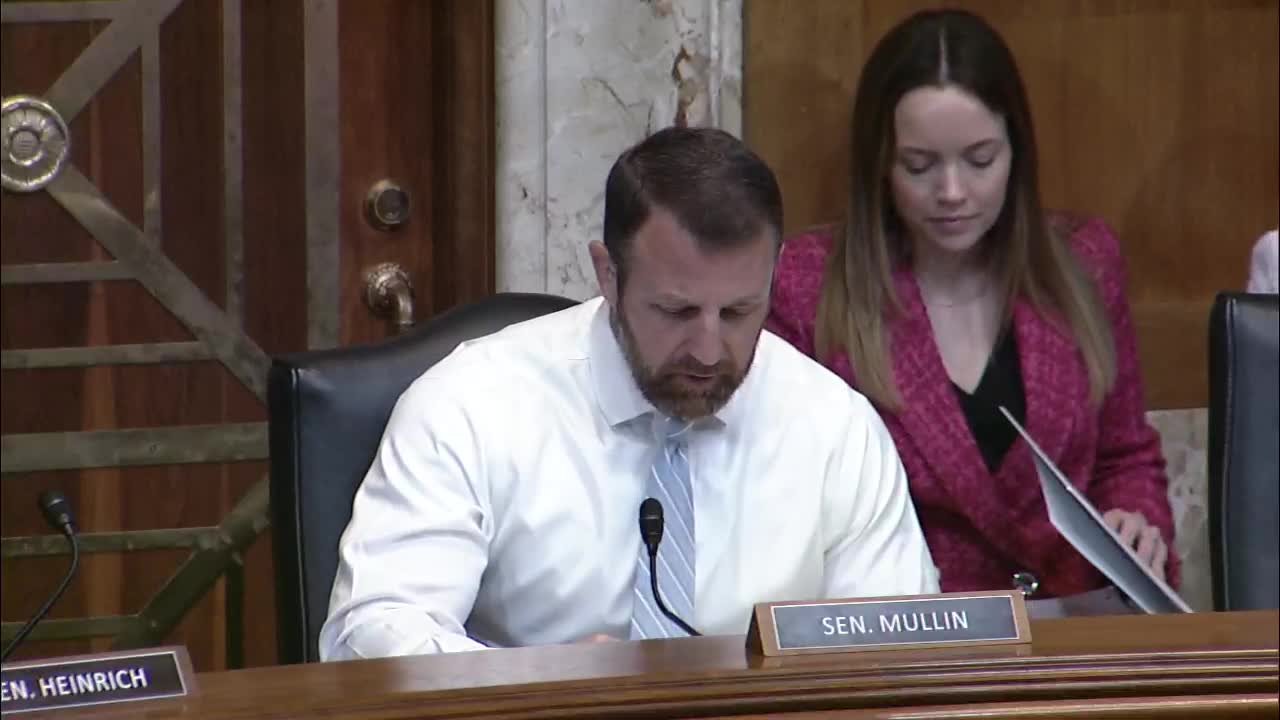
Chairman Mullin convened the Legislative Branch Appropriations Subcommittee for a fiscal 2026 budget hearing in which the directors of the Congressional Budget Office, the Government Accountability Office and the Government Publishing Office outlined funding requests and operational priorities.
The hearing focused principally on three agency budgets and several cross-cutting issues, including agency staffing, cybersecurity and information-technology needs, how federal agencies are using artificial intelligence, and questions about the Government Accountability Office's handling of documents submitted under the Congressional Review Act.
Dr. Phil Swagel, director of the Congressional Budget Office, said CBO requested $75,800,000 for fiscal 2026, an increase of $5,800,000 (8.2%) from 2025. "The request would address increased cost for paying benefits, allow CBO to improve its IT infrastructure, and add staff in areas of especially intense legislative interest," Swagel said. He said about half of the requested increase—roughly $3,000,000—would cover pay and benefits for current employees and the remainder would support cybersecurity and computing capacity; the full request would let CBO add 15 employees, increasing staffing from 270 to 285, with new analysts in health care, dynamic analysis, national security and homeland security.
Comptroller General Gene Dodaro described GAO's workload and urged additional resources to sustain oversight. "We have about a 50 recurring mandates," Dodaro said, and noted that in fiscal year 2024 GAO received hundreds of requests from congressional committees. Dodaro told senators GAO's current staff is a little over 3,500 and said the office is asking for an increase of about $122,000,000 in its appropriation; he also said the agency's total budget currently is about $811,000,000. Dodaro highlighted GAO's return-on-investment metric, saying that over the last six years GAO's efforts yielded about $123 in financial benefits for every dollar invested in the agency.
Hugh Halpern, director of the Government Publishing Office, requested $135,400,000 for fiscal 2026. Halpern told the subcommittee that $83,000,000 of the request funds congressional publishing (the same amount as FY2025), about $42,900,000 would support the Federal Depository Library Program and related public information activities (an increase attributed largely to labor costs), and $9,500,000 would come from the revolving fund to support technology upgrades including XPUB and GovInfo improvements. Halpern said GovInfo served more than 42 million requests a month and that GPO added about 260,000 document packages last fiscal year.
Senators pressed witnesses on several topics. On artificial intelligence, Dodaro said GAO has issued more than 50 reports since 2018 and has developed an audit framework to examine algorithms, data governance and related risks; "if you don't have good data going into these systems, you have to worry about bias, you have to worry about accuracy," he said. Swagel said CBO is studying how AI could affect productivity and the size of the economy and cautioned there is not yet a firm estimate of AI's net macroeconomic payoff.
Senators also questioned Dodaro about GAO's treatment of three EPA submissions under the Congressional Review Act. In that exchange Dodaro described receiving inconsistent submissions from EPA (once characterizing the actions as orders and later as rules) and said GAO sought clarification from EPA but received no response; he emphasized GAO's role is advisory and that the office did not change its earlier 2023 view that, in that instance, the action in question was an order under the Administrative Procedure Act rather than a rule for CRA purposes.
Several senators, including Senator Murray, raised the Impoundment Control Act and asked about GAO investigations of the administration's withholding of funds; Dodaro said GAO has 39 investigations underway and is seeking information from multiple agencies, with only a few having provided full responses to date.
No formal appropriations decisions were made at the hearing. Senators directed witnesses to provide additional materials and iterative reports where appropriate—Dodaro said GAO would provide past AI reports and its plans; Swagel said CBO would continue to prioritize cost estimates and technical assistance as needed.
The subcommittee proceeded through the scheduled question-and-answer period and concluded with Chairman Mullin thanking witnesses and members for their participation.