Get Full Government Meeting Transcripts, Videos, & Alerts Forever!
Get email alerts on the School Finance topic
No spam. Unsubscribe anytime.
Westerville board hears finance briefing on proposed state "clawback" and risks to district services
Summary
At a special April 28 meeting, Westerville City Schools officials warned that a House budget proposal to limit district fund balances to 30% could force frequent new levies, risk state oversight and cut programs; staff described the district's current forecast, past revenue shifts and options such as capital or termination-benefit funds.
Westerville City Schools officials told the Board of Education on April 28 that a proposed change in the Ohio state budget to limit local school fund balances to 30% of prior-year expenses would sharply reduce the district's flexibility and could force repeated levy campaigns, program cuts and state oversight.
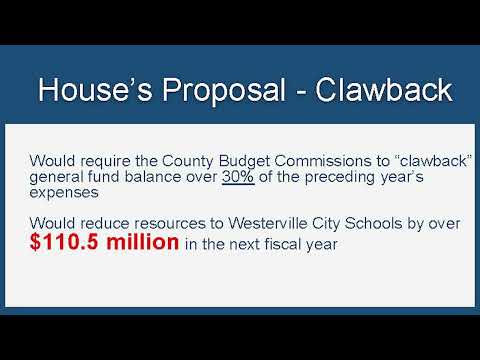
Nicole Marshall, who led the district's finance presentation, said the governor's and the legislature's competing budget proposals would move the state's contribution to K-12 education far lower: "Our state share was 43% in fiscal year 2020-21. It's currently 23%. The governor's proposal would drop it down to 11% by the end of the biennium." Marshall said the House proposal also contains a provision (described at the meeting as a "clawback") that would require County Budget Commissions to review cash balances after the June 30 fiscal year end and adjust tax rates for the next tax year if a district's unreserved balance exceeded 30% of the preceding year's expenses.
That mechanism, Marshall said, could force Westerville to return to voters repeatedly to pass operating levies and would reduce the district's ability to plan for recurring costs. "We'd be nearly in a negative unreserved situation by fiscal year 2027," she said while reviewing the district's five-year forecast. Marshall and other staff described prior revenue shifts that reduce predictability, including a $4 million drop in state funding this year linked to outdated cost inputs in the funding model, the phasing out of earlier homestead and rollback reimbursements, and the end of one-time federal COVID (ESSER) funds that totaled more than $32 million to the district.
Scott Reeves, who spoke about cash-flow and payroll timing, added that the district receives most of its local property tax revenue in two annual settlements (August and March) and that payroll could be at risk midyear under the proposed limits. "We spend over $5,600,000 just in salaries on one payroll," Reeves said, warning that the district could face difficulty meeting payroll as early as January or February of a fiscal year under the House proposal.
Board members and administrators outlined several concrete impacts that could follow sustained shortfalls or a mandated reduction of reserves: reductions in extracurricular programming, elimination or scaling-back of middle-school course offerings, larger class sizes, reduced transportation, curtailed advanced and college-credit programs and potential school closures. Board members repeatedly emphasized effects on economically disadvantaged students if optional programs are cut.
Marshall said the board previously set aside $30 million from the general fund to pair with a proposed bond; that capital-projects transfer was rescinded after voters rejected the November ballot issue and the funds returned to the general fund. She told the board that capital and termination-benefits funds exist under state law and can be used to segregate one-time expenses (buses, technology, facility projects, severance payouts) from recurring operating costs. At the meeting she referenced Ohio Revised Code 5705.13(b) when describing the statutory basis for certain special funds and identified local board policy 6210.01 (cash balance/reserve policy) and board policy 09/1930 (process for personnel complaints) as governance references mentioned during public remarks.
Staff also reviewed district facility needs and the effect of construction inflation. Carrie (facilities staff) said the district has a multi‑phase facilities master plan dating from 2019 and that inflation pushed several 1960s-era buildings and other projects into a larger price range; the district previously targeted elementary buildings including Cherrington, Huber Ridge, Blendon and Walnut Springs for the second phase of work. Administrators noted the rising cost of buses and equipment since 2019.
Board members and staff urged parents and residents to contact state legislators, update them on local impacts, and press for adoption of the Fair School Funding Plan with current (inflation-adjusted) cost inputs while opposing the clause described at the meeting as the 30% clawback. At the end of the special meeting the board voted to enter executive session to discuss negotiations and personnel matters; no policy change was adopted at the session.
Why it matters: District leaders said the proposal would move more cost onto local property owners, reduce the district's credit strength and borrowing capacity, and force choices that would change students' everyday programming. As Nicole Marshall told the board, "The larger the reserve, the better the entity is able to absorb the impact of sudden revenue loss or significant increases in operating costs and begin planning financial adjustments."