Get Full Government Meeting Transcripts, Videos, & Alerts Forever!
State Water Board outlines narrower Utility Wildfire General Order, adds thresholds and streamlined enrollment
Summary
State Water Resources Control Board staff described a revised draft Utility Wildfire General Order that narrows covered activities, adds a 0.5-acre threshold for some upland work, creates a non-notifying category with limited inspections and provides an optional consolidated enrollment for certain projects; public comments are due April 29.
State Water Resources Control Board staff on April 23 described changes to a revised draft Utility Wildfire General Order that will create statewide permit coverage for certain electric utility wildfire-prevention and post-fire activities while narrowing the scope and adding streamlined enrollment options.
Robert Stoddard, an environmental scientist with the State Water Resources Control Board, opened the outreach webinar by saying, “Welcome, everybody, to our discussion of the Utility Wildfire General Order.” The session was a public outreach meeting; staff said comments are due April 29 at 5 p.m. and that the revised draft was posted on the board’s 401 page on March 28.
Board staff said the order will function both as a Clean Water Act Section 401 Water Quality Certification and as waste discharge requirements, and therefore includes some upland activities that are not typically part of a 401-only certification. Paul Hann, Program Manager for the Watersheds and Wetlands Program, summarized the agency’s authority: “our agency's mandate is to address discharges of waste or threatened discharges in the waters of the state.”
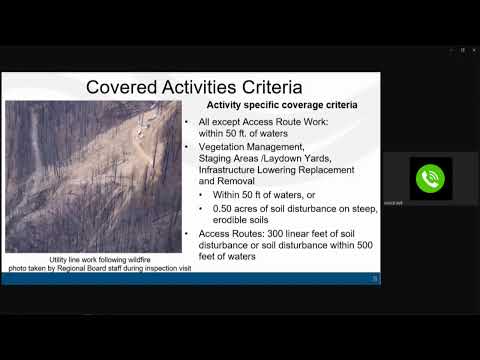
Why it matters: staff said the revised draft aims to strike a balance between reducing administrative burden and addressing water-quality risks that staff say have increased with larger-scale utility work in rights-of-way and access roads. The changes staff highlighted include a new 0.5-acre soil-disturbance threshold for certain activities, a 50-foot proximity trigger to waters for most activity types, new non-notifying and notifying categories (Category A and B), a consolidated enrollment option for some Category B (notifying) upland activities, and reduced inspection and reporting expectations for many lower-risk projects.
Key details from staff presentation and Q&A
- Scope and activity categories: The order lists 11 activity categories in Section 3 (A–K) including vegetation management, herbicide application, access route development and maintenance, staging areas, pole and tower…
Already have an account? Log in
Subscribe to keep reading
Unlock the rest of this article — and every article on Citizen Portal.
- Unlimited articles
- AI-powered breakdowns of topics, speakers, decisions, and budgets
- Instant alerts when your location has a new meeting
- Follow topics and more locations
- 1,000 AI Insights / month, plus AI Chat