Get Full Government Meeting Transcripts, Videos, & Alerts Forever!
Get email alerts on the Utility Wildfire General Order topic
No spam. Unsubscribe anytime.
State Water Board outlines narrower Utility Wildfire General Order, adds thresholds and streamlined enrollment
Summary
State Water Resources Control Board staff described a revised draft Utility Wildfire General Order that narrows covered activities, adds a 0.5-acre threshold for some upland work, creates a non-notifying category with limited inspections and provides an optional consolidated enrollment for certain projects; public comments are due April 29.
State Water Resources Control Board staff on April 23 described changes to a revised draft Utility Wildfire General Order that will create statewide permit coverage for certain electric utility wildfire-prevention and post-fire activities while narrowing the scope and adding streamlined enrollment options.
Robert Stoddard, an environmental scientist with the State Water Resources Control Board, opened the outreach webinar by saying, “Welcome, everybody, to our discussion of the Utility Wildfire General Order.” The session was a public outreach meeting; staff said comments are due April 29 at 5 p.m. and that the revised draft was posted on the board’s 401 page on March 28.
Board staff said the order will function both as a Clean Water Act Section 401 Water Quality Certification and as waste discharge requirements, and therefore includes some upland activities that are not typically part of a 401-only certification. Paul Hann, Program Manager for the Watersheds and Wetlands Program, summarized the agency’s authority: “our agency's mandate is to address discharges of waste or threatened discharges in the waters of the state.”
Why it matters: staff said the revised draft aims to strike a balance between reducing administrative burden and addressing water-quality risks that staff say have increased with larger-scale utility work in rights-of-way and access roads. The changes staff highlighted include a new 0.5-acre soil-disturbance threshold for certain activities, a 50-foot proximity trigger to waters for most activity types, new non-notifying and notifying categories (Category A and B), a consolidated enrollment option for some Category B (notifying) upland activities, and reduced inspection and reporting expectations for many lower-risk projects.
Key details from staff presentation and Q&A
- Scope and activity categories: The order lists 11 activity categories in Section 3 (A–K) including vegetation management, herbicide application, access route development and maintenance, staging areas, pole and tower repairs, substation maintenance, reconductoring, undergrounding, boardwalk repairs and electric utility infrastructure work. Staff combined transmission tower maintenance with pole maintenance from the prior draft.
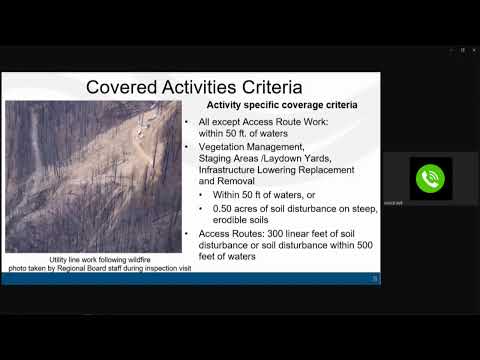
- Distance and size triggers: Staff said most activities (except access route work and vegetation management) will trigger coverage if they result in soil disturbance within 50 feet of waters. Access route work is covered if it results in 300 linear feet of soil disturbance or soil disturbance within 500 feet of waters. For vegetation management, slope and soil erodibility criteria remain for some situations and a 0.5-acre soil‑disturbance threshold was added for several activity types.
- Non-notifying Category A and limited inspections: To reduce administrative burden, some activities are eligible for a non-notifying category (Category A). Non-notifying projects must implement all best management practices (BMPs), comply with tribal cultural resource conditions, and maintain a project list (location, dates, brief description) that must be provided to board staff on request. Staff said only 5% of non-notifying projects must be inspected annually; inspection reports must be retained for three years and reported only if they identify BMP failures or erosion.
- Consolidated enrollment option: The revised draft offers an optional consolidated enrollment path for certain notifying Category B upland activities if utilities hold an approved programmatic plan and submit required information (plan description, location, dates, BMPs, tribal cultural resources report). If the submission is complete and staff does not request missing information, work may proceed after 30 days under the consolidated path.
- Tribal cultural resources: Jean Bandura, Senior Environmental Scientist, said staff changed tribal coordination requirements in response to utility comments. Staff shortened the pre-project contact period from 120 days to 30 days when tribal cultural resources are identified within a project area, removed duplicate coordination where another agency already conducts consultation, and added Water Board resources through the Office of Public Engagement, Equity, and Tribal Affairs to assist outreach. Bandura said these measures respond to both the State Water Board’s Tribal Equity Resolution and tribal requests for meaningful input.
- Overlap with other permits and emergency actions: Staff said the General Order is not intended to replace existing in‑water dredge-and-fill permits. Projects that qualify for another dredge‑and‑fill permit (for example, Army Corps authorizations) must obtain coverage under that permit instead of the general order. Staff also noted the Governor’s March 1, 2025 emergency proclamation suspending permitting for certain critical fuel‑reduction projects; projects authorized under the state suspension and CalEPA guidance are not subject to the general order and should follow the CalEPA Environmental Protection Plan developed for the suspension. Staff also cited Executive Order N‑24‑25 (Los Angeles and Ventura counties) as potentially affecting applicability in those counties.
- Fees and cost discussion: Jean Bandura said fees for upland activities are charged under the waste discharge requirement fee schedule; in‑water work remains subject to the dredge‑and‑fill fee schedule. Non-notifying Category A activities are not subject to fees, staff said. Staff acknowledged the draft introduces new compliance costs—particularly for upland activities and tribal consultation—but said many requirements align with current utility practices (erosion and sediment control plans, environmental monitors). When asked, staff said they do not have a statewide estimate of the number of projects that would be affected and asked utilities to provide project-location data or methodologies to help refine cost estimates. Staff said a per‑site cost discussion appears at the end of their responses-to-comments document but that a statewide project count was not available.
- Implementation timeline and comment period: Staff said the revised draft was released for comment on March 28, the written comment period closes April 29 at 5 p.m., and Board consideration for adoption is tentatively scheduled for October; the Board will set final implementation timing.
Stakeholder concerns raised during the webinar
Representatives from utilities pressed staff on the scope, the degree to which upland maintenance and road work will be covered, and the administrative cost and workload implications if large numbers of small projects are brought within the permit. Josh Stoopes of SMUD said the potential cost “would be extremely expensive to comply with” if many projects are covered. Susie Berlin (Northern California Power Agency and Golden State Power Cooperative) and others requested clearer documentation of the cost analysis and asked staff to confirm whether the cost comparison accounts for annual mileage-based wildfire mitigation fees. Staff pointed stakeholders to the responses-to-comments document and offered follow-up discussions and data sharing.
What staff said they will do next
Board staff invited written comments through April 29 and said they will consider more targeted outreach with utilities to collect GIS data on project locations and to refine estimates of the number of covered projects and likely administrative burden. Staff said they also anticipate the option for programmatic or service-area-wide enrollment paths that could reduce per-project paperwork.
Ending note
State Water Board staff emphasized the stated goal of establishing a “thin and light” permitting path that sets baseline erosion and sediment controls, provides tribal coordination, and captures activities staff identify as posing a meaningful risk to waters of the state while seeking to limit unnecessary paperwork for routine maintenance. Officials urged utilities and other stakeholders to submit detailed comments and project-location data during the comment period so staff can refine the draft before the Board’s consideration later this year.