Get Full Government Meeting Transcripts, Videos, & Alerts Forever!
Get email alerts on the Pfas Septage Biosolids topic
No spam. Unsubscribe anytime.
Ashland County committee probes PFAS risk from decades of sludge and septage land‑spreading
Summary
County Land Conservation Committee members discussed long‑standing municipal sludge and private septage land‑spreading after soil tests found PFAS; no countywide testing program or remediation funding currently exists and committee members requested planning and grants guidance.
The Ashland County Land Conservation Committee on Thursday examined decades of municipal sludge and private septic septage land‑spreading after department staff confirmed PFAS were found in soil at at least one long‑used site.
Committee members and utility staff described the problem and gaps in state programs for testing and remediation, and discussed next steps for mapping, sampling and seeking grant funds rather than adopting any regulatory action at the meeting.
Mary Jo Gingress, Land and Water Conservation Department director, said the county has two long‑used municipal sludge sites — one with at least 40 years of application — plus roughly 50 privately permitted septic‑spreading sites. “One thing that we're learning about spreading of septic, especially at municipal or industrial levels, is that PFAS, are accumulated in the sludge material,” Gingress said. She explained that PFAS are persistent, come from everyday consumer and industrial products and concentrate in wastewater residuals, and that the county has few tools for large‑scale testing or cleanup.
The nut graf: Committee members said the county must decide whether to seek sampling and funding to determine whether PFAS in soils is leaching to groundwater, and whether to alter where biosolids can be land‑applied. Staff emphasized that, for now, state programs and funding for widespread PFAS testing or reclamation are not available.
Utility staff and committee members described what is known and unknown. Brian Ladin, who identified himself as a water and wastewater utility manager, said, “it's something that is new to us as well... it is very expensive to deal with it.” Gingress said she had discussed the issue with Wisconsin Department of Natural Resources (DNR) wastewater and public‑health advisers and with county peers; she reported no statewide program exists to fund countywide PFAS well or soil testing.
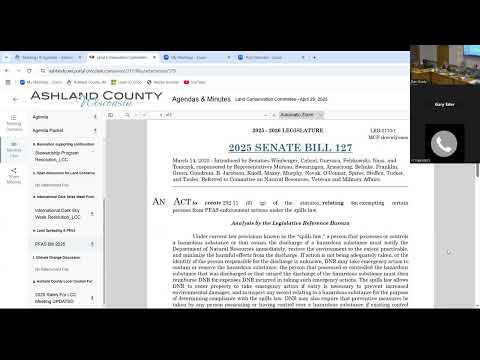
Gingress and committee members reviewed state and federal context. The packet included draft language for 2025 Senate Bill 127, which Gingress described as addressing PFAS spills and as containing exemptions for persons who spread biosolids or who own lands where biosolids were previously applied if the spreading complied with permits. Gingress told the committee she was told many of those exemptions already exist under the current state spills law and DNR permitting.
Committee members raised questions about liability and remediation responsibility if an owner complies with permits. George Boussay observed that the bill’s language appears to create an exemption without assuring a funding source for remediation: “It absolves certain parties responsibility without having anybody really pick up the responsibility,” he said. He planned to follow up with the legislature.
Committee members discussed options staff could pursue. Gingress said a single private well PFAS test costs about $500–$600 and that the department’s usual well‑testing program (which covers heavy metals and bacteria) does not include PFAS because of cost. She said one landowner had paid privately for PFAS testing and the well test returned no PFAS detections.
Utility staff reported voluntary sampling of sludge. A wastewater presenter said their voluntary test results showed PFAS concentrations “less than 50 parts per billion” in the most recent sample; he noted the EPA had recently lowered guidance levels but that no statewide regulatory change for sludge application was yet in effect. He also said the plant typically applies about six dry tons per acre and that DNR recommendations did not call for a change “as long as you’re not spreading over 10 dry tons per acre.”
Committee members suggested possible next steps that would be programmatic, not regulatory at this meeting: (1) develop a county PFAS “profile” to define what sampling would be needed; (2) seek state or federal grant funding if the biennial budget includes PFAS research and testing; and (3) prioritize testing in areas where private septic spreading occurs and where soils are sandy rather than clay. Gingress noted the county benefits from clay soils that slow leaching but said she could not say whether county wells are contaminated without targeted PFAS tests.
No formal county policy or regulation change was proposed or approved at the meeting. Members asked staff to explore whether a grant application or a formal plan could be developed so the county could request funds if opportunities arise.
The committee also discussed how federal wetland easement programs have treated lands with a history of sludge application. Charlie Ortman, the committee’s citizen representative, described a local case where a landowner’s application for a Natural Resources Conservation Service wetland easement was denied because of historical spreading. “I did speak to Tammy Baldwin's office, and they're gonna be going to the USDA to find out why wetland easements ... are being denied,” Ortman said.
The discussion closed with staff and members noting possible future actions: draft a sampling plan for grant funding, follow legislative developments including the budget line items for PFAS research, and continue outreach to landowners. Gingress cautioned that county testing or remediation would require grant funding because of cost.
Ending: The committee listed PFAS land‑spreading as its first discussion item and directed staff to continue gathering information, potential sampling plans, and to monitor state budget and DNR guidance for testing and remediation opportunities.