Get Full Government Meeting Transcripts, Videos, & Alerts Forever!
Get email alerts on the Proxy Advisory Firms topic
No spam. Unsubscribe anytime.
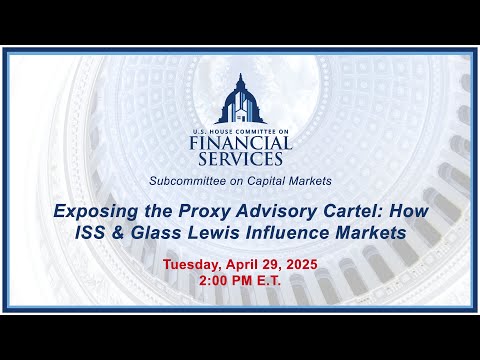
House Financial Services hearing examines influence and conflicts at proxy advisory firms
Summary
Witnesses at a House Financial Services Committee hearing sharply debated whether proxy advisory firms ISS and Glass Lewis exert excessive influence over shareholder votes and whether Congress or the SEC should impose new transparency and accountability rules.
WASHINGTON — The House Financial Services Committee on Tuesday heard competing views on the role and regulation of proxy advisory firms, with industry groups and academics saying the firms exert outsized influence over shareholder votes and critics warning that heavy-handed new rules could stifle competition.
Lawmakers heard five witnesses over several hours who described the market dominated by Institutional Shareholder Services (ISS) and Glass Lewis and discussed pending litigation over an SEC rule aimed at governing proxy advice. None of the witnesses defended the firms’ practices uncritically, but they diverged sharply on causes and remedies.
The dispute centers on whether proxy advisors operate with problematic conflicts of interest, routinely make errors that affect votes, and enable “robo-voting” by institutional investors, or whether regulating the firms more tightly would erect barriers to competition and punish useful market services.
Charles Crane, Managing Vice President of Policy at the National Association of Manufacturers, told the committee that "proxy advisory firms have had a significant and damaging impact on manufacturers, manufacturing workers, and Main Street investors" and called for statutory and SEC action to reduce conflicts and increase transparency. Crane and others cited the SEC’s 2020 proxy-advice rule and several pending bills that would require registration, greater disclosure of conflicts, and other guardrails.
Elizabeth Ising, partner at Gibson, Dunn & Crutcher LLP, said proxy advisors “play an important role and have considerable influence in the U.S. proxy system” but argued they lack fiduciary duties to investors and should face common-sense regulation, including advance sharing of draft reports so companies can correct factual errors.
Paul Rose, dean and professor of law at Case Western Reserve University, noted market concentration: "two firms, ISS and Glass Lewis, dominate over 90% of the proxy advisor market," and he said that regulatory incentives contributed to that outcome. Rose urged transparency, liability for misleading statements, and statute-level fixes if court rulings limit the SEC’s authority.
Paul Washington, president and CEO of the Society for Corporate Governance, advocated a “light touch” regulatory approach that would increase report review and conflict disclosures and address automated or “robo” voting. Washington described proxy advisors’ influence as twofold: they can determine vote outcomes and shape boardroom decisions even when votes are advisory.
Nell Minow, vice chair of ValueEdge Advisors and former president of ISS, pushed back on characterizations of the industry as a cartel, saying barriers to entry exist but arguing that clients voluntarily purchase advisory services and often vote with management; she noted ISS recommended in favor of management in roughly 96% of cases cited for 2024.
Committee members raised legal and practical points throughout the hearing: several witnesses described litigation over the SEC’s 2020 rule (which included requirements such as conflicts disclosure and issuer review of draft reports) and said portions of that rule have been stayed and litigated. Witnesses cited possible reforms in statute and agency rulemaking, including bills by Representatives Stiles, Fitzgerald, Nunn, Loudermilk and a study provision offered by Chair Wagner (as listed by Charles Crane).
Lawmakers also discussed concrete concerns offered by witnesses: that some advisory firms sell consulting services to companies they cover, that errors in reports can go uncorrected because companies cannot review draft recommendations under current practice, and that automated voting algorithms can result in large blocks of votes following a firm’s recommendation almost immediately after publication. Paul Rose and others said investors’ outsourcing of voting decisions—fueled in part by earlier SEC guidance to investment advisers—helped entrench the advisory firms’ position.
There were no committee votes at the hearing. Chair Wagner set a procedural expectation that witnesses would respond to follow-up questions and that members would pursue legislation; the record requires witness responses by 2025-06-04.
The hearing showcased a rare mix of bipartisan concern about transparency and market concentration, while revealing disagreement over whether tighter rules would correct problems or create new barriers to competition. Lawmakers signaled plans to consider bills that would require greater disclosure of conflicts, permit issuer review of draft recommendations, and clarify SEC authority over proxy solicitation.
Absent a court ruling or new statute clarifying SEC authority, witnesses and members agreed the issue will remain contested and likely return to the committee as drafts are refined and litigation proceeds.