Get Full Government Meeting Transcripts, Videos, & Alerts Forever!
Get email alerts on the Rezoning Hospital Nevada topic
No spam. Unsubscribe anytime.
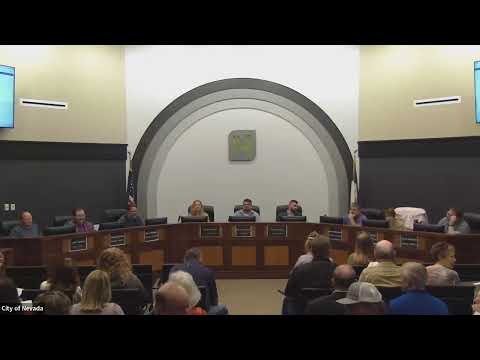
Nevada council approves second reading to rezone former hospital for proposed 60-unit apartments amid neighborhood opposition
Summary
The Nevada City Council voted to approve the second reading of Ordinance 10-64 to rezone the former hospital property at 630 Sixth Street from R-3 to R-4, advancing a proposal to convert the building into roughly 60 apartment units.
The Nevada City Council voted to approve the second reading of Ordinance 10-64 on April 20 to rezone the former hospital property at 630 Sixth Street from R-3 to R-4, advancing a proposal to convert the building into roughly 60 apartment units.
The rezoning drew a lengthy public hearing that featured residents who opposed the plan because of parking, density and neighborhood impacts and others who urged the city to allow adaptive reuse of the vacant property. After public comment, a council member moved and a second was made for the second reading; the motion passed.
Why it matters: The property has been vacant for years and residents said it poses a public-safety and blight risk if left unused; developers and some community members said the conversion would preserve the historic structure and add housing. The council’s action advances the project through the ordinance-reading process; several residents urged the council to slow down or require more conditions if the rezoning proceeds.
Council and staff said the city and project team have been pursuing state and federal funding to support the redevelopment. At the meeting a local financier and speakers described the total public awards for the project as $2,500,000 (with breakdowns included in materials to council), and noted the city contribution listed in the packet as $60,000.
During public comment, Sam Walter, 1023 Ninth Street, spoke in favor: "I believe this project would be an exciting positive for our community." He said the building’s adaptive reuse would be better than continued vacancy and cited other towns’ experience rehabbing similar properties.
Opponents said the project’s density and parking plan would harm neighbors. Doreen Meyer, 622 Fifth Street, said: "Please understand this is very personal and very emotional. I have been accused of being ill informed and emotional. I am emotional, but hardly ill informed." She urged the council to reduce unit count and explore alternative configurations.
Several speakers raised parking calculations and enforcement as central concerns. One resident said the site plan did not yet meet the city code’s parking ratio; speakers pointed to a 2.5-per-unit standard discussed in testimony and questioned whether the developer’s plan provided required off-street spaces.
Public-safety officials said abandoned buildings attract crime and fire risks. Ray Reynolds, Fire Chief, said the department has seen vandalism and trespass in vacant structures and warned that "we do have a substance abuse issue that takes place, but I I would not call it apocalyptic, but there are some public safety concerns that would be attracted for a building that large in the middle of town." The police and fire concerns were raised as reasons to avoid prolonged vacancy.
Developer allies and a financier said the building’s renovation is feasible and that adaptive reuse preserves valuable structure. In public remarks, a speaker who identified himself as a local financer said: "The developers are receiving $2,500,000 Not $3,500,000 2 point 5 million dollars." The same speaker provided a breakdown included in the packet showing a workforce housing award portion and a brownfield/environmental award portion; those figures were described at the meeting as roughly $784,000 (workforce housing credit), $216,000 (sales-tax reimbursement) and $1,500,000 (brownfields), totaling about $2,500,000; the city contribution shown was $60,000.
Council process notes: A member of the public asked about the ordinance process and whether a supermajority is required. A speaker asked, "to pass the ordinance, you need to have a super majority. Is that correct?" Council answered that a supermajority is required and that the ordinance must succeed on all three readings. At the meeting the council approved the ordinance’s second reading; the transcript records the motion, second and that the "motion passes." The record at this meeting does not include a roll-call tally for the ordinance vote.
What remains: Because the ordinance advanced on its second reading, the rezoning will require the remaining readings and any required supermajority votes in subsequent meetings. Multiple residents asked the council to require additional conditions, site plans, or reductions in unit count before final approval. The council did not adopt additional conditions during the vote recorded at this meeting.
Community context: Speakers on both sides described competing priorities — preventing blight and preserving public safety, versus creating housing supply and reusing an existing structure. Several commenters urged stronger enforcement of parking and nuisance ordinances if the project moves forward. The project and the council’s decision will continue to draw attention from neighborhood residents and downtown interests as future readings and approvals proceed.