Get Full Government Meeting Transcripts, Videos, & Alerts Forever!
Get email alerts on the Developmental Disabilities Budget topic
No spam. Unsubscribe anytime.
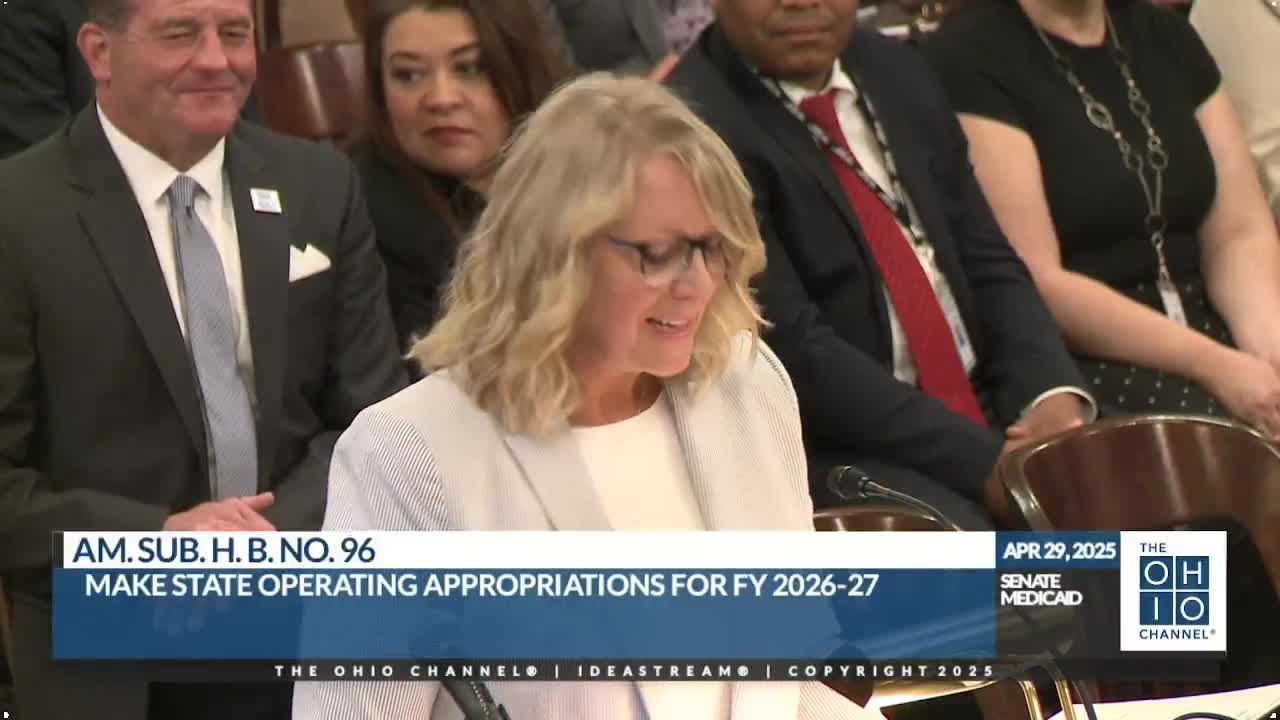
Developmental Disabilities director pitches budget to sustain direct‑support wages, expand technology and crisis supports
Summary
Kimberly Houck, director of the Ohio Department of Developmental Disabilities, outlined a biennial budget request to maintain rate increases for direct support professionals, expand technology supports and sustain services for youth with complex needs.
Kimberly Houck, director of the Ohio Department of Developmental Disabilities (DODD), told the Senate Medicaid Committee that the department’s 2026–27 request would preserve recent rate increases for direct support professionals (DSPs), continue investments in assistive technology, and fund supports for youth with complex needs.
Houck said more than 40,000 Ohioans currently receive waiver services through Ohio’s home‑and‑community‑based (HCBS) DD waivers and another portion of the system is served via intermediate care facilities (ICFs). She described the system’s funding mix — local, state and federal dollars — and credited recent legislative and executive action, including House Bill 94, with enabling local dollar use to leverage federal match and expand waiver capacity.
On workforce, Houck said Governor DeWine’s prior budget and recent actions substantially raised starting wages for DSPs. She said early estimates for July 2024 put average starting wages at $16.04 per hour and an overall average of $17.04 per hour; the department expects a statewide average DSP wage “of at least $18 per hour” once full data are available. Houck told senators DODD is requesting a GRF increase in FY26 to sustain those rates because some prior increases relied on one‑time federal and other funds.
Houck described technology investments — a dedicated line item for innovative technology and regional technology support teams that help people test assistive devices — and cited individual examples where GPS devices enabled safer community access. She also requested continued funding for the multi‑disciplinary comprehensive assessment team (MCAT) and supports for youth in crisis, including short‑term stabilization and long‑term residential capacity.
Fiscal figures Houck cited: DODD requested about $5.51 billion in all funds and $1.18 billion in GRF for FY26, and about $5.75 billion in all funds and $1.19 billion in GRF for FY27. Houck said the FY26 GRF increase is driven primarily by rate sustainment and timing differences caused by the use of one‑time funds in the prior biennium.
Houck closed by asking the committee to support investments to maintain provider rates, strengthen workforce recruitment and retention, and expand community and crisis supports for people with developmental disabilities and their families.