Get Full Government Meeting Transcripts, Videos, & Alerts Forever!
Get email alerts on the Education Student Discipline topic
No spam. Unsubscribe anytime.
Fairbanks North Star Borough School District reviews draft student personal electronic devices policy; first reading set for May 6
Summary
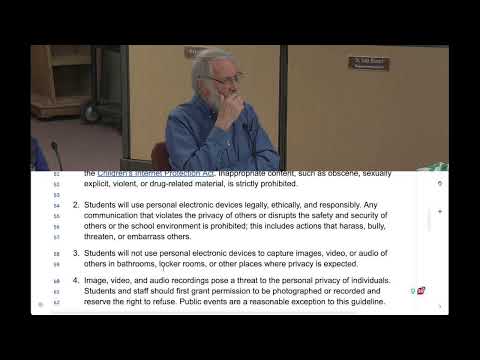
At a school board work session, Fairbanks North Star Borough School District staff presented a draft policy and accompanying administrative regulation intended to regulate student access to personal electronic devices during the school day and said they plan to bring the policy for a first reading on May 6.
At a school board work session, Fairbanks North Star Borough School District staff presented a draft policy and accompanying administrative regulation intended to regulate student access to personal electronic devices during the school day and said they plan to bring the policy for a first reading on May 6.
District staff described the proposal as an effort to create a single, consistent approach across elementary, middle and high schools to reduce classroom distraction, support student engagement and limit harms such as cyberbullying and disruptions during emergencies. "The goal is to have consistent and clear limitation on access to and use of personal electronic devices during the school day," a presenter said.
The presentation summarized national research and local district data. Staff cited John Hattie’s meta-analysis (Visible Learning) as finding a negative effect of mobile phones on learning (effect size reported in the packet as –0.24 across studies covering roughly 350,000 students). The presentation also referenced national surveys (including NEA membership survey results supplied in board materials) showing high educator support for broad restrictions and material from the Phone Free Schools movement describing usage and notification statistics. Locally, staff reported that 205 employees responded to a district staff survey (74 elementary, 96 middle, 54 high); the packet also listed 209 district-level bullying or harassment violations last year and about 121 school-level incidents since 2023.
Staff described current practices: elementary students are commonly required to keep phones off and stored (backpacks, lockers or cubbies) for the day; middle schools generally require phones out of sight or in lockers; high schools vary widely — from teacher discretion to no schoolwide rules. Staff said enforcement is inconsistent at the high school level and that a district policy would help standardize expectations and reduce classroom enforcement burdens on teachers.
Several practical issues dominated board discussion. Staff and board members raised emergency-response concerns: that active phone use during an unfolding emergency can distract students from staff instructions, accelerate parental arrival and spread misinformation. Staff noted the district’s search-and-seizure administrative regulation covers procedures for searching devices and that district-issued devices remain subject to different rules.
Board members debated exceptions and enforcement mechanics. The draft administrative regulation in the packet would allow documented medical or translation needs and preapproved instructional uses; staff said building administrators would preapprove instructional uses and maintain custody procedures for confiscated devices (phones would be stored securely in the office).
Opinion among board members diverged over lunchtime phone access at high schools. Several board members urged a stricter approach that would restrict phones bell-to-bell, including lunch, citing research and student mental-health concerns. Others said a high-school lunch ban risks pushing students off campus (the district has open campus at some high schools), could be difficult to police and would be a large cultural shift; those board members favored allowing phones before and after school and at lunch during an initial rollout. "I'd prefer to read high school students 9 through 12 may use their device before and after school," one board member said, proposing to remove lunch from the allowable times in the AR.
Staff outlined next steps for implementation if the board moves forward: a planned May 6 first reading of the policy; proactive communication to families and staff over the summer; principal and teacher guidance materials; training from student support services for counselors; and school-level planning for enforcement and documentation systems. Staff said principals and assistant principals have been consulted and that many school leaders support a consistent district policy.
No formal vote or board adoption occurred at the work session. The board requested more discussion and edits to policy language (definitions, wording about confiscation and whether to phrase device limits as applying to "student devices" or "non‑district issued devices"). Staff asked the board to raise any specific recommended edits before the May 6 first reading so the administrative regulation can be aligned with the board’s policy direction.
The board meeting record shows ongoing public and board concern about enforcement logistics, equity (students without devices), instructional exceptions and assistive devices. Staff and board members suggested outreach to parent groups and student councils and proposed pilot approaches and education efforts (Common Sense Media and student-facing sessions) to build student buy-in. The administration said they will incorporate board feedback and return the policy for first reading on May 6; the board encouraged public testimony at that meeting.