Get Full Government Meeting Transcripts, Videos, & Alerts Forever!
Get email alerts on the Human Resources Budget topic
No spam. Unsubscribe anytime.
Cochise County HR director outlines budget priorities for background checks, NEOGOV and counseling
Summary
Human resources staff detailed the county's proposed spending on background screenings, the NEOGOV applicant system, trauma counseling for public-safety staff and unemployment administration during a Cochise County budget discussion. No formal votes were recorded.
Jennifer, Cochise County human resources director, reviewed major human-resources budget line items and described how the county screens candidates, supports employees after critical incidents and pays for hiring and unemployment services.
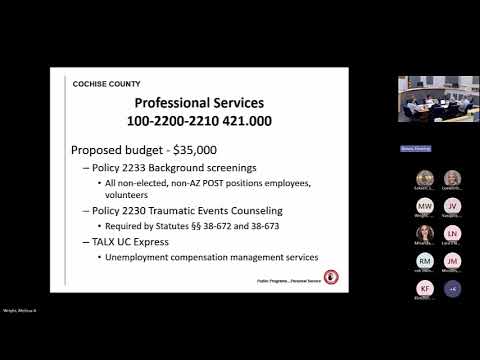
She said the county proposes keeping a professional-services line roughly the same at $35,000, which covers background-screening contracts, trauma counseling for law-enforcement and detention staff, and related services. "Our motto is making the county better," Jennifer said as she opened the presentation.
The presentation distinguished background checks handled by county HR from those conducted by the sheriff’s office. Jennifer said county HR performs criminal background screens, Social Security verifications and I-9 checks for non–POST-certified positions and for volunteers; POST-certified law-enforcement checks are done by the Cochise County Sheriff’s Office. She described an individualized assessment process for screenings that return caution flags, noting factors considered include how long ago an event occurred and the specifics of the allegation.
On credit checks, Jennifer said the county limits them to certain finance-related jobs, such as treasury and other ‘‘sensitive’’ fiscal positions, because a credit record alone does not necessarily indicate future misconduct. She also said the HR policy calls for a new background check when an employee is promoted or moves into another position if it has been more than a year since the last screening.
Jennifer said trauma counseling for law enforcement and dispatchers is required by Arizona statute and that the county contracts with a provider who specializes in that population. She said the provider bills by the hour and reported the county used four counseling sessions last fiscal year and nine so far in the current fiscal year. Jennifer described the service as billing by the hour but the precise hourly rate and the fiscal-year billing figures were presented in the meeting with numeric language that was unclear in the transcript.
The county’s applicant tracking system, NEOGOV, was listed as another major budget item. Jennifer said the March-to-March cost for the NEOGOV Insight product is $21,853; a separate national posting service (governmentjobs.com) costs $3,272 annually for national exposure. A background-screening integration that connects NEOGOV to the screening vendor was listed at $2,525 per year; Jennifer said the integration prevents HR staff from handling candidates’ most sensitive personal data directly.
On unemployment administration, Pete, an HR team member who handles unemployment claims, described a quarterly contract billed at $2,250 per quarter for an unemployment-administration service that assists the county with hearings and with combating fraudulent claims. Jennifer said the proposed budget includes $60,000 for countywide unemployment insurance (including the courts); year-to-date unemployment payments were stated as $10,600.
Board members asked about overlaps with court personnel, intergovernmental agreements and how the county allocates HR costs when services are shared across departments. Jennifer said courts’ personnel data represent about 22% of the county’s employee population and noted discussions about whether HR would assume more court HR functions and, if so, how to account for costs. No formal action or vote was taken on those items during the discussion.
The presentation also summarized a small, seldom-used line for Merit Commission hearings and ancillary costs (mailings, hearings) and a request to increase the department’s cellphone line by $500 to avoid repeatedly moving funds between lines. Board members and staff agreed to continue follow-up conversations about IGAs, cost allocations and the courts’ use of HR services.