Get Full Government Meeting Transcripts, Videos, & Alerts Forever!
Get email alerts on the Public Transit Fare Policy topic
No spam. Unsubscribe anytime.
Officials review plan to make Ride On buses fare-free; county staff say net fiscal savings possible over six years
Summary
Montgomery County staff outlined fiscal impacts of a proposal in the executive's FY26 budget to eliminate Ride On fares, projecting a $4.4 million net positive for the mass transit fund over fiscal years 2026'30 while noting lost fare revenue and other trade-offs.
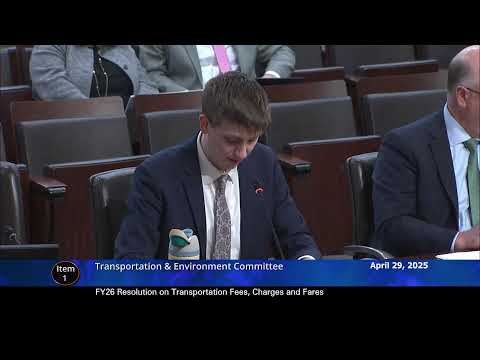
Montgomery County officials discussed the executive's proposal to make Ride On bus service fare-free and the budgetary consequences during a briefing on the Mass Transit Fund.
MCDOT staff told the County Council the proposal would eliminate Ride On fare revenue (estimated at $1.5 million in FY25) and some related fare programs while cutting fare-collection costs and creating capital savings that could reduce the county's mass transit property tax rate.
The issue matters because the fiscal trade-offs affect the Mass Transit Fund and the county's ability to fund capital projects. "Which is, eliminating ride on fares, so making ride on fare free for riders," a Montgomery County Department of Transportation staff member said, describing the proposal and why several fare-related line items in the staff report would be removed. The staff report examines only fiscal impacts; other policy issues such as equity and climate were described as outside the scope of that analysis.
Staff outlined the main budget figures: projected fare revenue loss of about $1.5 million in FY25; annual fare-collection costs of roughly $600,000 that would be eliminated; a $250,000 allocation proposed in the executive's FY26 budget for a "Fare Transit Ambassadors" program; and capital savings the staff said total $11,030,000 in FY26 and just over $21,000,000 over FY25'30. The staff also said those capital savings would allow the mass transit property tax rate to drop from $0.0892 to $0.0834.
MCDOT presented four fiscal scenarios in the staff report: (1) the baseline of continuing $1 fares; (2) the executive's recommendation of $0 fares; (3) $1 fares with active enforcement; and (4) raising fares to $2.25 with active enforcement, the latter matching Metrobus fares. Staff said the baseline scenario, because it retains capital investments required by WMATA while collecting low post-pandemic fare revenue, carries the greatest net cost to the Mass Transit Fund over the six-year window.
Staff also noted pre-pandemic annual fare revenue for Ride On exceeded $21 million. "This is due to sluggish farebox recovery rates after the pandemic," the presenter said, and added that a prior year appropriation of roughly $1 million remains unspent because of procurement delays; combined with the other capital items staff estimated a total of about $22.5 million when that prior-year amount is included.
Councilmembers pressed staff for clarity on the tables and signs. "I just wanna drill down on this," said Councilmember Kenny, noting what the table labeled Scenario 1 showed for returns; staff clarified that negative numbers in the report represent a negative cost to the Mass Transit Fund (i.e., a positive contribution) and that the tables show total cost to the fund.
Gary Nellen of the Office of Management and Budget responded to a technical question about the inclusion of the prior-year appropriation: "I believe the '21 and a half does include the prior year appropriation. We can get back to you and confirm that, though," he said.
The staff presentation also referenced a letter from Maryland Department of Transportation Secretary Paul Wietefeld transmitted to the council urging against making Ride On fare-free. According to staff, the MDOT letter stressed the importance of fare revenue for operating costs, argued that consistent regional messaging that riders pay fares is needed to boost revenue, and highlighted potential impacts to the Purple Line project.
No formal vote or final action on the fare recommendation was recorded in the briefing. Staff framed the report as fiscal analysis tied to the executive's FY26 proposed budget; the Council's next procedural steps were not specified in the presented transcript excerpts.
The conversation combined budget figures, references to WMATA requirements for fare-collection equipment, and the county's internal capital planning. Council members asked follow-up questions during the presentation, and OMB staff offered to confirm the inclusion of the prior-year appropriation in the six-year totals.
The discussion remains at the analysis and Q&A stage in the County's FY26 budget process; a final decision would require formal council action in subsequent budget proceedings.