Get Full Government Meeting Transcripts, Videos, & Alerts Forever!
Get email alerts on the Public Transit topic
No spam. Unsubscribe anytime.
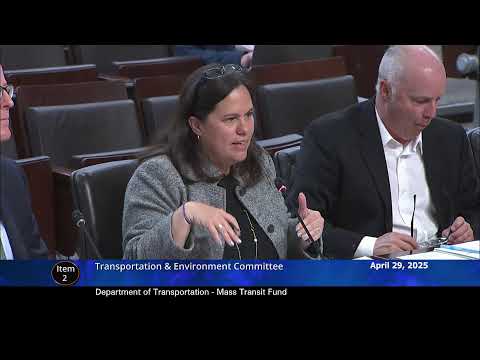
Committee backs fare-free Ride On, funds ambassadors and several transit pilots and CIP changes
Summary
A Montgomery County Council committee endorsed the County Executive’s FY26 recommendation to make Ride On fares free, approved related operating and capital adjustments including $250,000 for transit ambassadors, and cleared multiple pilot and CIP amendments pending final council action.
The Montgomery County Council Transportation and Environment Committee on an apparently unanimous voice agreement endorsed the County Executive’s recommendation to make Ride On fares free in FY26 and approved several related operating and capital budget changes, including a $250,000 line item for transit ambassadors and a pilot for automated bus-lane enforcement.
The endorsement comes amid staff and council discussion about sharply falling fare recovery — “fare recovery in 2015 was 20 percent … in 2019 that dropped to 16 percent, and we’re now at 2 percent,” a committee speaker summarized — and concerns about preserving service levels and safety if Ride On goes fare-free.
Committee members and agency staff framed the proposal as both a social-service measure and a budget decision. One committee speaker said they had advocated previously for free fares for youth and noted that earlier free-fare pilots produced a rapid increase in youth ridership. Department staff said the executive’s package would add approximately $17.5 million in net expenditures across the Mass Transit and Grant funds, driven largely by personnel and nondiscretionary adjustments in the countywide budget.
Staff described a modest set of operating additions tied specifically to the fare-free rollout: $250,000 for a “Fare Free Ambassador” program intended primarily for outreach, messaging and some contracted staff presence at stops and onboard (not to hire new full-time employees), and a $160,000 operating addition for a WMATA-run automated bus-lane enforcement pilot (WMATA would provide the capital costs for bus cameras). Agency staff said the ambassador funding would be used largely for contracted outreach and some overtime for existing road coordinators and supervisors; they said they would provide more detail to the full council before final adoption.
Committee members pressed staff on enforcement, nuisance behavior and safety. Staff said past enforcement shifts had moved to an “inform, don’t enforce” posture after altercations years ago and that the ambassador program is intended to add eyes on the system and to communicate expected behavior. ‘‘It was a best practice to have additional eyes on the service…to make sure that we aren’t creating an unsafe or unproductive environment,” a department representative said.
Members also sought assurances that routes and hours would not be reduced as part of the change. Staff repeatedly said the decision to make Ride On fare-free should not by itself reduce service quality in the short term; in the longer term, if fiscal pressures force reductions, fares would be one tool the county could reconsider.
The committee also discussed related technical amendments in the fees, charges and fares resolution that implement several parking-district changes: a monthly $10 specialized-service-provider and childcare-center permit in the Bethesda, Silver Spring and Wheaton parking lot districts (implementing Bill 29-24E, enacted by the Council on March 4 and signed March 17), elimination of daily-maximum and lost-ticket fees for Silver Spring (because the last gated garages converted to app-based systems), and consolidation of garage-specific monthly permit rates into a single $195 cap for the Silver Spring Parking Lot District (staff said this is a technical change to give DOT flexibility and would not immediately change current monthly rates).
On capital planning, committee members reviewed six Mass Transit CIP amendments transmitted since the operating budget: (1) an operating-component appropriation for the Howard County Flash extension (roughly $1.1 million assumed as reimbursement from Howard County) that staff recommended keeping in the FY26 budget despite Howard County’s transmission/timing uncertainty; (2) savings on Ride On bus fleet and fare-equipment replacement projects because fare equipment will not be procured for new buses under a fare-free decision; (3) a funding swap and schedule changes for the Maryland 355 Bus Rapid Transit projects driven by state-level changes and Opportunity Lanes funding reallocation; (4) a $10.2 million increase and one-year schedule delay for the Veirs Mill Road BRT; and (5) a small federal-aid vs. current revenue swap for hydrogen fuel-cell buses and fueling site to match FTA grant agreements. Staff said none of the federal grant relationships appeared in jeopardy but that several items depend on external partners and federal or state timing.
Votes at a glance — actions the committee recorded for the record included the committee’s approval of the fees, charges and fares resolution implementing the parking changes (approved without objection) and unanimous committee support for adopting the executive’s transit recommendations, including the fare-free policy and the Mass Transit Fund operating changes. Committee members indicated they would place the $250,000 ambassador line on the reconciliation list so staff could provide more detailed program design and metrics to the full council before final adoption.
Committee discussion included repeated requests that staff provide clearer metrics and evaluation plans for the ambassador program and that the administration spell out how much of the $250,000 would be contractual outreach versus overtime for existing staff. Staff said they have examples from peer agencies and would provide additional details for the full council. On the Howard County extension, staff said the $1.1 million in the FY26 budget represents roughly a quarter-year of operating cost assuming service would begin late in the fiscal year; they recommended keeping the line in the budget so a supplemental appropriation would not be necessary if Howard County completes its funding midyear.
The committee also recommended moving forward with a WMATA-coordinated automated bus-lane enforcement pilot on Georgia Avenue (with University Avenue to follow once lanes are permanent). Staff said business rules, including an initial warning period (they discussed about 30–45 days), would be developed with WMATA and the county police automated enforcement team.
The committee closed by recording unanimous support for the executive’s transit changes and the CIP amendments presented at the session, and it sent the ambassador line-item to the reconciliation list for further detail before full council consideration.