Get email alerts on the Transit Fares topic
No spam. Unsubscribe anytime.
Committee backs making Ride On fare-free and approves technical fee changes
Summary
The Transportation and Environment Committee on April 29 unanimously approved the County Executive’s FY26 resolution making Ride On bus service fare-free and removing related fare equipment projects while adopting technical updates to parking and garage fees.
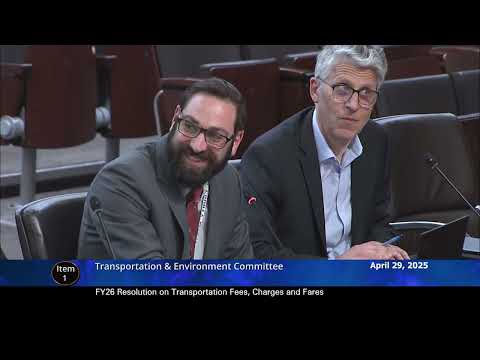
The Transportation and Environment Committee on April 29 unanimously approved the County Executive’s FY26 resolution on transportation fees, charges and fares that would make Ride On bus service fare-free beginning in FY26 and remove several related fare line items and capital expenditures from the Mass Transit Fund.
Committee leadership said the action responds to a sharp decline in farebox recovery and aims to lower barriers to transit. The committee vote followed staff presentations and public-data scenarios that compared four fiscal approaches: maintaining the $1 fare baseline, a zero-fare option (the executive recommendation), $1 fares with active enforcement, and a $2.25 fare with enforcement.
Why it matters: The staff fiscal analysis showed lower fare revenue today than before the pandemic and projected that eliminating fares would remove annual fare-processing costs while generating upfront capital savings tied to not installing or replacing fare-collection equipment. Committee members and department staff framed the change as a mix of fiscal and policy choices involving equity, access and operational considerations.
What staff said: Council staff said fare revenue is now a small share of Ride On’s budget compared with pre-pandemic levels; staff estimated fare revenue of about $1.5 million in FY25 and cited roughly $600,000 in annual fare collection costs that would be eliminated under a zero-fare approach. The executive’s proposal also identifies $11,030,000 in FY26 capital savings (about $21 million across FY25–30) that result from not buying or installing fare equipment.
Department officials described trade-offs. Joanna Conklin of DGS and transit staff said the capital cost to modernize fare equipment produced a multi-year payback under scenarios that keep fares, but that technological change and low current fare recovery made the capital investment harder to justify now. Phil McLaughlin, general manager, Division of Transit Services, cautioned that enforcement programs cover a small share of service (he said enforcement staff would be present on roughly 1 to 1.5 percent of service) and that enforcement is unlikely to be transformational.
Concerns and mitigations: Maryland Department of Transportation Secretary Paul Wietefeld sent a letter urging caution, arguing that fare revenue helps support operations and that a consistent regional message matters. Committee members pressed staff on potential safety and nuisance issues raised by other agencies that have adopted fare-free service, and staff said the budget includes $250,000 for a Transit Ambassadors program intended to provide on-the-ground presence, communications and behavior-management activities during rollout.
Other items in the resolution: The same fees resolution made several technical adjustments: it implements a $10 monthly parking permit for specialized service providers and qualified childcare centers in the Bethesda, Silver Spring and Wheaton parking lot districts (per Bill 29-24E); it removes daily-maximum and lost-ticket fees in the Silver Spring Parking Lot District because the final gated garages converted to app-based electronic payment; and it standardizes monthly garage permit pricing across Silver Spring garages (removing garage-specific listings in the resolution while retaining current rates through the parking district budget).
Vote and next steps: The committee approved the fees, charges and fares resolution unanimously. Committee staff will forward the approved recommendations to the full council. The executive also included a $250,000 recurring line in the Mass Transit Fund budget for Transit Ambassadors; committee members asked staff to return to the full council with a clearer plan and performance metrics for that line item.
Budget context and limits: Staff repeatedly noted that some policy issues—regional coordination, Purple Line impacts, and longer-term fare-collection technology changes—remain unresolved and could prompt future reconsideration. Staff also emphasized that the fiscal analysis presented focused on budgetary impacts and did not substitute for broader policy deliberations the council or the county may undertake.
Ending note: Committee members said they supported the move as a short- to medium-term policy that expands access, while instructing staff to monitor effects on safety, reliability and budget pressures and to report back with performance data.
AI generated
The text on this page is AI generated. Summaries, highlights, analysis, and video transcripts are all produced from the original source material.
AI can make mistakes, so if you spot one, and we will fix it for everyone.
Note: the source content is unaltered by us. Any content source we link to, be it a video, an audio recording, or a document, is presented exactly as its publisher released it. That publisher is usually a government body, sometimes an individual official or another organisation.