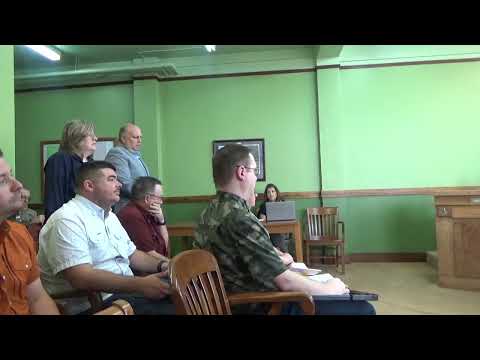
Freestone County discusses Texas Historical Commission funding agreement, questions on easement, costs and timeline
Loading...
Summary
Freestone County officials, architects and consultants discussed a proposed Round 13 Texas Historical Commission funding agreement and a perpetual grant easement for restoring the county courthouse, raising questions about which costs are the county’s responsibility, insurance implications and next steps for bidding and testing.
Freestone County officials, architects and consultants spent an extended portion of a public meeting discussing a proposed funding agreement with the Texas Historical Commission (THC) for Round 13 of the Historic Courthouse Preservation Program and the companion grant easement required by the THC.
The discussion centered on documents that must accompany the county’s application and, if approved, the grant: the funding agreement and the grant easement with attachments. Architects said they are preparing required attachments — a project cost statement, scope of work and project schedule — while the easement package requires a survey and other exhibits the county must provide.
The exchange mattered because the funding agreement limits the THC’s funding term to 20 years after final funding, while the easement would be recorded in perpetuity. County officials repeatedly pressed the design team and THC representatives for clarity about what costs the county must cover should work exceed program‑eligible items.
Architects and county staff described which items THC considers program‑eligible (core restoration activities) and which are typically “non‑program eligible” (examples discussed included additional acoustic panels, certain security upgrades and some site or utility work). An architect explained that some items often treated as non‑program eligible can nevertheless be allowed if justified — for example, certain security work tied to life‑safety needs — but those costs would fall to the county unless otherwise approved by THC.
County staff noted the funding agreement language requires the county to fund any “non program eligible cost associated with the project.” One county official raised a practical question about how broad that category could be: “I’m just curious if there’s historic what could that be?” Staff and the architect responded with examples and said the THC offers a consultant to advise on security recommendations.
On cost and insurance, staff relayed current insurance numbers used for budgeting: an insured replacement value cited in discussion was roughly $6.6 million for the building and about $2.2 million for contents; staff also said a historical replacement valuation had been quoted around $31 million. County staff said the county’s annual courthouse insurance premium is roughly $18,000 under the current policy; staff were seeking updated quotes that would reflect historic‑replacement coverage. A county speaker warned the easement’s perpetual nature could affect future insurance and long‑term costs and asked THC staff to clarify how perpetual easements are treated for replacement valuations.
Architects reported structural issues that will require further investigation during construction. They said limited exploratory demolition and excavation will be needed to confirm hidden conditions, including potential missing columns in one area and localized masonry or lintel deterioration. On hazardous materials, the design team said partial asbestos testing has been done previously in some spaces; they advised full testing and appropriate abatement planning where indicated. The team cautioned that prior courtroom work required long, phased gutting without closing the courthouse and that asbestos issues historically have been isolated to certain materials from mid‑20th century repairs.
Mechanical/electrical/plumbing planning raised operational questions. An MEP engineer said replacing the courthouse electrical service will require at least a short full shutdown of building power to transfer to new gear and estimated a period of about three to four weeks to complete that switch. The group also discussed the county’s overhead service and longer‑lead equipment: representatives from the county’s electric provider said ordering and installing a new transformer can take months (commentators cited nine months to about a year for delivery) and that trenching or an easement would be required to move from overhead to an underground service.
On procurement and schedule, the architect said the project will use traditional bidding: the architect prepares bid documents, solicits contractors and the county will evaluate bids on price and qualifications rather than automatically choosing the lowest cost. County staff and the architect recommended a pre‑bid contractor walkthrough and allowing bidders sufficient time on site to prepare full proposals. Several speakers said tariffs and market volatility have been affecting prices for HVAC and electrical equipment.
Toward the end of the discussion the meeting chair moved to proceed with the funding agreement and to go out to bid, but the transcript does not record a formal vote or final approval. County staff said next steps include getting updated insurance quotes, completing the survey and easement attachments, finishing the project schedule, conducting additional testing (structural and asbestos) as needed, and preparing bid documents.
If the county accepts a THC award, staff cautioned the county will still have to secure contractor bids and decide how to handle any non‑program costs or unexpected cost escalation before committing to construction. The design team offered continued technical support, including THC security consultant recommendations and coordination on phasing to limit disruption to courthouse operations.
Meeting participants who spoke on the record included county staff, the project architect, an MEP engineer and representatives from the county’s electric provider; multiple county officials and local contractors also asked questions and sought clarifications. The county recorded concerns about long‑term implications of a perpetual easement, potential county liability for non‑program costs, the timeline for electrical transformer replacement and the need for more precise bid estimates before authorizing work.
Next steps listed in the meeting record are: finalize attachments for the THC funding agreement and grant easement (including survey), obtain updated insurance pricing and clarifications about historic‑replacement valuation, complete additional structural and asbestos investigations as part of bid documents, and issue a public bid solicitation with an on‑site contractor walkthrough. A motion to move forward with approval and go out to bid was made; the transcript does not show a recorded vote or final outcome.