Get Full Government Meeting Transcripts, Videos, & Alerts Forever!
Get email alerts on the It Budget topic
No spam. Unsubscribe anytime.
Cochise County IT presents FY25-26 budget to sustain cybersecurity, replace aging equipment
Summary
Cochise County IT told the Board of Supervisors it needs continued funding to cover rising software and hardware costs, maintain cybersecurity monitoring and to replace aging devices; supervisors pressed for clearer cost allocation and proposed periodic reviews to detect overlaps or weaknesses.
Cochise County's information-technology team presented its fiscal year 2025–26 budget request to the Board of Supervisors at a work session in the Supervisor's Hearing Room on Melody Lane, saying continued investment is needed to maintain public-safety communications, cybersecurity monitoring and aging equipment.
"We wanna present our, financial year 25, 26 budget request," said Alan Gordon, interim IT director and chief technology officer. Gordon told supervisors the IT operation "supports more than 25 departments and elected offices, managing over 2,000 computers, mobile devices, radios, and the key network systems that keep operations connected across Cochise County. We also maintain 30 communication tower sites to ensure continuous service for public safety, dispatch, and emergency response."
The department emphasized rising costs for hardware, software licensing, cybersecurity tools and vendor services driven by inflation and global supply-chain pressures. Gordon said vendors from "Dell and Panasonic" have warned of upcoming price increases and that the county has pursued multiyear contracts and bulk purchases to reduce exposure.
On cybersecurity spending, Gordon described a multiyear Darktrace purchase that the county uses to monitor network traffic: "It actually monitors all the traffic that's going in our network, and it looks for something that's changed... they'll give us an alarm saying, hey. Look what this person's doing, or they download a bunch of data." The department said it has also made multiyear purchases of other enterprise tools to lock in pricing.
Supervisors questioned several line items and asked for clearer accounting of where IT costs are borne. The IT team said it is centralizing purchases so departments do not buy duplicative software and noted that most licensing (including Office 365 and cloud services) is a recurring county expense.
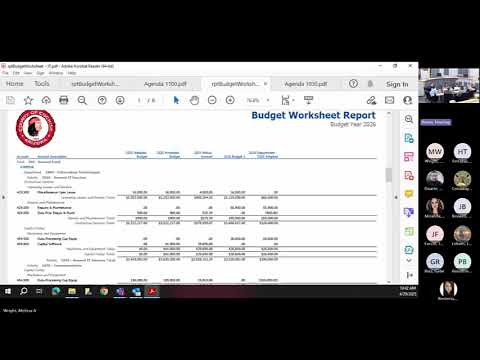
The department outlined specific contract figures and recurring costs in discussion: a three-year Freshworks ticketing purchase listed in the budget, Azure cloud hosting expenses for virtual servers, and a multiyear cybersecurity agreement; the IT team said multi-year contracts have reduced the department's near-term budget pressure. The IT presentation also covered fleet charges for vehicle gas and maintenance and described a small vehicle fleet used for tower and field work.
Supervisors pressed the IT team on internal chargebacks, grant-funded positions, and overlap between IT-provided services and departmental budgets. One supervisor asked for the ability to trace total technical costs for individual departments (for example, flood control or the sheriff's office) including direct purchases, shared services and chargebacks; IT said such an analysis is possible but would take time. Several supervisors suggested pursuing periodic reviews—short of a full forensic audit—to identify inefficiencies or potential misuse. The county had a prior fraud-risk review, a staff member said, and supervisors mentioned the possibility of bringing in outside reviewers who specialize in detecting anomalous billing patterns.
Gordon said the IT staff is testing artificial-intelligence tools, including Microsoft Copilot and other AI pilots, but that the department plans training and controls before broad rollout to prevent inappropriate uploading of county documents. The team also described current tools to manage licensing and usage reports for products such as Office 365 and Adobe, and said some tracking remains manual.
The meeting closed with supervisors asking staff to follow up with more detailed breakdowns: a clearer list of licenses and seats for major contracts, an analysis of how shared sales-tax capital funds are allocated to IT items, and an initial plan for periodic reviews to look for overlapping charges or process weaknesses. No formal vote was taken on the budget during the work session; the item was presented for discussion and clarification.
The board adjourned and noted the next meeting would immediately follow with risk managers.