Get Full Government Meeting Transcripts, Videos, & Alerts Forever!
Get email alerts on the Roads And Engineering Budget topic
No spam. Unsubscribe anytime.
Cochise County details engineering budget, major road projects including Douglas Port of Entry and Kansas Settlement Road
Summary
At a county work session April 29, Cochise County engineering staff reviewed planned road projects, grant funding and right‑of‑way costs for the Douglas Port of Entry and several county roads, and answered supervisors' questions about scope, bidding and construction timing.
Cochise County engineering staff on April 29 reviewed the division’s fiscal highlights and planned road projects, including right‑of‑way work for the Douglas Port of Entry and construction plans for Motion Road, Davis Road and Kansas Settlement Road.
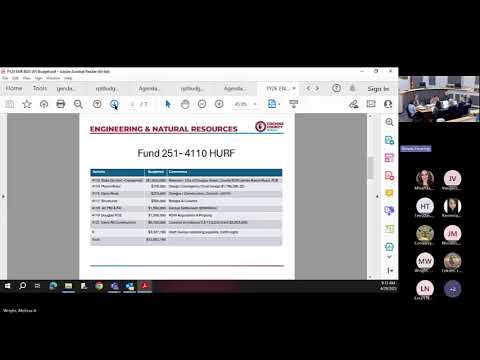
The county’s engineering director, Jackie Watkins, told supervisors the county has “a million dollar grant funding for the Douglas Port of Entry” provided by the City of Douglas as part of an $8,000,000 city grant. Watkins said the county has a contract with a title/real‑estate firm to handle title, escrow, appraisals and a Phase I environmental review; that contract’s fee is listed in the presentation as $576,408, and the county will pay property costs in addition to that amount.
Watkins summarized several large roadway projects. Motion Road (7.8 miles) is under design and the presentation lists a construction estimate of about $50,000,000; the county has a $6,000,000 grant applied to that project and about $3,000,000 remaining after scheduled right‑of‑way purchases. Davis Road is shown as multiple projects; the segment labeled Activity 4115 (Central to 191) has an estimated construction cost of about $9,000,000 and a grant application pending. For Kansas Settlement Road the slides show a total reconstruction estimate of about $30,000,000; Cochise County currently has roughly $1.5 million available and staff described that amount as sufficient to repave or reconstruct roughly one mile, not the full corridor.
Supervisors pressed staff to clarify what the county budgeted amounts cover. Watkins said design work is done in‑house and the county’s budgeted sums for these projects generally pay contractors to perform construction work after plans are completed and the county goes to bid. On the Kansas Settlement example, Watkins explained that mobilization costs for paving contractors can be $200,000–$400,000 per mobilization and that larger projects (several contiguous miles) are generally more cost‑efficient than repeated, single‑mile mobilizations.
Right‑of‑way acquisition was discussed at length. Watkins described typical right‑of‑way expenses—title work, appraisals, negotiations and Phase I environmental reports—and said federal grant rules apply when federal dollars are used: if a project contains any federal funding, federal acquisition requirements must be followed. Watkins said the county has closed on 12 properties for Davis Road and is negotiating on several others.
Staff and supervisors also discussed funding sources and departmental budgets. Watkins said engineering and flood‑control work are tracked in separate fund accounts; some staff and activities are paid from HEERF and flood‑control district funds. A supervisor noted the county’s limited local tax revenue for flood projects and questioned whether the county should hold funds until a larger contiguous project can be executed to obtain better unit pricing.
The session was informational; no votes or formal decisions were taken during the work session.
Ending: Supervisors did not take action at the work session. Staff indicated more detailed budget and project items will be brought to upcoming public budget hearings and specific project meetings for further direction and possible formal action.