Get Full Government Meeting Transcripts, Videos, & Alerts Forever!
Get email alerts on the Zero Waste topic
No spam. Unsubscribe anytime.
Missoula reviews progress on '0 by 50' zero‑waste plan; task force to set near‑term priorities
Summary
Home Resource and City of Missoula staff briefed an April audience on the city’s 0 by 50 plan, highlighting reuse, event diversion wins and infrastructure such as a municipally owned compost facility while flagging data gaps, legal limits and funding constraints. A task force will produce 3–5 year recommendations.
At an April Home Resource lunch‑and‑learn in Missoula, Kelly Hess, executive director of Home Resource, and Leigh Raderman, climate and sustainability specialist for the City of Missoula, presented a status update on the city’s 0 by 50 plan — the city’s roadmap to 90% waste diversion by 2050 — and described a new task force that will recommend near‑term priorities.
The plan, formally adopted by the City of Missoula in 2018, sets a community goal of reaching what the presenters described as “0 waste” (defined in the plan as roughly 90% diversion). “0 by 50 is Missoula’s pathway to 0 waste, and we're gonna talk about it together,” Hess said during the presentation.
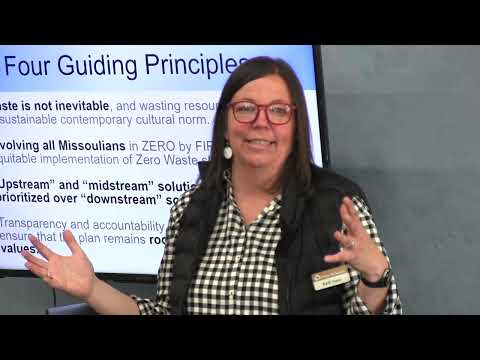
The update emphasized four guiding principles in the plan — that waste is not inevitable, that implementation must be equitable across all Missoulians, that upstream and midstream solutions should be prioritized over downstream fixes, and that transparency and accountability are essential — and four paths to implementation: access, infrastructure, education and policy.
Presenters and Home Resource staff described specific, already‑implemented programs that the city and community organizations have used to advance the plan. Home Resource’s reuse store diverts building materials — the presenters cited approximately 2,000,000 pounds kept out of landfills through reuse — and the organization runs Pledge 0, a business assistance and event program that audits waste streams and provides volunteers and sorting stations at large events. The presentation credited high diversion rates at recent events: Home Resource staff reported the county fair achieved about an 86% diversion rate when vendors used compostable service ware and volunteers staffed sorting stations.
Raderman said the city’s decision to purchase the local compost facility has enabled private compost collection businesses to operate and helped create a more closed‑loop system for food and yard waste. The panel also noted that Missoula now offers year‑round household hazardous‑waste collection on Home Resource property; that service is operated by Missoula County and the Missoula County Water Quality District, and runs on appointments with a sliding fee scale.
School programs were highlighted as a success: speakers said K–8 public schools now have 0 waste stations in cafeterias in many schools, paired with the 0 Waste Ambassador curriculum for elementary students. “We can meet kids where they are,” Hess said, describing classroom education and on‑site sorting that teaches students how to use compost and recycling stations.
Speakers named remaining challenges. Raderman said the city has limited staff and funding compared with the scope of goals, and noted that some state laws limit local choices for waste policy. The presenters described a persistent measurement problem: the city lacks full access to consistent, local waste‑stream data because the landfill and some hauling operations serve multiple counties and jurisdictions, and reporting is aggregated. A 2019‑based desktop study provides a baseline the city has used, but staff said they are still working with local partners to obtain direct weight‑based diversion data and hope to have better measurements by the city’s 2025 interim target date.
In a question‑and‑answer exchange, attendees asked about glass recycling. Panelists said Recycling Works, a local nonprofit, offers periodic drop‑off events and occasional pickups for food‑grade glass. When full loads are available, Recycling Works ships consolidated glass to Momentum Recycling in Salt Lake City, Utah, where it is processed into fiberglass insulation. Presenters described the approach as a current, pragmatic solution given Montana’s local market conditions for crushed glass.
Panelists also cautioned that switching to compostable service ware is not a simple fix: compostable plastics can contain chemical additives and require specific industrial composting conditions. Speakers said some composters in other states, such as Oregon, have rejected certain products because of those additives, so businesses should get technical guidance rather than assume every “compostable” label is acceptable.
The meeting closed with a description of the newly formed 0 by 50 task force’s charge: to perform a progress check and produce a 3–5 year roadmap that prioritizes realistic, implementable actions given current staffing, funding and state‑level constraints. Raderman said the task force will aim to identify near‑term wins that build political support and secure funding.
The presenters pledged to share the task force’s findings with Home Resource’s board and Missoula City Council and to circulate the full action plan and timelines to meeting attendees via email.
Ending: The session concluded with an invitation to the public to continue the conversation at Home Resource’s monthly lunch‑and‑learn series and with staff contact information for businesses, schools and event organizers seeking technical assistance.