Get Full Government Meeting Transcripts, Videos, & Alerts Forever!
Get email alerts on the Synthetic Cannabinoids topic
No spam. Unsubscribe anytime.
Senate debate on synthetic cannabinoids pits public‑safety ban against regulation; IPP motion fails
Summary
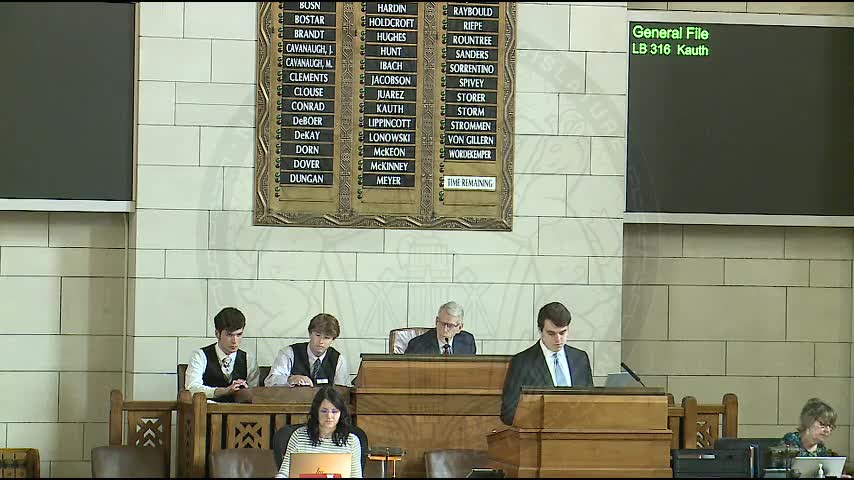
The Nebraska Legislature held extended debate on LB316, a bill aimed at banning certain hemp‑derived synthetic cannabinoids, with proponents citing public‑health risks and opponents urging a regulated licensing approach; a motion to indefinitely postpone the bill failed on a 10‑32 roll call.
The Nebraska Legislature spent substantial floor time debating Legislative Bill 316, a measure sponsored in committee by Senator Katrina Kautz that would ban possession, sale and use of certain hemp‑derived synthetic cannabinoids (commonly described in testimony as delta‑8 and similar isomers). The debate split members along public‑safety and regulatory lines and included a failed motion to indefinitely postpone.
Senator Katrina Kautz opened on LB316, saying the bill addresses ‘‘a growing health crisis in Nebraska. Synthetic cannabinoids, including delta 8 THC, are being sold across the state and causing harms to Nebraskans.’’ Kautz told the body that test results and anecdotal reports show products frequently have inaccurate labeling and that many contain intoxicating levels of THC or unidentified chemicals.
Opponents, led by Senator John Kavanaugh, argued a regulatory approach is preferable to a ban and circulated LB16 as an alternative to create licensing, testing, age limits and advertising rules. Senator Kavanaugh characterized LB316 as an overbroad ban and said, ‘‘LB 3 16 just says we're gonna outlaw these things because we don't like them. Right?’’ He argued for licensing, laboratory testing standards, a 21‑plus age limit and local permitting.
Floor actions and procedural votes recorded on the transcript include: - A motion to cease debate passed by roll call (31 ayes, 9 nays). This cleared the way for a final vote on the IPP motion. (Cease debate vote recorded by the Clerk.) - Senator John Kavanaugh moved to indefinitely postpone (IPP) LB316; the roll‑call vote on the IPP recorded 10 ayes and 32 nays, and the motion to indefinitely postpone failed. - Senator John Kavanaugh subsequently moved to reconsider the IPP vote; that motion had been made on the floor and was pending at the end of the provided transcript.
Key factual points and figures discussed on the floor: Senator Kautz and others cited results from the Attorney General’s office and local law‑enforcement purchases and tests, and observed many states have banned synthetic cannabinoids. Opponents repeatedly cited a fiscal note: the Revenue Committee’s estimate that a ban would result in a general‑fund loss of about $1,583,000 (the transcript cites a $1,600,000 figure as a fiscal note approximation); proponents of regulation cited tax receipts from one multi‑store retailer—about $96,000 in sales tax collected in 1 month from roughly 11 locations—as evidence of greater revenue impact if the market were banned.
Committee testimony and floor speakers included public‑health advocates, the Attorney General’s office, industry representatives, and consumer advocates. Supporters of a ban emphasized unknown contaminants, untested byproducts of synthetic conversions, and reports of hospitalizations and serious adverse events; opponents emphasized consumer protection through testing and licensing, avoiding a black market, and temporary economic impacts to retailers and farmers.
The debate also included constitutional and federal‑law points: multiple senators said LB316 would create a state definition of hemp that differs from the federal 2018 Farm Bill definition and raised concerns about interstate commerce and litigation risk.
Where it stands: Because the motion to indefinitely postpone failed on the roll call recorded in the transcript, the bill remained live. Senator John Kavanaugh moved to reconsider that vote; action on the reconsideration was pending in the later portion of the transcript provided to this report.
Sources: Opening statement by Senator Katrina Kautz; floor debate and roll calls recorded in the George W. Norris Legislative Chamber during the 60th day of session.