Get Full Government Meeting Transcripts, Videos, & Alerts Forever!
Get email alerts on the Disaster Stockpile topic
No spam. Unsubscribe anytime.
New Oregon disaster stockpile gets funding allocations; officials outline plan for inventories and rotation
Summary
At an April 29 informational hearing, Oregon emergency officials described the newly funded Disaster Preparedness Stockpile program, explained agency funding allocations and outlined plans for a common operating picture, procurement responsibilities and inventory rotation.
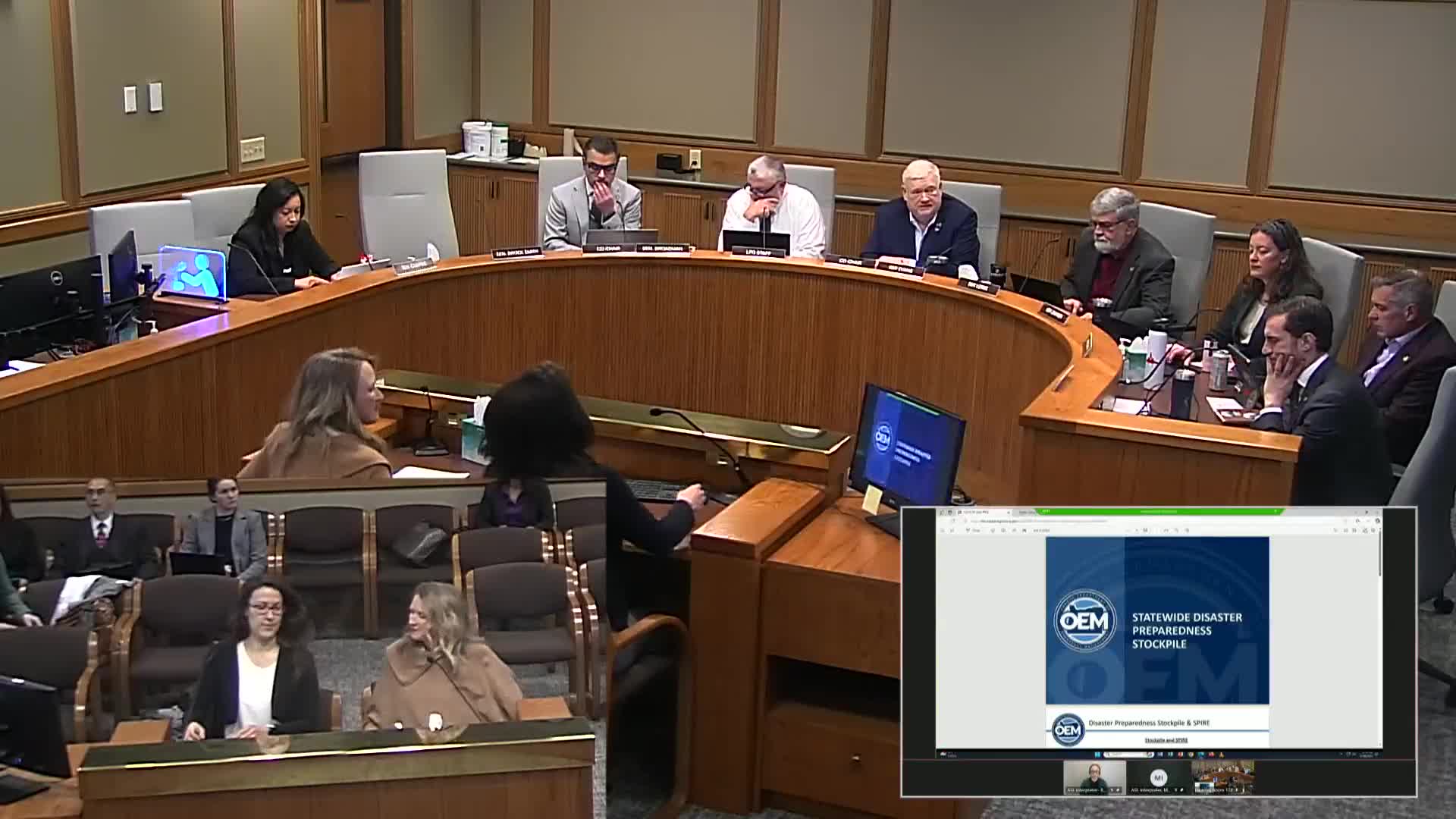
At an April 29 informational hearing of the Public Safety Subcommittee of the Joint Committee on Ways and Means, Whitney Stewart, logistics and staging base manager for the Oregon Department of Emergency Management, outlined the Disaster Preparedness Stockpile program, the funding allocations made in the current budget and next steps for procurement and inventory management.
Stewart said the stockpile and SPIRE share some authorities — both can purchase equipment over $5,000 and both require accountability through reporting — but differ in funding source, procurement approach and intended ownership. "These similarities and differences are subject to change as the stockpile program is very young," Stewart told the committee.
Under the fiscal year 2025 funding structure described at the hearing, the Department of Human Services would receive $3,200,000 for locally stored disaster supply caches (coastal regions); the Oregon Health Authority would receive $837,000 for personal protective equipment rotation and regionally stored medical supply caches; and the Oregon Department of Agriculture would receive $200,000 for large and small regionally stored animal sheltering kits. Stewart said these interagency agreements are in review and that funds were transferred to OEM a few weeks before the hearing to allow procurement work to proceed.
Stewart described other elements: the stockpile is a one-time general fund special purpose appropriation rather than a recurring bond-funded program; it can purchase items below $5,000 and commodities; it must follow Oregon procurement law (whereas SPIRE has legislative carve-outs from the contracting code but generally follows procurement best practices); and it is not intended for private 501(c)(3) organizations to own stockpile elements directly, though partners may propose uses and must remain accountable to OEM.
Stewart discussed initial procurements and partnerships: the Oregon Department of Human Services, Oregon Health Authority and Department of Agriculture will each manage the procurements for the elements assigned to them, and OEM will lead procurements for regionally staged interoperable communications equipment. Stewart also said the Confederated Tribes of Warm Springs have been an early partner for traffic-control equipment and that related intergovernmental agreements have been drafted for review.
Committee members asked whether agencies would rotate medical supplies and PPE to avoid expiration; Stewart said partner agencies would report rotations back to OEM and could use vendor-managed inventory or their own warehousing approaches for rotation. She noted procurement-plan adjustments were made after passage of the budget bill when the Department of Agriculture reported market volatility in steel prices; OEM adjusted funding so the department could purchase the originally intended five large-animal sheltering kits rather than four.
Stewart said the stockpile program aims to build a "common operating picture" — a GIS-based shared inventory and contact system that shows what partners hold, where items are located, and how to deploy them in an incident. She said that, because the stockpile is newly funded on a one-time basis, OEM has not yet integrated stockpile elements into regular exercises but that future integration and software or warehousing changes are planned as the program matures.
The presentation was informational; no committee action was taken. Stewart emphasized the program's early stage and the need for flexible procurement approaches and sustained partner engagement to maintain inventories and integrate systems.
Ending: Officials said interagency agreements and procurement work are ongoing and encouraged partners to engage in planning as the stockpile moves from initial procurements toward a shared inventory system.