Get Full Government Meeting Transcripts, Videos, & Alerts Forever!
Get email alerts on the Sign Code topic
No spam. Unsubscribe anytime.
Bloomington amends sign code after one-year review; council carves out fence rule
Summary
The City Council approved multiple changes to the sign code following a year-long look-back, authorizing roof signs in some districts and other clarifications while reserving a proposed ban on signs mounted to residential fences for further work. The council also authorized summary publication of the ordinance.
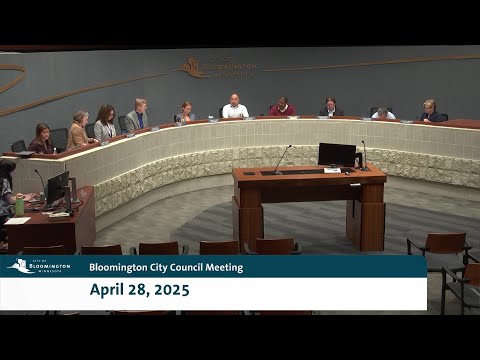
Bloomington City Council on April 28 adopted several amendments to the city sign code after a one-year review of the ordinance the council approved last year. The changes add clarifications and new permitted sign types in commercial and mixed-use areas and leave a proposed restriction on residential fence-mounted signs reserved for later work.
The planning manager, Nick Johnson, told the council the city issued 66 sign permits under the new code in 2024 and had approved 33 so far this year. Johnson said staff tracked implementation issues and presented 15 recommended changes, five labeled as "cleanup" and the remainder policy clarifications. "When you're knee deep in the code as opposed to theoretical situations ... you tend to notice some of these opportunities for improvement," Johnson said.
The planning commission supported 15 of 16 proposed edits presented in January. Among policy changes the council approved were permitting roof-integral signs, allowing roof signs in sign districts 3–5 (commercial, industrial and mixed-use), clarifying how building frontage is measured, increasing the allowed size of directional signs in high-traffic districts (including the Mall of America Cx2 district) and creating clearer permanent sign construction standards to exclude vinyl banners as permanent signage unless mounted to a rigid backing.
Matt Wylen of Clear Channel Outdoor spoke in the public hearing and asked the council to reduce the minimum electronic billboard dwell time from 20 seconds to the industry standard of 8 seconds, saying lower dwell times increase advertising flexibility and local advertising opportunities. "We've demonstrated we can operate these safely at the 8-second standard," Wylen told the council. Council members asked staff to return with additional data before changing the dwell-time standard.
Council members questioned provisions on signs mounted to residential fences and their potential First Amendment implications, as well as operational enforcement. Planning staff said fences can conflict with other code sections (easements, height limits and sight triangles) and said their recommendation to prohibit fence-mounted signs aimed to avoid repeated code conflicts. After extended discussion the council approved all proposed edits except the prohibition on signs attached to residential fences; that subsection (21.3040.11.b.14 in the draft ordinance) was set to "reserved" for further study and possible separate action.
Council member Lohmann made the motion to adopt the staff-recommended changes except for that single subsection; the motion passed unanimously. The council then authorized summary publication of the ordinance amending Chapter 21 and Appendix A of the city code, also by a 7-0 vote.
Council members asked staff to return with additional work on the 7-story building provision (allowing up to three building signs per elevation in certain cases) and to revisit the electronic billboard dwell-time question with updated safety and traffic data.
The ordinance changes take effect after the city completes the summary publication process required under state law.