Get email alerts on the Homelessness Enforcement topic
No spam. Unsubscribe anytime.
Council approves ordinances targeting sidewalk sitting, camping and derelict structures amid calls for services
Summary
The city adopted multiple ordinances that ban sitting/lying on public sidewalks, unauthorized camping, and expand penalties and nuisance definitions; council members and commenters stressed the need for services and a daytime resource center as enforcement tools are considered.
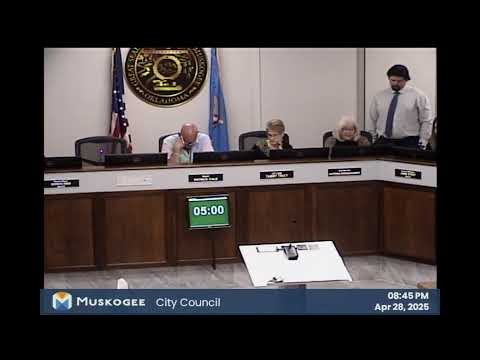
Muskogee — The Muskogee City Council on April 28 approved a package of ordinances aimed at public safety and code enforcement related to homelessness: a prohibition on sitting or lying on public sidewalks, an unauthorized camping ordinance, and related updates to penalties and nuisance definitions for vacant or derelict structures.
Councilor Tracy Hoose introduced the set of ordinances as part of a broader effort to address health, safety and business impacts tied to encampments and unsecured vacant structures. The council approved Ordinance No. 42‑59‑A (prohibition on sitting or lying on public sidewalks), Ordinance No. 42‑60‑A (unauthorized camping), Ordinance No. 42‑61‑A (penalties) and Ordinance No. 42‑62‑A (amendments to nuisance definitions). Each ordinance passed on roll call with unanimous support.
Why it matters: Council members said the measures are intended to give the city additional options to address behaviors that pose public-health, safety and cleanliness concerns — for example, unauthorized tent encampments near businesses and unmaintained vacant buildings that have been entry points for trespass and fires. Supporters said enforcement tools could protect business owners, first responders and unhoused residents themselves.
Council debate and concerns: Several councilors and commenters stressed they did not intend to criminalize homelessness. Councilor Hoose and others said the ordinances are paired with work by a homeless task force; however, council members and public speakers asked the city to identify daytime places and service connections for people who are unhoused. “We need some designated place for them to go to have those resources pulled,” a speaker said, urging that enforcement be paired with placement options and outreach.
Council action: The ordinances set misdemeanor penalties (including a $50 fine for some violations) and allow code enforcement for owners of vacant buildings that are not secured or maintained. Council also approved a standalone ordinance to create statutory penalty provisions that align with enforcement of the new rules. Staff and council members said police and outreach partners will target enforcement toward behaviors rather than criminalizing homelessness per se.
Next steps: Council members encouraged additional work by the homeless task force and staff to identify daytime resource locations, coordinate with providers and publish enforcement protocols that emphasize referrals to services when possible. The council’s vote authorizes enforcement mechanisms; implementation will involve police, code enforcement and social-service partners.
AI generated
The text on this page is AI generated. Summaries, highlights, analysis, and video transcripts are all produced from the original source material.
AI can make mistakes, so if you spot one, and we will fix it for everyone.
Note: the source content is unaltered by us. Any content source we link to, be it a video, an audio recording, or a document, is presented exactly as its publisher released it. That publisher is usually a government body, sometimes an individual official or another organisation.