Get Full Government Meeting Transcripts, Videos, & Alerts Forever!
Get email alerts on the Capital Improvement Plan topic
No spam. Unsubscribe anytime.
Committee reviews $75 million proposed capital plan; Gateway funding swap, parks and sidewalks draw questions
Summary
Cleveland’s Municipal Services and Properties Committee reviewed a proposed 2025 capital improvement plan totaling up to $75 million, with discussion focused on how bond proceeds would be used, a funding swap that covered Gateway repairs, and priorities for streets, parks and public safety facilities.
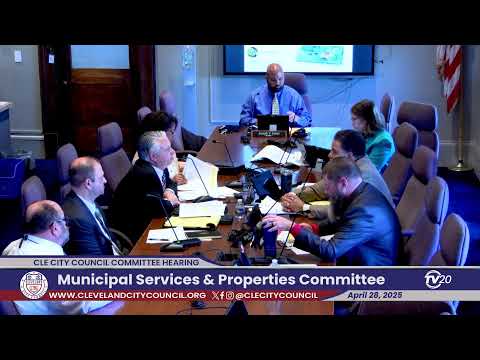
The Municipal Services and Properties Committee met Monday, April 28, 2025, to review a proposed capital improvement plan (CIP) that city staff said could reach $75 million in bond proceeds to fund public facilities, roads and bridges, recreation projects and cemetery work.
Committee members and staff said the FY2025 proposal would direct roughly $35 million to public facilities, $28 million to roads and bridges, $11 million to parks and recreation, and $500,000 to cemetery projects. Staff also described several program-level items included in the proposal: an $8 million residential resurfacing allocation, a $12 million vehicle-and-equipment pool, and a $500,000 annual “recreation glow up” program for basic repairs at recreation centers.
The CIP matters because it sets the city’s bonding plan and schedules projects that affect neighborhoods, stormwater and sidewalks, public safety facilities, parks and other services. Chief Tewen, whose prepared statement staff read into the record, summarized the plan’s purpose: "The capital improvement plan is essential to the operations of the City Of Cleveland and its residents." That statement, staff said, reflects the plan’s use to prioritize long-term projects and to preserve assets with at least a 10-year useful life.
Staff outlined how the CIP was developed. The Municipal Office of Capital Projects (MOCAP) said it solicited project requests from departments and council offices, received more than $140 million in requests, and then narrowed that list by applying criteria such as safety needs, regulatory compliance, third-party funding requirements and mayoral or council priorities. A capital improvements committee including public safety and finance staff reviews cost estimates and eligibility; final eligibility for bond-funded projects, staff said, is confirmed by bond counsel.
Gateway swap and bond eligibility
A central item of committee discussion was a prior funding swap staff described that used existing city project funds to cover capital repairs at the Gateway sports complex and then replaced those project allocations with bond proceeds. The finance director and other staff said bond counsel approved the earlier “swap” because the city used “like purpose” funds to make the payment and later replenished those project accounts.
The finance director summarized the legal guidance staff relied on: "As long as it was a like purpose, we were able to do that swap," and said city staff would provide written confirmation from bond counsel on request. Committee members pressed for documentation of the legal opinion and for clarity on ownership and reversion rights: staff said the city does not currently own the Gateway Complex, but certain reversion clauses can transfer ownership to the city or county under specific circumstances.
Project highlights and outstanding questions
- Fire records management system: The plan lists a $314,000 line for a fire division electronic records replacement. Committee members asked whether the item had previously been included in earlier bond packages; staff said the item had not been reviewed by bond counsel yet and agreed to research its earlier budget history.
- E. 60th/6th Street Green Street transformation: Staff described a $2 million additional request that would bring the project to an estimated $4 million; previous council allocations and anticipated federal earmark requests were discussed as possible supplemental funding.
- Residential resurfacing and sidewalks: Council members emphasized the $8 million added for residential resurfacing and raised the relationship between resurfacing and the tree-damage sidewalk (TDS) backlog. Staff said the city awarded an almost $8 million contract to a contractor to catch up on older TDS locations; that work will be split across two construction seasons.
- Fifty–fifty sidewalk program: The line item for the resident/city split-remediation program remains in the CIP; staff reminded the committee that third parties may fund the resident portion under codified ordinance provisions.
- Parks and recreation master plan: Councilwoman Rebecca Meyer pressed staff on how the parks master plan priorities (she cited Lonnie Burton and Stella Walsh) feed into the CIP. Staff said Lonnie Burton is fully designed and included, while Stella Walsh requires further design and scope work; a $4 million placeholder labeled “future park renovations” appears in the 2026 proposal and staff said that can be reallocated once projects are scoped.
- Warsaw Park playground: Staff confirmed Warsaw Park’s replacement playground appears in the 2025 proposed CIP and said the project is proposed to move forward in 2025 as scoped in the proposal.
- Police district facilities: Committee members raised concerns about aging police district stations and asked whether those renovations would be bond-funded. Staff said the planned police district rehabilitation will not rely on the general GO bond proceeds listed in the CIP; instead the administration cited a different authority in the Ohio Revised Code that allows a separate funding approach and said renovations would proceed on a different schedule.
Other technical and fiscal items
Staff outlined bond types the city typically uses (general obligation facility, recreation, road/bridge and cemetery bonds) and said bond counsel determines final classification. Staff also described a recent shift in how bond-interest earnings are allocated across CIP purposes: the finance director said the city historically distributed interest by cash balances but that bond counsel clarified the city may allocate interest to the purposes with the greatest need in the year rather than distributing it pro rata. "We could allocate interest to what purpose we want in that year, versus equally allocating it," the finance director said.
Staff briefed the committee on the city’s debt limit mechanics: general obligation borrowing must generally stay below 10% of total assessed value; staff said the city was near roughly 8.5–8.8% prior to the 2024 reassessment and that the reassessment increased the borrowing capacity. Staff said the $75 million figure in the proposal is a maximum and that finance will evaluate existing project balances and interest earnings to limit the amount actually issued.
Requests and next steps
Committee members asked staff to provide documentation from bond counsel on (1) the legal basis for the Gateway funding swap and (2) the changed approach to allocating bond-interest earnings. Staff agreed to provide the memos and to follow up with additional research on items whose history was unclear, including the fire records management system and specific prior-year allocations tied to Gateway. Staff said formal legislation to authorize any bonding will follow the committee presentation.
The committee concluded by asking staff for further detail and schedules for construction and borrowing, and to return with any requested bond-counsel memoranda and itemized lists for projects that members asked to inspect or tour.