Get Full Government Meeting Transcripts, Videos, & Alerts Forever!
Get email alerts on the Gun Violence Declaration topic
No spam. Unsubscribe anytime.
Cleveland council to introduce resolution declaring gun violence a public-health crisis
Summary
Councilman Starr said the City Council will introduce a resolution to declare gun violence a public-health crisis and highlighted local homicide and injury data; community groups and council leaders urged a comprehensive prevention strategy and warned grant cuts have reduced local outreach capacity.
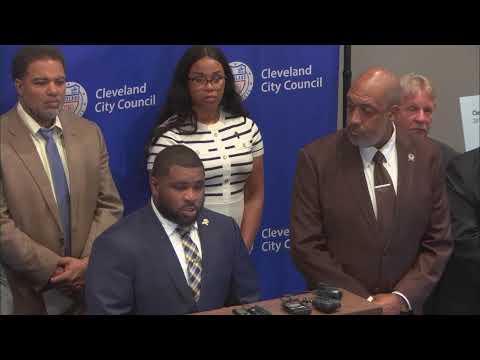
Cleveland City Council members said they will introduce a resolution to declare gun violence a public-health crisis and will put the measure to a vote this evening, saying the step is intended to coordinate prevention, intervention and enforcement efforts across city and county agencies and community partners.
The declaration is intended to accelerate citywide, cross-sector action “to mobilize resources and partnerships across law enforcement, health care, education and community organizations,” Councilman Starr said, citing a span of data the council majority described as evidence that gun violence has deep and disproportionate local impacts.
The councilmen and community speakers framed the move as a response to several local statistics cited during the remarks: from 2019 through February 2024, speakers said Cleveland recorded 953 homicides, 825 of them Black victims; Cuyahoga County had the highest rate of gun-related deaths in Ohio in 2021; and Cleveland emergency-room visits for gunshot wounds in 2023 were described as about 102 per 100,000 residents, concentrated among Black males ages 18 to 24. Council leaders and community groups said these figures demonstrate the need for sustained prevention and intervention funding.
Myesha Watkins, executive director of Cleveland Peacemakers Alliance, described the effect on families and frontline responders and urged the city to treat violence as a public-health problem rather than solely a criminal-justice one. Watkins said, "A survivor of gun violence is not just the person who lost their loved one, but the people that are the most impacted by this disease of violence," and urged investment in community-based services and supports.
The council president (name not stated in the transcript) voiced support for a multi-pronged approach that pairs prevention with law-enforcement action, saying, "Hurt people hurt people," and arguing the city should both hold perpetrators accountable and expand programs that prevent violence before it occurs.
Speakers also warned of recent federal grant cuts affecting community violence-intervention (CVI) programs. According to speakers, the Department of Justice CVI funding picture changed under the federal administration and, as presented at the meeting, 65 CVI organizations nationwide had grants terminated across 48 cities and 25 states with roughly $154 million awarded historically and about $40 million reported unspent; Cleveland Peacemakers Alliance was described as having about $1.7 million of a $2 million grant left unspent. Watkins and council members said those reductions hampered local hospital-response work, victim supports and small programs such as safe houses.
Council members said the council will also declare May 1–7 National Gun Violence Survivor Week locally and will host a survivor-focused event on May 7 at 6 p.m. at Langston Hughes (East 70th Street). The council asked for a joint approach with Cuyahoga County and said it is seeking private-sector and philanthropic partners to replace or supplement lost federal funds.
No formal vote on the resolution was recorded in the transcript; council members said they would introduce the resolution and bring it to a vote the same evening. Council members and community leaders described complementary steps they expect to pursue if the declaration passes, including aligning prevention programs, encouraging court-watch and judicial accountability efforts, and directing staff and partner organizations to coordinate services and outreach.
The city also noted recent council legislation to increase penalties for nuisance activities, curfews and street shutdowns (details of the ordinance were not specified in the meeting record). Council members repeatedly emphasized that the declaration is intended to drive a comprehensive mix of prevention, intervention and enforcement rather than to replace law-enforcement activity.
Next steps listed by council members at the meeting included the formal introduction of the resolution, a vote to be held that evening, planning the survivor-week event at Langston Hughes on May 7 and outreach to county officials and private-sector partners to identify funding and program partners.