Get Full Government Meeting Transcripts, Videos, & Alerts Forever!
Get email alerts on the Homelessness Response topic
No spam. Unsubscribe anytime.
Committee approves contracts to continue ‘Home for Every Neighbor’ rapid rehousing initiative
Summary
Council committee approved Ordinance 502-2025 to allow one‑year contracts (with one renewal) with partners to continue the Home for Every Neighbor unsheltered-to-housing program; presenters reported roughly 11.5 days average time from engagement to move‑in and intensive 12‑month subsidies and case management.
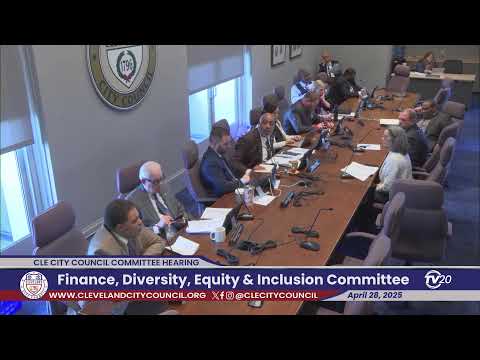
Cleveland’s Finance, Diversity, Equity, and Inclusion Committee approved Ordinance 502-2025, authorizing the Department of Public Health to contract with Downtown Cleveland Alliance, Centers for Families and Children and other homeless-services partners to continue the Home for Every Neighbor direct‑to‑housing initiative for one year with one option to renew.
Liam Hagerty, leader of the Home for Every Neighbor program, described the initiative as a coordinated, housing‑first crisis response modeled on FEMA-style “housing command” concepts. Hagerty told the committee the program teams do outreach, case management, unit acquisition, subsidy payments and cleanup; they identify regular campers, match units to household needs, and provide move‑in furniture and 12 months of rental subsidy coupled with intensive case management.
Hagerty said the program has housed more than 140 people since it started and that a later slide showed 154 people across roughly 50 locations and 13 wards; he reported an average time from engagement to move‑in of about 11.5 days and said 73 percent of participants had been unhoused more than a year prior to rehousing. The initiative uses a rent/subsidy model: Hagerty said the participant agreement provides a 12‑month subsidy, case managers meet weekly in the early months, and the program works with county Continuum of Care resources to transition eligible households to permanent vouchers when possible.
On budget, the department told the committee last year’s allocations included a little over $1.8 million from the city’s 24/25 budget and a $2.7 million federal Emergency Rental Assistance (ERA) grant; the 25/26 request in committee totaled $1,920,000 plus two FTEs and one Cleveland Foundation fellow to continue operations. Committee discussion examined program sustainability: several council members, including Councilman Michael Polizzi and Councilman Brian Casey, praised rapid operational results but questioned whether the city should continue funding a program many said should be a county responsibility. Speakers also raised landlord screening, unit inspections (HQS), legal aid for tenants and mediation to resolve landlord-tenant disputes.
Program-level details provided in committee included: an average 1‑bedroom rent figure quoted at "$10.95" (unit of measure not specified in the transcript), a two‑bedroom average of $13.50 (the department said that included utilities), and flexibility in subsidy length when additional tailored support is needed. Hagerty said the current contract and ERA funding cover move‑ins through September of the current year; the new allocation would support new placements beginning October 1, 2025. Committee members asked for and were promised reporting on participant outcomes after the 12‑month subsidy period.
Ordinance 502‑2025 was read and, after committee discussion and Q&A, the committee marked the item approved. The transcript recorded the committee approval but did not include a roll‑call tally. The department will continue to implement the rapid rehousing workflow, report back on 12‑month outcomes, and coordinate with county and nonprofit partners on voucher transitions and wraparound services.