Get Full Government Meeting Transcripts, Videos, & Alerts Forever!
Get email alerts on the Occupational Licensing Military topic
No spam. Unsubscribe anytime.
Committee hears substitute to speed Texas licensure for military families, veterans
Summary
Senate Bill 2255, revised in committee to include active-duty members and veterans and to shorten processing from 30 days to 10 days, would allow expedited licensing for people with out-of-state licenses in good standing; the committee heard several witnesses and left the bill pending.
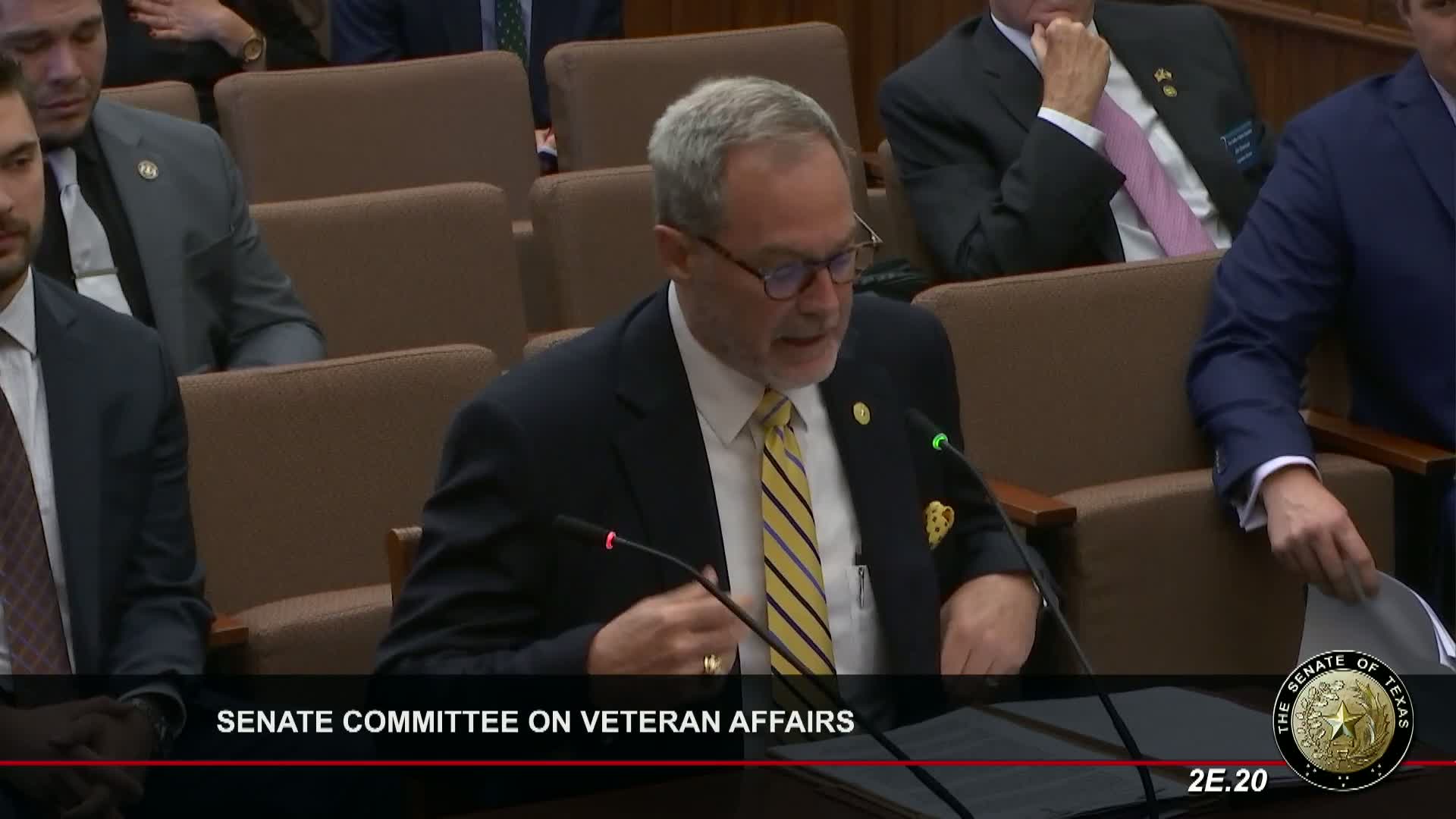
Senate Bill 2255, a measure to streamline occupational licensing for military spouses, service members and veterans, was presented and discussed before the Senate Committee on Veteran Affairs on Oct. 12, 2025. The committee received multiple supporters and technical testimony and left the bill pending.
Senator Bryan Sparks, the Senate sponsor, said the bill would make it easier for people holding an out-of-state license in good standing and with a comparable scope of practice to obtain a Texas license. "This bill aims to streamline the process for military members, their spouses and veterans to obtain a Texas occupational license," Sparks said. The sponsor also noted the committee sent up a committee substitute that expanded the original spouse-only language to include active-duty personnel and veterans and reduced the agency processing time from 30 days to 10 days.
Several organizations spoke in support. Jim Brennan, legislative director for the Texas Coalition of Veterans Organizations, called the bill a way to "mitigate that interruption" to family income when service members relocate. Glenn Hammer, president and CEO of the Texas Association of Business, said military-spouse unemployment is "around 14 or 15%" and urged legislator support so employers can hire qualified workers more quickly.
Samuel Hooper, legislative counsel at the Institute for Justice, called the bill a boost for economic liberty that follows the group's model legislation by focusing on "scope of practice rather than the more exclusionary substantial equivalence test," which he said will offer more opportunity. Doug Jennings, general counsel for the Texas Department of Licensing and Regulation (TDLR), testified as a resource witness on implementation.
Jennings described how the substitute would change procedures at state licensing agencies: applicants would submit an affidavit that they hold a license in good standing and provide military orders; agencies then would have 10 days to accept the application, request missing documents, or direct the applicant to the correct licensing authority. Jennings said the bill would remove a current step in many cases — obtaining a letter of good standing from the issuing state — that can take "a week" to "six months." He also noted a federal law passed in recent years and Chapter 55 of the Occupations Code have created some confusion at the agency level; Jennings said the bill would align state practice with recent federal developments and codified agency rules and would require better data collection on complaints and dispositions.
Mitch Fuller, legislative director for the Department of Texas Veterans of Foreign Wars, testified in support and said the bill helps veterans and spouses find employment quickly. After testimony, the committee closed public comment and left SB 2255 pending for further consideration; the record shows no roll-call vote at this hearing.