Get Full Government Meeting Transcripts, Videos, & Alerts Forever!
Get email alerts on the Environmental Health topic
No spam. Unsubscribe anytime.
State on-site wastewater association urges Kerr County to adopt stronger OSSF order, perpetual maintenance for advanced systems
Summary
A representative of the Texas On-site Wastewater Association urged the court to adopt a county order that supersedes state minimums—requiring permits on lots 10 acres or larger, perpetual maintenance contracts for certain advanced treatment units, and nutrient-reduction standards—subject to TCEQ review and public hearing.
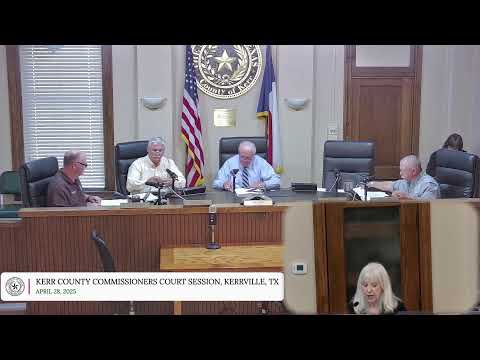
Randy Shalette, a representative of the Texas On-site Wastewater Association (TOWA), urged Kerr County Commissioners to adopt a more stringent on-site sewage facility (OSSF) county order that would supersede the state minimum rules in Chapter 285 and require additional protections for groundwater and public health.
Shalette told commissioners that many counties in the Hill Country already require permits for systems on lots of 10 acres or more and require ongoing maintenance for advanced treatment units. He said Kerr County is a regional outlier: “When you look at the entire Hill Country… Kerr County is the only county that does not have an OSS order with a section 9 or section 10 that requires everything to be permitted,” he said.
Shalette recommended three principal changes: (1) require permitting (no 10-acre exemption) for new systems regardless of lot size, (2) require perpetual maintenance contracts for advanced aerobic treatment units (ATUs) so systems remain serviced over their useful life, and (3) add nutrient-reduction standards (reference to proposed Standard 245) as those standards become available. He said perpetual maintenance is a public-health issue and warned that without ongoing service, an ATU “can turn into a glorified septic tank spraying raw sewage on the surface.”
County staff and commissioners asked clarification questions. Shalette and county staff noted that a county order that exceeds state rules must be submitted to TCEQ for approval and that the county would hold a public hearing before adoption. Shalette said homeowners may maintain systems themselves after required initial maintenance periods in some circumstances, but commercial, multifamily and rental properties are already required by state rule to have life-of-system maintenance contracts.
Commissioners did not adopt a change at the meeting; they asked staff to pursue further work on a draft county order and confirmed that any change would be published and submitted to TCEQ for review and be subject to public hearing.