Get Full Government Meeting Transcripts, Videos, & Alerts Forever!
Get email alerts on the Strategic Plan topic
No spam. Unsubscribe anytime.
Harmony Public Schools reviews draft “Harmony 2030” strategic plan, consultants outline five priorities
Summary
Harmony Public Schools board members reviewed a draft of the “Harmony 2030” strategic plan on April 26 in a presentation from Kearney consultants, who summarized stakeholder research and proposed five priority areas for the next five years.
Harmony Public Schools board members reviewed a draft of the systemwide “Harmony 2030” strategic plan during their April 26 meeting, hearing a presentation from lead consultant Bill Slavnick and colleagues from Kearney who described stakeholder research and five priority areas the plan proposes.
Consultants said the draft is intended to set a five‑year roadmap for curriculum, educator talent, organizational culture, systems of support (including compensation and technology), and external partnerships and alumni engagement. Bill Slavnick, lead consultant with Kearney’s strategic planning team, summarized the research behind the draft and told the board the plan is intended to produce “an organization that is planning strategically on an ongoing basis on behalf of kids.”
Consultants described the evidence base behind the draft and why the priorities matter
Kearney told the board the planning team conducted hundreds of interviews and focus groups, surveyed more than 2,000 Harmony educators and more than 3,500 parents, and completed classroom observations across the network. Slavnick said the team conducted “319 interviews” and many focus groups to capture perspectives from campus, district and central‑office staff, students, parents and external partners. He said the objective was to build a plan that scales without repeatedly changing direction at the campus level.
The consultants presented five interrelated priority areas: 1) strengthen curriculum and related learning experiences with attention to project‑based learning and deeper work in science, 2) accelerate development of frontline educators (with emphasis on novice teachers and multi‑year induction), 3) preserve and strengthen organizational culture and network structure, 4) fortify systems of support (compensation strategy, technology and capital operations and AI literacy/policy), and 5) expand external support including alumni relations and career and technical education (CTE).
On curriculum and instruction, Slavnick said Harmony’s STEM identity is a network strength and urged integrated delivery of English language arts with STEM content so multilingual learners and other students build language while learning rigorous content. “If you don’t have a strong curriculum, kids are not gonna learn at high levels,” he said.
On talent development, the consultants noted more than 40% of classroom teachers in Harmony are in early career stages. The plan emphasizes multi‑year, instructionally focused induction for new teachers, accelerated pathways for novice teachers to become accomplished, and stronger internal pipelines for teacher and campus leaders so experienced teachers can support peers and step into leadership roles.
On systems of support, Slavnick highlighted compensation strategy, sustainability and market competitiveness as key challenges; he said the plan will prioritize sequencing of resources, not a universal across‑the‑board raise. He also recommended increased AI literacy across the network and development of AI guidance citing concerns about student data and classroom application. Slavnick said the planning team reviewed AI guidelines from more than 20 states to inform Harmony’s work.
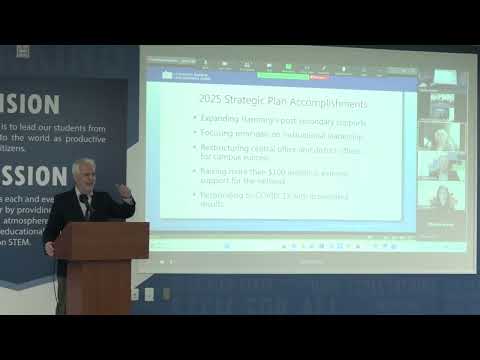
On external support, the consultants pointed to Harmony’s postsecondary work and alumni base: the presentation said Harmony currently has about 17,000 alumni and projected that figure could grow to roughly 35,000 over five years; consultants discussed ways alumni engagement could support students and system expansion. The presentation also said the network has raised more than $100 million over the prior five years to support programming.
Board members asked questions; consultants said the draft is a review item
Board members asked a range of clarifying questions during the review. One board member asked whether the proposed ELA–STEM integration builds on earlier initiatives such as the district’s prior Race to the Top work; Slavnick replied the plan builds on existing efforts rather than starting from scratch and that the emphasis is on making existing work more impactful at scale. Other members asked about timeline and prioritization: Slavnick said developing profiles of a “successful Harmony teacher” and a “successful Harmony principal” should be achievable within the first year and that the next phase of work will identify KPIs and timelines.
Slavnick described the process timeline inconsistently in the question period — he stated both that an initial phase took “three months” and that the planning work began in September — and told the board the next step is for the Kearney team and Harmony leaders to define KPIs and an implementation timeline.
No board vote was solicited on the plan at this meeting; the item was presented for review and feedback. Slavnick closed by urging the board to “keep the main thing the main thing” — language he used to emphasize student achievement as the primary goal of the plan.
What happens next
Consultants said the next phase is to finalize KPIs and implementation timelines and to continue participatory development of teacher and leader profile documents. Board members did not take formal action on the strategic plan at the April 26 meeting; the presentation was recorded as a review item with the expectation that staff and consultants will return with more detailed metrics and timelines for board consideration.
Ending
The board’s review session produced clarifying questions and general support for the draft priorities but no formal vote; staff and the Kearney team will bring KPIs and an implementation timetable back to the board in future meetings for decision and possible adoption.