Get Full Government Meeting Transcripts, Videos, & Alerts Forever!
Get email alerts on the Refugee Resettlement topic
No spam. Unsubscribe anytime.
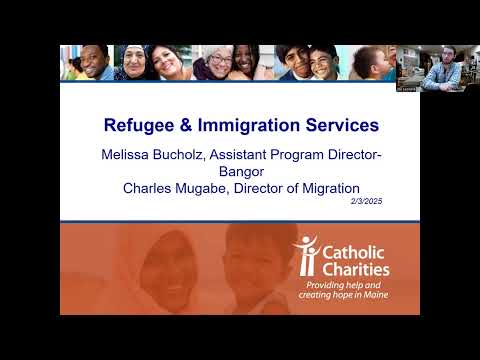
Catholic Charities outlines Bangor resettlement caseload; executive order pauses new refugee arrivals
Summary
Catholic Charities presented an update on refugee resettlement in Bangor, reporting 14 households served this fiscal year so far and warning that a recent presidential executive order temporarily suspended refugee admissions nationwide, canceling scheduled flights to Bangor.
Catholic Charities representatives told the Government Operations Committee that their Bangor office has worked with 14 households (19 adults and three children) in the current fiscal year and that resettlement operations will continue for clients already in the area, even as a recent presidential executive order temporarily suspended new refugee admissions.
Charles Mugabe, director of migration for Catholic Charities, and Melissa Buchholz, assistant director of Refugee and Immigration Services, described the agency’s services in Bangor, including case management, workforce services and health navigation. Buchholz said two‑thirds of the fiscal‑year arrivals were refugees vetted and resettled via federal processes; the remainder included secondary migrants and arrivals categorized as humanitarian entrants. Languages and countries of origin cited included Haitian Creole (Haiti), Spanish (Venezuela, Nicaragua), Swahili (DRC) and Dari (Afghanistan).
Mugabe said the White House executive order titled (in the presentation) “Realigning the United States refugee admission program” suspended refugee resettlement for 90 days and requires the secretary of homeland security and the secretary of state to produce a report to justify resuming admissions. He said flights scheduled to bring roughly 14 people to Bangor in February were canceled because of the order. Catholic Charities said the office will remain open to serve existing clients and walk‑ins and will continue services to those already resettled. If resettlement resumes under federal allocations for fiscal 2025, Catholic Charities had an approved placement target of up to 115 individuals for the Bangor region.
Committee members asked about employment, education and housing. Buchholz said 12 adults in the current fiscal year were “employable” (ages 18–64), six had secured job placements, three were in Job Corps training and others were pursuing additional opportunities; she said Catholic Charities provides workforce services for up to five years after arrival. Mugabe said the program’s “core services” are federally funded and cover roughly 90% of immediate needs but that housing scarcity and rental requirements (credit history, prior rental references) present persistent barriers. He said Catholic Charities coordinates with local school districts and that some federal funds administered by the Office of Maine Refugee Services and Department of Education flow to schools to support English‑learner services, but that recent federal budget changes have strained that support.
Presenters encouraged committee members to join quarterly stakeholder consultations to share capacity feedback with state and federal officials. Several councilors raised concerns about school capacity, local costs for ESOL services and distinguishing between screened refugees and other arrivals who may not have federal vetting. Catholic Charities emphasized that those arriving under federal refugee resettlement undergo extensive vetting overseas and medical screening prior to arrival.