Get Full Government Meeting Transcripts, Videos, & Alerts Forever!
Get email alerts on the Capital Improvements Schools topic
No spam. Unsubscribe anytime.
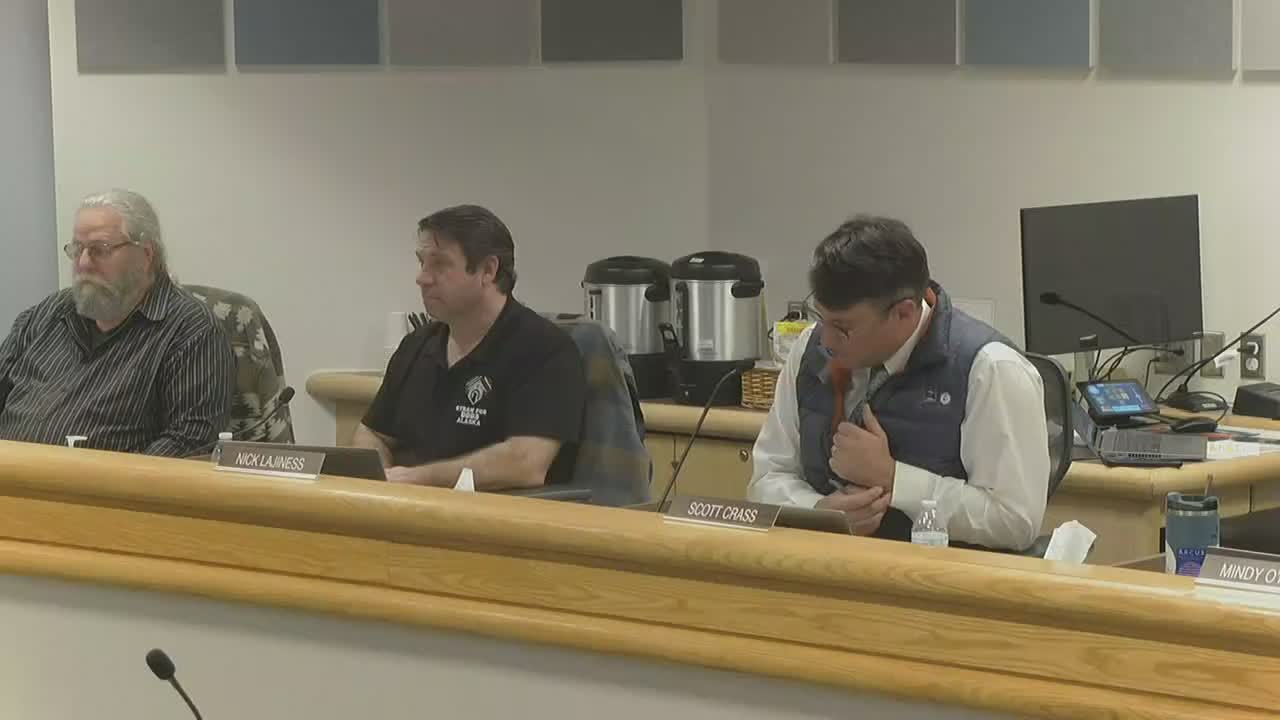
Assembly hears two ordinances to formalize school district participation in capital improvement process
Summary
Two proposed borough ordinance amendments (No. 2025-57 and 2025-58) would add a presentation opportunity for the Fairbanks North Star Borough School District and explicitly allow the superintendent to designate two district representatives to participate in CIP scoring and ranking.
Two assembly members presented separate but related ordinance proposals aimed at improving communication between the Fairbanks North Star Borough Assembly and the Fairbanks North Star Borough School District over capital projects and legislative priorities.
Assemblymember Haney introduced Ordinance No. 2025-57, which would amend Fairbanks North Star Borough Code (FNSBC) 7.12.120 to add a scheduled presentation by the school district to the assembly finance process. "The purpose of this ordinance is to improve communication between Fairbanks Northstar School Board, the Assembly, Interior Delegation, and improve the capital improvement process," Haney said, describing a proposal to allow the school board (or its designee) to present proposed capital projects and identify funding sources at the second finance meeting in October so the assembly has earlier visibility into district needs.
Assemblymember Rotemond followed with Ordinance No. 2025-58, a narrower amendment designed to ensure school-district participation in the CIP ranking and scoring process by allowing the superintendent to designate two district representatives to participate. Rotemond said the ordinance arose from communication breakdowns around a large mechanical project at North Pole High School — a multi-million-dollar item that officials and staff have since treated as an example of projects that need clearer vetting and earlier attention. "You didn't participate. You didn't get your money. And don't come crying to us is basically where I'm at," Rotemond said, summarizing his view that formalizing participation will improve outcomes.
Assembly members and staff discussed whether the proposals would change the existing executive nomination process and raised questions about timing and statutory alignment. Mayor Hopkins and borough staff clarified the current schedule for CIP nominations, as summarized by borough staff: public nominations for the FY25 CIP were accepted roughly August 20 to October 1; the draft resolution went to the Finance Committee on Nov. 2 and to the full Assembly on Dec. 14; projects were scored in January, with a subsequent finance committee review on Feb. 1 and assembly consideration on Feb. 20; funded projects are entered into the recommended budget and may be funded beginning July 1.
Assemblymembers asked whether the changes could be achieved administratively rather than by code amendment; Haney said she had spoken with the school board president and borough clerk and that the ordinance is intended to create a durable, consistent channel for school-district input that would not depend on changing administrations. Some members noted the potential timing mismatch between the proposed October presentation date and the borough’s legislative-priority schedule; others said the practical effect could be useful even if the timing requires refinement.
Rotemond’s ordinance also includes language to give administration flexibility to pull smaller, high-priority items from large bundled projects so the borough can fund achievable maintenance and prevent emergency appropriations later. Rotemond cited a prior multi‑million‑dollar mechanical project that later required an emergency appropriation when components failed.
No final votes were taken during the meeting; staff and members indicated they would work through technical language and timing before the ordinances return for formal action.
Ending: The two ordinances were presented for initial consideration and generated discussion on timing and implementation. Staff provided the current CIP nomination calendar and said borough and school-district staff would continue to coordinate language and process before any final action.