Get Full Government Meeting Transcripts, Videos, & Alerts Forever!
Get email alerts on the K 12 Schools Budget topic
No spam. Unsubscribe anytime.
Fairbanks North Star Borough School District outlines $16.5M shortfall, closures and staffing cuts in FY26 recommended budget
Summary
District leaders told the Assembly Finance Committee the FY26 recommended budget assumes a $60 million local contribution, anticipates state funding increases tied to the Base Student Allocation, and includes school closures, contracting custodial services and staff reductions to close an estimated $16–17 million gap.
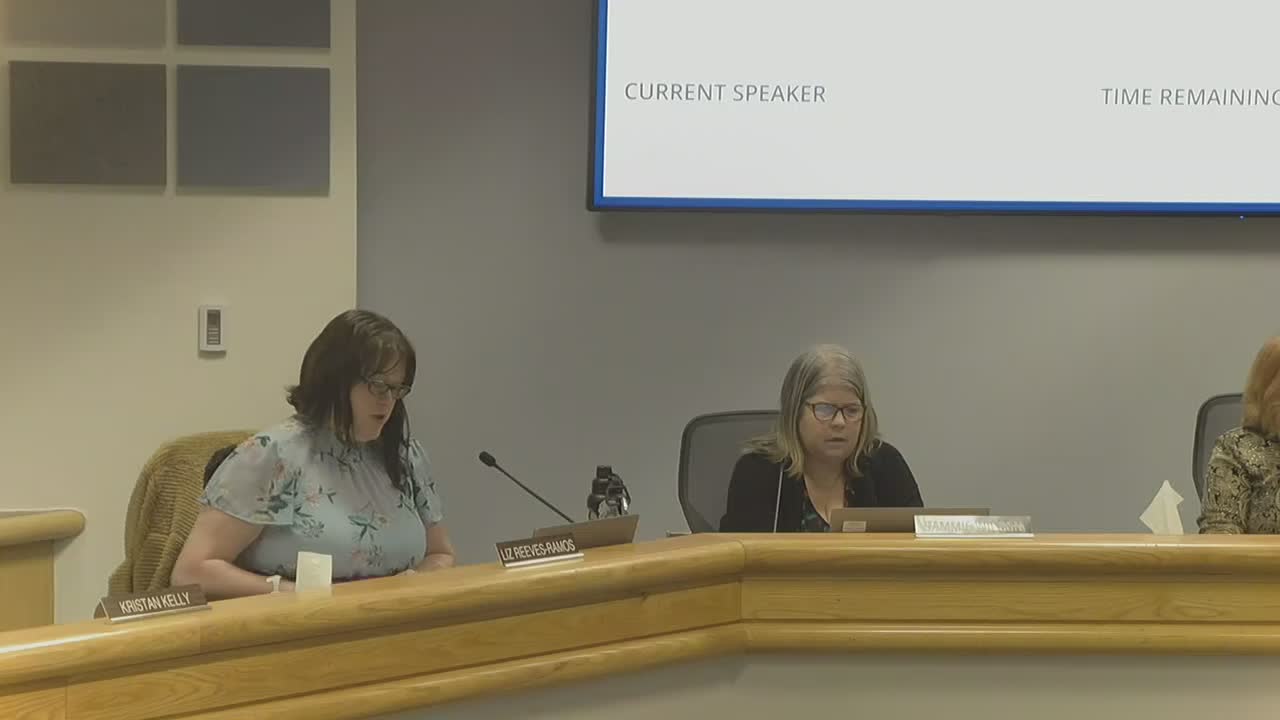
Fairbanks — The Fairbanks North Star Borough School District presented its recommended FY26 budget to the borough Assembly Finance Committee on April 17, outlining an estimated preliminary deficit of roughly $16.5 million and a package of closures, program cuts and staffing changes aimed at balancing that gap.
Superintendent Dr. Luke Meinert, Chief Operations Officer Andy DeGraw and School Board President Melissa Burnett walked committee members through student-enrollment trends, revenue assumptions and specific reductions the board has approved. Meinert opened by thanking the Assembly for passing a minimum local contribution resolution of $60 million, which the district assumed in building its recommended budget.
The district reported a projected FY26 enrollment decline of about 79 students from current levels and is assuming a Base Student Allocation (BSA) increase in the state formula equivalent to $680 per student in the budget model. DeGraw said the district’s total revenue from all sources is projected at about $192.4 million — roughly $5.6 million below the current year — and that state revenue is expected to drop by about $7 million, largely because of recent enrollment declines.
Why it matters: district leaders said the combined effect of rising expenditures and lower revenue produce a multi‑million dollar shortfall that required the board to approve personnel and program reductions. The district warned that if assumed state or local funding does not materialize, the board would need to make additional cuts, possibly including school closures.
Key budget moves and impacts
- School closures and downsizing: The board approved closure of Midnight Sun, Pearl Creek and 2 Rivers elementary schools and approved a downsizing at Salcha Elementary. DeGraw estimated the three closures would yield about $4.6 million in savings; Salcha downsizing about $500,000.
- Staffing and positions: The recommended budget increases class sizes by one student in most grade bands (K–5 from 25 to 26; 6–8 from 28 to 29; 9–12 from 31 to 32), a change DeGraw said produces about a 14.4 FTE reduction in certified classroom teachers. The district also plans to contract out evening custodial services (estimated savings about $3.0 million) and to assume future staff vacancies as a budgeted saving (just over $1.0 million).
- Districtwide reductions: The budget packages reductions in charter school allocations (approximately $520,000 less), administrative expenditures (about $500,000), and deferred purchases for curriculum and laptops that DeGraw described as “kicking the can down the road.” The district eliminated the Star of the North building lease in North Pole and reduced some secondary counselors and other positions.
- Revenues and reserves: DeGraw said the district’s FY26 preliminary deficit is about $16.5 million (roughly $10 million from increased expenditures and $5.5 million from declining revenue). The district reported a difference between the borough and state fund-balance calculations of about $2.1 million; the state calculation focuses only on the general fund and currently shows roughly $13.5 million. Because of enrollment declines, administration expects FY25 audited fund balance to land in the $8–10 million range after year-end adjustments.
Questions and board context
Committee members pressed the district on enrollment projections, the drivers of the 600-student decline referenced during the presentation, and how the district is supporting students through curriculum and interventions. Meinert highlighted three district goals — literacy, “growth for all” (with attention to Alaska Native and special education students) and family engagement — and said recent algebra changes and literacy work showed measurable improvements (for example, double-digit increases in some literacy and algebra metrics).
Board President Burnett described a memorandum the board passed directing that any additional funding received this year be prioritized to classrooms and class-size reduction. She said the district would prioritize PTR (pupil–teacher ratio) changes if funding were sustained through the state formula rather than one-time sources.
Charter schools and funding formula
District officials explained the difference between permanent increases to the BSA (which by statute would flow through the foundation formula to charters) and one-time state funding (which districts may allocate differently). DeGraw said the board reduced the planned pass-through of one-time funds to charters in this proposal so the district can preserve core services.
Community impact and next steps
District leaders warned that a failure of the state to provide the assumed BSA increase — or a rollback of the assumed local contribution — would force deeper cuts, including the possibility of additional closures. Board and administration officials said they hoped to avoid more closures and would instead use additional state or local revenue to restore classroom staffing and deferred materials where possible.
The presentation moved the Finance Committee’s FY26 deliberations forward; the Assembly’s budget schedule includes a public hearing and further votes in May.
Ending
District staff provided committee members with follow-up offers to supply disaggregated data on homeschool and out-of-district correspondence enrollments, building condition reports, and other materials requested during the Q&A. Several Assembly members emphasized the need to balance short-term one-time funding priorities and sustainable staffing choices.