Get Full Government Meeting Transcripts, Videos, & Alerts Forever!
Get email alerts on the Contaminated Sites topic
No spam. Unsubscribe anytime.
DEC outlines contaminated sites near Chena River, highlights PFAS at Fairbanks Airport training area
Summary
Robert Burgess of the Alaska Department of Environmental Conservation walked the Chena Riverfront Commission through DEC’s contaminated‑sites web map, identified clustered groundwater plumes near Fort Wainwright and downtown Fairbanks, and described PFAS and remediation work at the Fairbanks Airport fire‑training area.
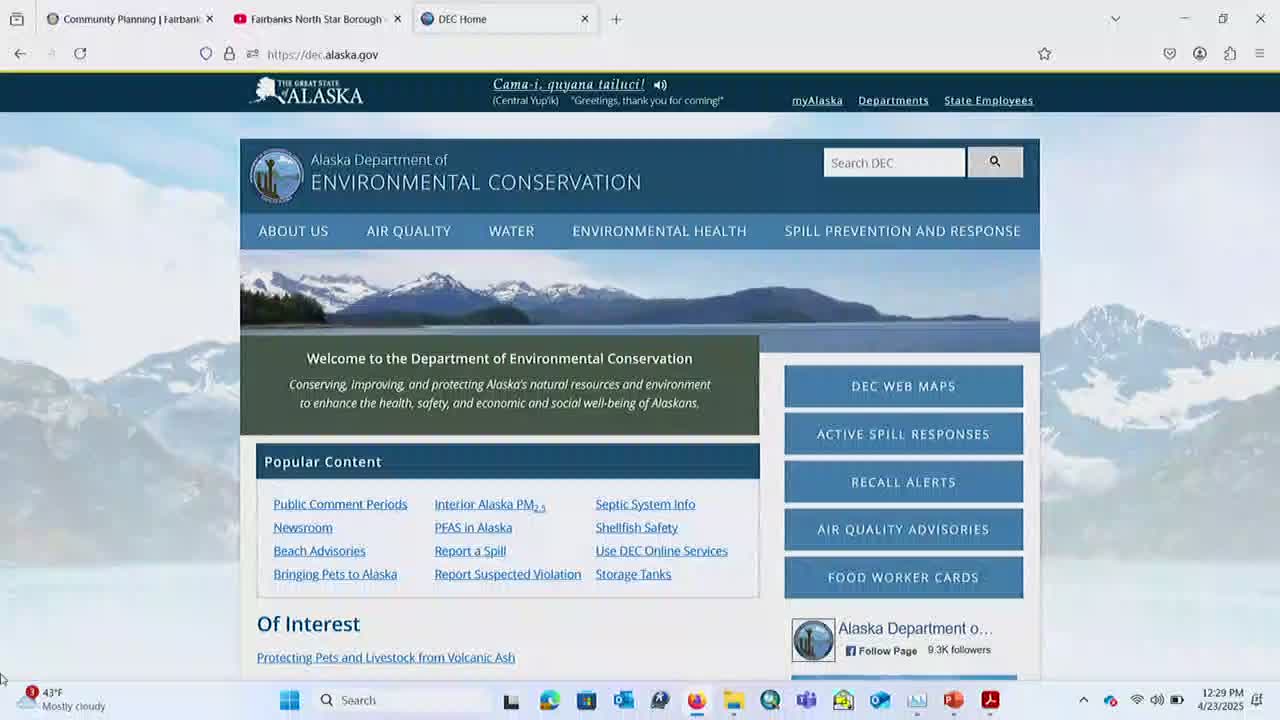
Robert Burgess, a representative of the Alaska Department of Environmental Conservation’s Contaminated Sites Program, told the Chena Riverfront Commission on April 23 that DEC maintains a public web map showing active and closed contaminated sites along the Chena River and its tributaries.
The map shows clustered groundwater plumes near Fort Wainwright, historic dry‑cleaning solvent plumes downtown, a sulfolane plume from the North Pole refinery and isolated PFAS detections around the Fairbanks Airport training area and Peggar Lake. Burgess said the map helps users identify active sites, mapped groundwater plumes and documents attached to each site.
“PFAS...it’s very difficult to break down PFAS. It’s just a hard bond to break,” Burgess said, explaining why PFAS persists in soil and water and why aqueous film‑forming foams (AFFF) used historically at airports and training pits are a common statewide source.
Burgess described the DEC site classification symbols used on the web map: diamonds for active sites, yellow squares for cleanup complete sites and red stars for sites that are cleanup complete but closed with institutional controls. He said institutional controls often take the form of an environmental covenant recorded under the Universal Environmental Covenants Act (UECA) to limit exposure and spell out landowner responsibilities.
Commissioners asked about the degree to which plumes reach the Chena River and whether aquatic life is affected. Burgess said DEC and responsible parties use groundwater monitoring, private water‑well sampling and pore‑water or sediment sampling to assess migration to surface water. He said private wells affected by the Fairbanks Airport PFAS plume were offered hookups to Golden Heart Utilities and that, in most cases, DEC did not find drinking‑water action‑level exceedances except for one private well on Tall Spruce Road that did exceed the action level.
DEC staff noted that pore‑water sampling methods vary—cores can be squeezed, or passive samplers can be left in sediments—and that PFAS pore‑water methods are still evolving. Burgess pointed commissioners to dec.alaska.gov and DEC’s contaminated sites web map for documents and reports and offered to return with more detailed, site‑specific information.
Burgess also said federal and industry funding has supported recent work at the Fairbanks Airport: the FAA provided a matching grant for remediation completed the previous summer that included removal of training‑pit water and use of a destructive PFAS treatment technology (hydrothermal alkaline liquid treatment, HALT). He encouraged commissioners to contact DEC with follow‑up questions at robert.burgess@alaska.gov.
The commission did not take formal action on DEC materials at the April 23 meeting; Burgess said he could return with targeted analyses or additional documentation if the commission requested it.