Get Full Government Meeting Transcripts, Videos, & Alerts Forever!
Get email alerts on the Distilling topic
No spam. Unsubscribe anytime.
Author traces Washingtonstate distilling history, links colonial roots to modern craft boom
Summary
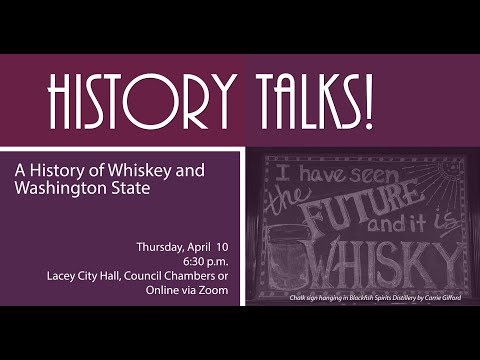
At an April History Talk at the Lacey Museum, author Becky Garrison outlined the history of distilling in the Pacific Northwest, from early Hudson's Bay Company operations through Prohibition-era bootlegging to the recent growth of craft distilleries in Washington.
Becky Garrison, an author and journalist, traced the history of distilling in Washington state during an April History Talk at the Lacey Museum, describing how spirits shaped settlement, commerce and contemporary craft production in the Pacific Northwest.
Garrison told the audience the region's distilling story begins with early 19th-century commercial operations and home production, moved through a violent and adulterated Prohibition-era underground, and has re-emerged as a craft sector in the 21st century with distinct Pacific Northwest styles.
Garrison framed the history around three through-lines: the practical role of spirits in frontier commerce and preservation; public-health and regulatory responses to adulterated products; and the cultural and economic revival represented by modern craft distilleries.
She cited an early instance of distilling in what is now Washington state when, in 1833, the Hudson's Bay Company built a distillery at the site of Fort Vancouver. Garrison said archaeological finds from Fort Vancouver have included barrels, taps and copper tubing and that bottles were common in the site's reconstruction records.
Using national examples for context, Garrison described colonial-era production (including a large distillery operated by George Washington, which she said produced about 10,500 gallons of rye along with fruit brandies) and the shift westward where spirits became portable currency for trappers, traders and settlers. She quoted Mark Twain's observation that whiskey often preceded the other trappings of "civilization."
Garrison outlined the health and safety problems of early frontier spirits, describing widely circulated nicknames such as "rotgut," "bug juice," and "coffin varnish," and she noted how some illicit products contained dangerous contaminants, including methanol. She said those public-health problems prompted federal and state reforms such as the Bottle and Bond Act (1897) and the Pure Food and Drug Act (1906), and referenced a 1909 Taft-era legal definition effort for whiskeys.
On the Prohibition era, Garrison put key dates on the record used in her talk: a wave of local "dry" laws in Washington in the early 20th century, a near-statewide dry status into 1916, and national prohibition from Jan. 17, 1920, to Dec. 5, 1933. She described the Pacific Northwest experience as less gangster-driven than in some eastern cities: bootlegging there at times resembled organized commerce, and Garrison cited the case of Seattle bootlegger Roy Olmstead (whose office is on display at Smith Tower) as an example of a prominent local operator.
Garrison described smuggling methods used in the region, including small boats and, later, aircraft flown to and from Canada. She said enforcement was uneven and that enforcement squads sometimes staged performative raids while the wider trade continued.
Shifting to the post-Prohibition regulatory era, Garrison described the creation of state controls such as the Washington State Liquor Control Board and a three-tier system separating production, distribution and retail. She said some early state-controlled distilling operations existed but that commercial distilling as a craft industry did not reappear in any sustained way until Dry Fly opened in February 2007. She said a 2008 change in state law helped expand the number of licensed distilleries in Washington.
Garrison gave a contemporary estimate, noting the count of active Washington distillers is fluid: "approximately 75," she said, while acknowledging that some licenses are issued but never used and that closures occurred after the COVID-19 pandemic.
She described current craft trends in the region: experimentation with specialty grains and wort-brewing techniques that emphasize flavor over yield, the emergence of American single malt as a category (with distillers such as Westland and Clear Creek called out), and a focus on terroir and environmental practices. Garrison cited Copper Works and other Northwest distillers as innovators and noted projects tying distilling to local histories, such as a Bainbridge Island whiskey project connected to Japanese American incarceration history.
Garrison also discussed workforce and training developments: she pointed to the new two-year brewing, distilling and cider-making program at South Puget Sound Community College and said home distilling remains illegal in the U.S. (home brewing and home winemaking were legalized in 1979, she said). She noted increased participation by women in training programs and in distilling work.
Throughout the presentation, Garrison emphasized that women were historically central to home distilling and that women today are prominent among craft distillers. "Women were the first craft distillers in the United States," she said during the talk.
Garrison closed by noting economic pressures on the industry: post-COVID changes in consumption and a number of recent closures and restructurings, which she said have made the sector more precarious even as new styles and producers continue to appear.
The program at the Lacey Museum concluded with a question-and-answer session attended by in-person and online participants; museum staff reminded attendees about sign-in and upcoming events, and the museum said it is preparing a move to the Belltown Center on Sixth Avenue and will continue to operate the Russell House site as a research center.
Ending: The presentation combined historical sources, oral histories and local case studies to trace how distilling shaped and reflected economic, social and regulatory change in Washington state; Garrison encouraged continued research on understudied effects, including the impact of alcohol on Indigenous communities during early commercial trade and frontier expansion.