Get Full Government Meeting Transcripts, Videos, & Alerts Forever!
Get email alerts on the Land Use Zoning topic
No spam. Unsubscribe anytime.
Planning commission approves five-year special-use permit for Keith Storage Yard in Chandler Heights
Summary
The Maricopa County Planning and Zoning Commission on April 10 approved a five-year special-use permit allowing limited outdoor storage of empty roll-off bins and parking of up to seven commercial trucks at 17442 E. San Tan Boulevard in the Chandler Heights area, subject to revised conditions addressing screening, hours and access.
The Maricopa County Planning and Zoning Commission on April 10 approved a five-year special-use permit allowing a limited storage yard for empty roll-off bins and parking for commercial trucks at 17442 East San Tan Boulevard in the Chandler Heights area.
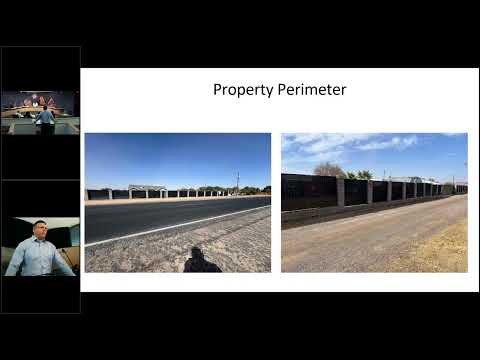
The permit, SU240008 — known in the record as Keith Storage Yard — was recommended for approval by county planning staff with conditions (a through o, including revised stipulations j and l). The approval limits the site to storage of empty roll-off bins and a defined number of commercial vehicles, requires visual screening or masonry wall, and calls for county review of access because the western driveway was originally permitted for residential use.
Darren, planning staff, told the commission the request is for an interim industrial use on a 1.8-acre site in the RU-43 zoning district and that the recommendation was approval subject to the listed conditions. Bridal Ray, the applicant’s representative, described a detailed site plan and narrative and said the operation would not accept or store household garbage: “There is no on-site compaction that takes place … he does not bring garbage back to the site.”
Neighbors who spoke at the hearing gave mixed accounts. Richard Moss, who said he shares the longest common boundary with the property, voiced support: “I judge my neighbors on three criteria. First would be smell. There is no discernible offensive aroma whatsoever wafting up their property.” Patrick Cardez, identified as Mike Keith’s business partner and day-to-day operator, said the business hires locally and typically finishes work by midafternoon: “We don’t operate on the weekends … we’re done by 03:00 most days.”
Opponents raised concerns about noise from trucks, backup beepers and on-site activity. Sally Skirball, who said her property backs onto the site, described construction of a large structure and said she has heard banging and other activity: “The business does create noise and it does disrupt my lifestyle on my RU-43 zoning district … I am strongly opposed to their continued use.” Devony Kelsh, whose property shares the driveway to the rear of the site, asked whether trucks would use the private driveway and noted uncertainty about what might happen if the property changed hands.
On access and operations, Ray said primary access would be from San Tan Boulevard but that circulation sometimes uses the easement on the east side; he added the large roll-off containers are not stackable. Darren told the commission the western driveway’s change of use must be evaluated by the county transportation group (TISMO) and that the applicant must satisfy any requirements within six months of board action. Darren also clarified zoning runs with the land and the approved SUP is limited to five years, and that if the use is discontinued or abandoned the SUP would cease.
Commissioners debated noise and access but supported the permit and the conditions placed on it. Commissioner Layton moved approval; Chairman Lindblom seconded. The motion carried by roll-call vote, recorded as 6–0 in favor.
The SUP includes specific operational limits in the county’s conditions of approval: storage of empty roll-off bins only, limitations on on-site assemblies and repairs, visual screening or masonry wall as required, limits on hours of operation, and a requirement that the owner address any access modifications requested by county transportation review. The commission’s five-year permit will require renewal if the use continues beyond that term.