Get Full Government Meeting Transcripts, Videos, & Alerts Forever!
Get email alerts on the Community Development topic
No spam. Unsubscribe anytime.
Graham County holds initial public hearing on roughly $291,000 in CDBG funds; officials seek project ideas
Summary
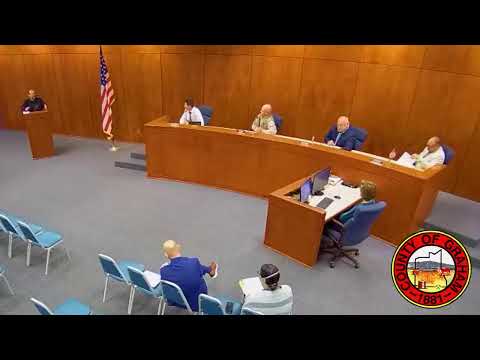
At the Feb. 3 Graham County Board of Supervisors meeting, County Manager Dustin Welker and consultant William Osborne held the initial public hearing required for Community Development Block Grant (CDBG) funding allocated to Graham County — roughly $290,000 — and asked residents and local officials to identify shovel-ready housing, infrastructure and community projects.
At the Feb. 3 Graham County Board of Supervisors meeting, County Manager Dustin Welker and consultant William Osborne led an initial public hearing on Community Development Block Grant (CDBG) funds available to Graham County — roughly $290,000 to $291,000 in the county rotation — and invited residents, towns and agencies to propose projects for the county to consider.
County Manager Dustin Welker said, "This grant comes through CDBG ... it's a set amount, dollars 290,000, dollars 2 hundred and 90 1 thousand, I think, this year." He told the board that the grant is subject to federal requirements and is typically used for housing, infrastructure, accessibility and community facilities serving low- and moderate-income residents.
William Osborne, a consultant working with SEAGO, said the hearing is part of the formal process the county must follow to document community participation. "We need to hear from you and the community what ideas for potential projects that the board of supervisors could consider," Osborne said. He said items not raised in this initial hearing must be added at a future published public hearing to be eligible for the county's resolution of application.
Osborne outlined how CDBG funding is distributed in Arizona: the Arizona Department of Housing (ADOH) allocates a regional account to councils of government (SEAGO for this region), and Graham County is in a rotation that makes it eligible for approximately $290,000 in the current cycle. He described several program types that can qualify, including street and sidewalk improvements, water and sewer projects, community facilities and parks, public services (childcare, job training, health and substance-abuse services), and owner-occupied housing rehabilitation. He noted that some competitive pots exist (for example, colonia grants and state special projects) and that applications and scopes must be shovel-ready for certain awards.
Osborne and Welker described additional constraints and requirements the county must consider: federal environmental review and, for construction projects over federal thresholds, Davis-Bacon prevailing-wage requirements. Osborne said that owner-occupied housing rehabilitation programs may now be eligible even if a property lies in a FEMA floodplain provided the project does not expand a dwelling's footprint.
The hearing included public suggestions and local priorities. Comments and ideas recorded during the session included street improvements (Twentieth Avenue, Willie's Way, Forty-Third Street area), fairgrounds parking and utilities, shoulders or chip-seal for Hot Springs Road (near Eden/Fred Webb subdivision), pedestrian safety and lighting along Ray Lane and Golf Course Road exercise paths, additional picnic tables and playground upgrades at county parks, filling and repurposing the lower pond at a local park (including a potential pickleball court), and improved pedestrian crossings or warning signals on exercise-path crossovers.
Osborne said timeline guidance is that a resolution to apply is typically adopted by April 1 and applications are usually due in August, but he encouraged the board and community to continue submitting project ideas in writing. He and SEAGO staff offered to receive written project suggestions and publish them ahead of the next public hearing to help shape the county's resolution of application.
Next steps: county staff and SEAGO will accept written project proposals from the public and local agencies, circulate a list of candidate projects before the next hearing, and schedule subsequent public hearings where the board would adopt a resolution to apply for specific CDBG projects.