Get Full Government Meeting Transcripts, Videos, & Alerts Forever!
Get email alerts on the Economic Development Housing topic
No spam. Unsubscribe anytime.
Coconino County draft plan draws debate over tourism, rural industries and housing
Summary
County staff presented the draft "Resilient Economies + Housing" chapter; participants pressed for stronger language on supporting ranching, forestry and local production, asked for clearer housing definitions and flagged short-term rentals and second homes as drivers of local housing costs.
Coconino County staff and community members spent the meeting reviewing the draft Resilient Economies + Housing chapter of the county’s comprehensive plan, focusing debate on tourism’s economic dominance, support for ranching and forest-based industries, workforce retention and housing affordability. John Solstol, the economic development director of Coconino County, and county planning staff summarized the chapter and solicited edits and policy priorities.
The discussion centered on three themes: (1) tourism and second homes vs. local production, (2) rural economies and natural-resource industries, and (3) housing policy and tools. Several participants urged the county to more explicitly recognize and support production industries—ranching, timber and native-plant-based enterprises—alongside tourism, which many said dominates local employment and land-use pressures.
Why it matters: participants said the chapter will guide policy and land-use decisions that affect housing supply, workforce retention and management of large private and public lands. Multiple speakers warned that an economy driven primarily by second-home buyers and discretionary tourism can depress wages and limit housing availability for long-term residents and workers.
Most urgent points - Tourism and second homes: Staff flagged recent coverage showing higher-than-average second-home demand in areas including Flagstaff; a speaker noted the county’s second-home market averages about $796,000, and several participants said those dynamics contribute to high housing costs and low retention of younger workers. - Support for rural industries: Committee members pressed for stronger language and data on ranching, forestry and natural-product economies (pine nuts, native-plant products, timber/lumber). Jim Parks proposed adding explicit recognition of “Adobe, rammed earth, straw bale, traditional log, and native stone” as encouraged alternative building methods; he also offered statewide agriculture impact figures for inclusion. - Housing clarity and workforce retention: Commenters, including local employers, described staff turnover tied to housing costs and long commutes. Participants requested clearer definitions in the chapter for “affordable,” “attainable” and “workforce” housing and recommended moving those definitions to the start of the housing section. - Short-term rentals and second homes: Staff said the draft already includes a short-term rental count ("right around 970"), and speakers asked for clearer policy direction; staff noted state law limits local authority to cap the number of short-term rentals or their frequency, but local registration and permitting remain tools for tracking them. - Rural planning areas (RPAs) and transfer tools: Staff confirmed the county currently has one rural plan area (Diablo Canyon) and nine area plans overall and suggested the document could highlight RPAs as a tool. Staff also noted that state statute allows transfer of development rights to municipalities, which some speakers identified as a possible mechanism to protect working landscapes while enabling housing growth in towns.
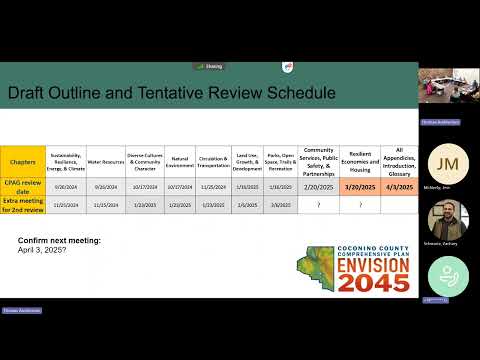
Supporting details and follow-up requests - Data requests: Reviewers asked staff to clarify several data points in the chapter, including whether large dollar figures shown are county-specific or statewide, and to provide context for forestry sector numbers cited from conservation sources. - Opportunity zones: A reviewer asked staff to check the Department of Commerce database on opportunity zones (designated by census tract) and summarize local tracts and investment activity. - Implementation plan and next steps: Staff said the chapters will be packaged into a full draft for the required 60-day public review and public hearings later this spring/summer; the committee agreed to reschedule the next meeting to April 3 to review appendices, the glossary and the implementation plan, and to help draft implementation strategies.
No formal policy decisions were adopted at this meeting; the session produced several requested edits, data follow-ups and a scheduling direction to staff.
Ending: Staff asked participants to submit written follow-up where appropriate (for example, Jim Parks offered to send data and suggested text on agriculture and building materials). The committee will review a combined draft ahead of the 60-day public review and reconvene as needed to respond to public comments.