Get Full Government Meeting Transcripts, Videos, & Alerts Forever!
Get email alerts on the Emergency Services Budget topic
No spam. Unsubscribe anytime.
Cochise County work session: emergency services budget could shift to general fund if federal grants are cut
Summary
At a Cochise County Board of Supervisors work session in the Supervisors' Hearing Room in Melody Lane, Emergency Manager Dan DeShawn outlined a proposed fiscal year 2026 emergency services budget totaling $465,394 and cautioned that federal grant reductions could force the county general fund to pick up more recurring costs.
At a Cochise County Board of Supervisors work session in the Supervisors' Hearing Room in Melody Lane, Emergency Manager Dan DeShawn outlined a proposed fiscal year 2026 emergency services budget totaling $465,394 and cautioned that federal grant reductions could force the county general fund to pick up more recurring costs.
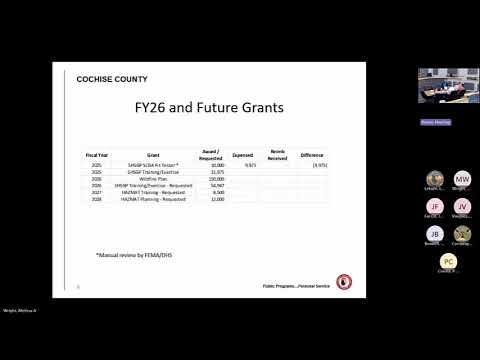
DeShawn told supervisors the Emergency Management Performance Grant (EMPG), which has historically required a roughly 50% local match, is under manual review and that the county is planning for a possible 10% cut this year. "We won't get our actual award until May or June," DeShawn said, adding that the grant program's language emphasizes "these funds are to be used to build capacity, not necessarily maintain that capacity." He said multiple FEMA and Department of Homeland Security reviews are affecting state and local awards.
The budget presentation described a mix of grant-funded and general-fund-supported items. DeShawn said that under the proposal the general fund share would be about 58 percent while grant matches would be closer to 42 percent. He identified the FY2026 total as $465,394 and said the general-fund total shown in the packet is $293,000; the packet also lists grant reimbursement revenue and examples of past one-time projects such as radio maintenance at CECOM.
Staff and supervisors pressed for clarity on how much the county would need to cover if EMPG or other grants were reduced or eliminated. One supervisor summarized the exposure by saying, "You have to pick all of it up," if grant reimbursement ceased. DeShawn walked through the math offered in the packet: personnel costs of about $226,000 are included in the total, and the packet shows roughly $1.16 million in grant revenue figures used to offset some costs in the broader budget documents; when asked, DeShawn said the immediate net impact to the general fund if the primary grant were lost would be about $147,000 based on the figures presented in the packet.
DeShawn also described several planned and potential grants: a recurring training-and-exercise grant (about $21,975 recurring in one line), two hazmat planning/training grant requests in 2027 and 2028, and a community wildfire protection plan (CWPP) contract that staff described at different points in the discussion with inconsistent dollar figures in the packet. At one point the packet shows a $50,000 one-time grant for the CWPP; later in the discussion staff said $150,000 is budgeted for GIS and contractor work to produce the CWPP and that the board previously approved the agreement with a 90/10 grant-to-general-fund split. Because the transcript contains conflicting figures for that CWPP line item, the precise contract amount is not specified in the meeting record.
Supervisors and staff also discussed staffing: DeShawn said the emergency management office currently has two staff members. Both positions have historically been funded roughly 50/50 with grant and general-fund dollars; if grant revenue declines, the county would need to determine whether to reassign or fully fund those positions from the general fund. DeShawn said staffing structures and GL (general ledger) organization are being considered so the county can separately track grant-funded and general-fund expenditures.
DeShawn reviewed recent uses of grant funds, including radio maintenance and short-term projects such as PPE and emergency plans, and noted some grants have already been canceled at higher levels. He said exercises are conducted several times a year in the county, ranging from tabletop exercises to full functional drills that have included hospitals, dispatch centers and active-shooter training with role players.
No formal motions or votes were recorded during the work session. Supervisors requested clearer figures for the budget packet and noted the county typically receives EMPG award notices in May in a normal year, but staff warned this year is atypical and that timing and amounts are uncertain.
DeShawn and staff said they will return with clarified budget documentation and await the federal and state grant award notifications before the board makes final budget decisions.