Get Full Government Meeting Transcripts, Videos, & Alerts Forever!
Get email alerts on the Housing Authority Budget topic
No spam. Unsubscribe anytime.
Cochise County housing authority presents budget showing small shortfall; no action taken at work session
Summary
At a Cochise County Board of Supervisors work session, housing authority representative Anita Baca reviewed a HUD-funded budget that projects a $6,001.24 deficit, described funding sources and reserve rules, and outlined possible cuts to training; the board discussed but took no formal action.
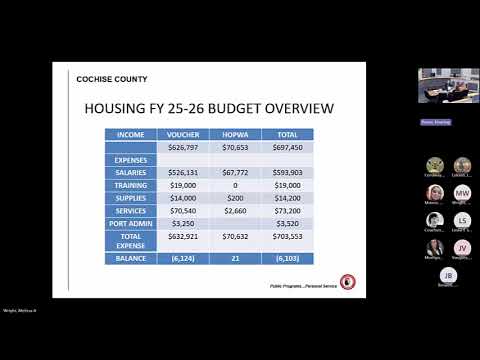
At a Cochise County Board of Supervisors work session in the Supervisor's Hearing Room on Melody Lane, Anita Baca, a representative of the county housing authority, presented the authority's proposed budget and said the authority currently projects a $6,001.24 shortfall for the estimated fiscal year.
Baca said the housing authority is funded primarily by the U.S. Department of Housing and Urban Development and runs multiple voucher programs, including tenant-based rental assistance, Section 8–style vouchers, emergency housing vouchers, special-purpose vouchers and HUD-VASH. "The voucher programs are, are under an annual contributions contract," Baca told the supervisors, saying funding levels are set by HUD based on prior-year leasing and reconciled quarterly.
The nut of the issue, Baca said, is federal funding and lease-up levels. She described an administrative budget projection of $626,797 and an HOPWA (Housing Opportunities for Persons With AIDS) award estimated at $70,653; together these figures feed the authority's operating budget. She said the authority's software and a third-party accountant (identified in the presentation as Lindsay MRI company) manage tenant records, inspections and monthly and annual reporting to HUD. "Our software, our accountant and our software also submit our annual and monthly reports to HUD by the due dates," she said.
Baca described line-item breakdowns included in the packet: salaries, training (noting much training is out of state), supplies, services (which include accounting, audits, phone charges and two field cell phones), portability administrative fees when vouchers move to other jurisdictions, and county overhead for payroll and related services. She said the authority currently uses Bank of America accounts that HUD has approved and that HUD is reviewing how to invest reserves above a $500,000 threshold; the authority presently holds just under $1.5 million in reserves.
To close the gap in the projected budget shortfall, Baca said the authority has contingency funds and would prefer to avoid cutting training if possible. She told the board the most likely reductions would come from the training line item and emphasized that lease-up increases boost HUD funding: "As our lease up increases, it's a win win because we get to administer as many vouchers as we possibly can ... and as a result, our funding also goes up from HUD," she said.
Supervisors asked clarifying questions about reimbursements and county accounting. Baca explained that the county pays payroll and invoiced costs are then charged to the appropriate grants; the housing authority reimburses the county. She said the authority typically submits reimbursements within one month and no more than two months after invoicing.
No formal motions or votes were taken on the budget during the work session. The presentation concluded and supervisors moved on; the board's next regular meeting was announced for April 22 at 10 a.m., covering the library, flood, jail districts and a regular supervisors session.
Notes: this account is based on the work-session discussion; the transcript contained several numeric line-item figures that were unclear or partially garbled; figures in the budget text above reflect the amounts stated on the record where they were intelligible.