Get Full Government Meeting Transcripts, Videos, & Alerts Forever!
Get email alerts on the Solid Waste topic
No spam. Unsubscribe anytime.
Cochise County details solid‑waste revenue, closure fund and recycling practices
Summary
Public works staff told the Cochise County Board of Supervisors that solid‑waste operations generate most tipping‑fee revenue, that state law requires a dedicated landfill‑closure fund, and that recycling and metal recovery reduce landfill airspace and tipping fees.
Jason Fazio, Cochise County public works director, briefed the Board of Supervisors on the county’s solid‑waste funds and operations, saying statutory requirements and market sales shape revenues and long‑term obligations.
Fazio said the county holds a landfill closure fund required by state law to cover monitoring and maintenance after a landfill closes. “This is one of those statutes that we have to put money away so that we can care for the landfills, indefinitely,” he said, explaining a study sets the annual contribution to ensure long‑term care.
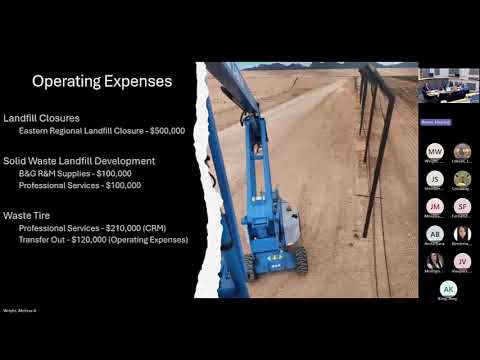
The county’s budget presentation lists a landfill‑closure amount of about $3,320,000 and a solid‑waste landfill‑development line of about $2,000,000. Fazio described those as statutory and planning reserves: the closure fund to meet auditor and statutory liability calculations and the development fund to preserve capacity for future cells.
Fazio also outlined revenue sources for solid waste operations: tipping fees collected at scales, a portion of local half‑cent sales tax, and the sale of recyclables and scrap metals. He said recycling revenue is often modest on a per‑ton basis but provides value by preserving landfill “airspace” — the county’s capacity to accept waste — which has a higher effective value when used for refuse rather than low‑value recyclables. “If we save that airspace, basically, we’re saving money or generating money at that point,” Fazio said.
State funding supports the county’s waste‑tire program. Fazio said the program pays for handling and for a private contractor that hauls tires for processing in Phoenix; the county’s budget item covers operating costs and the contractor’s hauling fees.
On expenses, Fazio said the closure fund line includes a liability calculation set with auditors and finance — including small shares for methane and water testing — and the development fund supports transfer‑station upkeep and contracted building work. He noted operating leases in the solid‑waste budget largely cover site printers and porta‑toilets at rural transfer stations and a modest land lease for one site in San Simon.
Fazio described capital plans for solid waste including a walking‑floor trailer to improve hauling efficiency to Tucson recyclers, and a planned engine rebuild for a large landfill scraper to extend its life. He said the county hauls roughly 80,000 to 83,000 tons a year through its system and ships several thousand tons of metals and cardboard to Tucson to reduce landfill volumes.
The county’s solid‑waste superintendent and staff will continue to develop details for specific projects and to meet with supervisors individually on request.