Get Full Government Meeting Transcripts, Videos, & Alerts Forever!
Get email alerts on the Children Youth Families topic
No spam. Unsubscribe anytime.
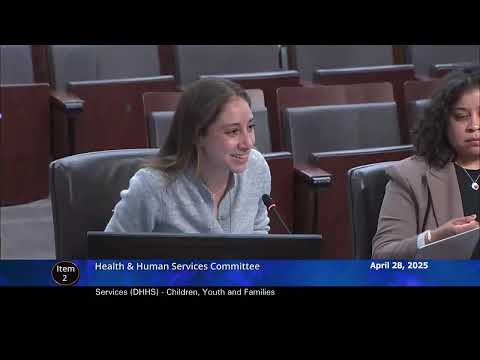
DHHS outlines FY26 Children, Youth and Families priorities: youth safety, kinship expansion and eligibility gains
Summary
The DHHS Children, Youth and Families team presented FY26 budget items emphasizing a youth safety initiative, child welfare gains (kinship placements and adoptions), and Office of Eligibility's progress on program compliance and digital outreach; Treehouse Child Advocacy Center reported elimination of its trauma therapy wait list.
Montgomery County Department of Health and Human Services (DHHS) leaders briefed the Health and Human Services Committee on FY26 recommendations and program changes across Children, Youth and Families (CYF), highlighting a youth safety initiative, progress in child welfare permanency, and improvements in eligibility and enrollment systems.
DHHS Director Dr. James Bridgers and Acting Chief Lori Garibay Aquino described CYF's two operational buckets: school- and community-based services (positive youth development, early childhood, school-based services) and social services (child welfare, eligibility and support services). The county executive recommended an approximately $12.9 million (10.2%) increase for the whole service area; the packet shows staff increases and two recommended reductions tied to leveraging state contracts instead of county funds.
On youth safety, DHHS emphasized four priorities from its review: create a unified data source or interoperable dashboard, implement interagency client coordination, catalog and publish safe spaces for youth, and consider a youth resiliency steering committee or dedicated office. Dr. Bridgers and others said data-sharing and confidentiality are major constraints that must be addressed through long-term interagency agreements.
Child welfare staff reported several measured gains in FY24'FY25: an increase in permanency outcomes (guardianship/adoption), 33 adoptions finalized in FY25, and a substantial rise in kinship-home approvals (from 10 to 39 newly approved kinship homes). Child Welfare reported that 51 kinship homes are currently hosting 99 youth and that kinship placements now account for roughly half of youth placements in out-of-home care. Staff discussed a fellowship partnership with the University of Shady Grove that provided stipends (approximately $20,000 per year per fellow) and yielded several hires.
Child Welfare aims to raise kinship placements from 25% to 50% over five years and to increase permanency through reunification, adoption and guardianship within 24 months of entry from 30% to 50%.
Office of Eligibility and Support Services (OESS) staff described compliance improvements after pandemic-era disruptions: Maryland's application processing and redetermination timeliness have improved, and the state now ranks high in compliance. OESS highlighted the community digital platform with more than 500 participants and a Community Connect portal that consolidates programs including Care for Kids and Senior Dental. OESS described plans to expand outreach, improve application processing and reduce error rates, and to deepen stakeholder partnerships and staff training to improve retention.
Charlie Regan, Executive Director of the Treehouse Child Advocacy Center, told the committee that a combination of county support and an added forensic interviewer eliminated the trauma-therapy wait list for most months; the Treehouse now conducts over 90% of forensic interviews in the county and has expanded referral and training partnerships with MCPS, MCPD special victims and health providers. The Treehouse said it had developed the HOPE program, expanded referral criteria and planned additional family advocates and outreach.
Council members asked for follow-up metrics and data: Councilmember Lukey pressed for clarity on how MCPS behavioral health staff would integrate with the youth safety work; Councilmember Sales asked for numbers on how many medical examinations and wellness checks for children taken into care were being completed and for mental-health referral partner details. DHHS agreed to provide more granular numbers and follow-up on interoperability and referral counts.
Council staff noted two executive budget reductions that lean on state contracts: a $42,000 reduction in county post-adoption services in favor of the Maryland Department of Human Services'contracted providers (Center for Adoption Support and Education and Adoptions Together), which will shift roughly eight local referrals into the state contract; and an $826,000 reduction reflecting full state funding for the Summer EBT/Sun Bucks program, which reached roughly 88,000 unique students in mid-2024.
The committee received the presentation and signaled support for the executive recommendations and for follow-up data and coordination sessions with education partners to refine the youth safety and data-sharing plans.