Get Full Government Meeting Transcripts, Videos, & Alerts Forever!
Get email alerts on the Ui Striking Workers Sb916a topic
No spam. Unsubscribe anytime.
Employment Department briefs committee on SB 916 A: unemployment benefits for striking workers, DOL conformity, and estimated fiscal impact
Summary
The Oregon Employment Department briefed the House Committee on Labor and Workplace Standards April 28 on SB 916 A, outlining how UI eligibility, federal conformity and trust‑fund impacts would be handled if the bill allowing some striking workers to receive benefits passes.
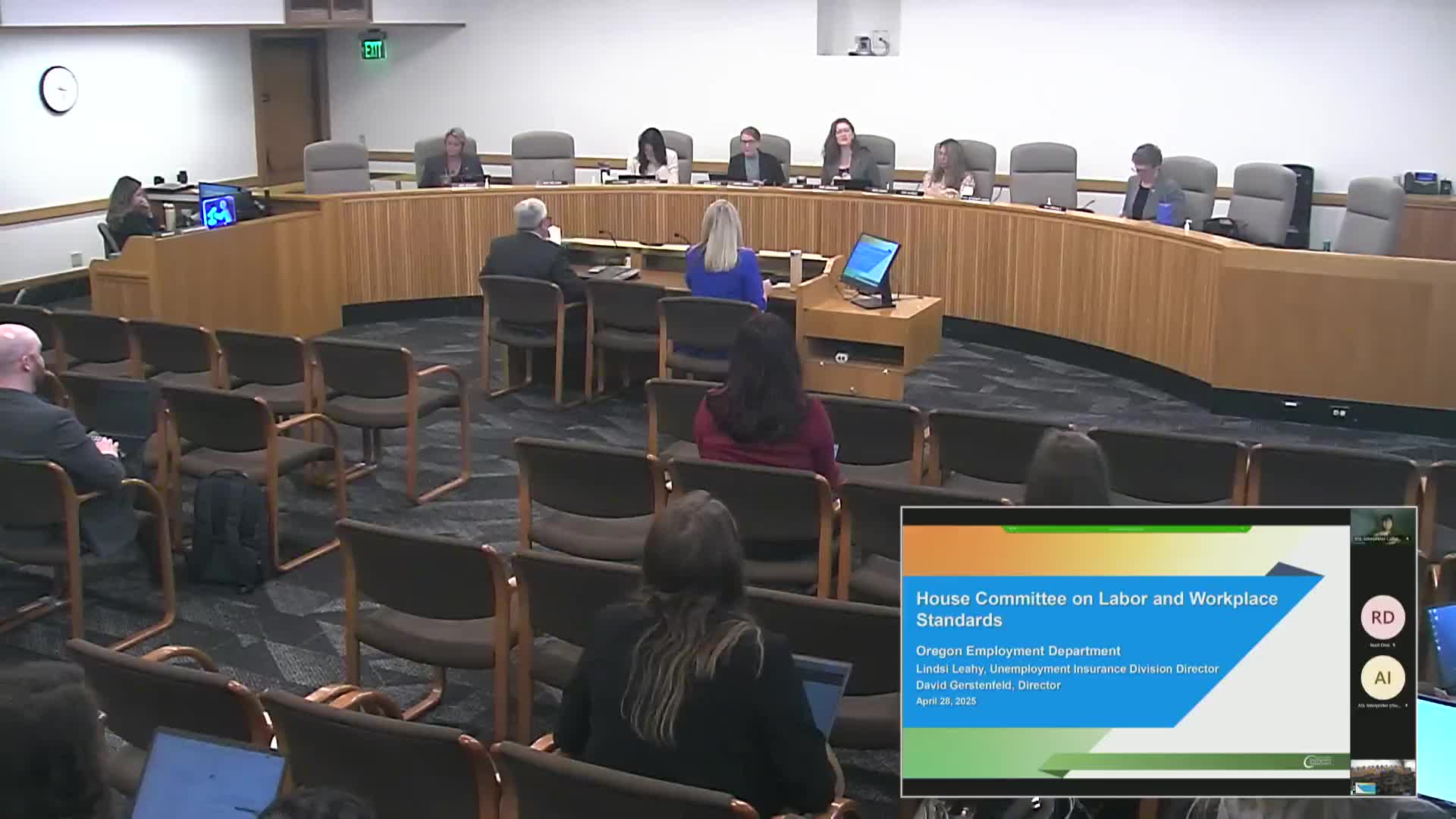
The House Committee on Labor and Workplace Standards held an informational meeting April 28 with the Oregon Employment Department (OED) on Senate Bill 916 A, which would allow certain striking workers to claim unemployment insurance (UI) benefits while a strike continues, subject to weekly eligibility requirements and an expectation of return to employment.
OED officials Lindsay Leahy, Unemployment Insurance Division director, and David Gerstenfeld, director of the Oregon Employment Department, told the committee the department has no formal position on SB 916 A but provided technical analysis about program implementation, federal conformity and estimated trust‑fund impacts.
Key takeaways from the department’s briefing - Eligibility and weekly requirements: To qualify for UI generally, claimants must have sufficient base‑year wages (for example, at least $1,000 or 500 hours in the base year), must not be disqualified for other reasons (quitting without good cause or misconduct) and must meet weekly requirements of availability for work, active work search and ability to accept appropriate work. OED said SB 916 A would not change those fundamentals; it would instead tailor what “available” and “actively seeking work” mean for striking workers who intend to return to their jobs. - Federal conformity: OED said the state has flexibility to define “actively seeking work” in special circumstances. The department shared the bill with the U.S. Department of Labor and received an informal, nonbinding written response indicating the DOL did not see a conformity problem; OED noted the DOL only issues a definitive review after legislation is enacted. Staff referenced historical precedent (New York law upheld in a U.S. Supreme Court decision) and a 1979 DOL letter in their informal conversations. - Timing and benefits sequence: OED outlined a typical timeline if the bill becomes law (the department said the statutory effective date in the draft is Jan. 1, 2026). A striking worker would be disqualified for the first strike week, serve the standard waiting week in the second week of the strike and begin receiving benefits in the third week if otherwise eligible. Claimants must still meet weekly eligibility standards each week they claim. - Back pay and overpayments: If a striking worker later receives back pay for the strike period, OED said those UI payments would be treated as non‑waivable overpayments. OED described collection tools available—offsets against future UI benefits, bank and wage garnishment, interception of tax refunds and third‑party collection—and said those tools are part of the agency’s existing collection practice. For tax‑paying employers, benefits paid during strikes would affect employer experience ratings unless the benefits are later collected as overpayments; for reimbursing employers, OED would seek dollar‑for‑dollar reimbursement when overpayments are collected. - Estimated fiscal impact on the UI trust fund: OED provided two historical “look‑back” scenarios to estimate the potential fund impact. Using a 10‑year historical average (assumptions: average strike duration 8.6 weeks; 888 employees on strike each week; 55% tax‑paying employers/45% reimbursing), OED estimated a trust‑fund loss of about $2.6 million over the 2025–27 biennium and roughly $2.1 million billed to reimbursing employers over the same period. Using a three‑year recent average (assumptions: average duration 6.3 weeks; 2,805 employees on strike each week; 47% tax‑paying/53% reimbursing), OED estimated a trust‑fund loss of about $5.3 million over the 2025–27 biennium and about $5.9 million billed to reimbursing employers. OED said both scenarios would have a negligible impact on the trust fund adequacy ratio (roughly 0.04%–0.08% of the current fund balance in their models).
Department clarifications and implementation points Leahy and Gerstenfeld emphasized several practical points for committee consideration: - The department will define what “available” and “actively seeking” mean for striking workers who intend to return to their jobs and will solicit public feedback on that definition if the bill passes. - OED already handles special weekly requirements for temporarily laid‑off workers and union‑dispatch situations; the striking‑worker adjustments would be implemented through similar mechanisms. - Overpayments caused by later back pay are handled through the department’s existing processes; OED said it can pursue active collections if necessary and that recovered amounts can be credited back to employer accounts (particularly reimbursing employers) once collected. - Tax matters and employer experience ratings: benefits paid during a strike are charged in the usual way to a tax‑paying employer’s experience rating; if back pay is later paid and UI benefits are recovered, OED said those recovered UI amounts would not be used to charge an employer’s experience rating.
Why it matters SB 916 A attempts to reconcile two competing interests: access to income for workers during prolonged bargaining while preserving the integrity and solvency of the UI trust fund and federal conformity requirements. The department’s modeling suggests limited fiscal risk to the fund under historical assumptions, but OED cautioned that the model’s results depend on future strike frequency, duration and the mix of reimbursing versus tax‑paying employers.
Next steps and open questions OED officials said they would finalize operational definitions and stakeholder guidance if the bill passes, and they encouraged public input during rulemaking and implementation. The committee scheduled a longer public hearing on SB 916 A to follow the information session; OED staff were asked to be available for technical questions during that hearing.