
Senate committee hears bill to tax receipts when Oregon-chartered credit unions buy bank business portfolios
Get AI-powered insights, summaries, and transcripts
Subscribe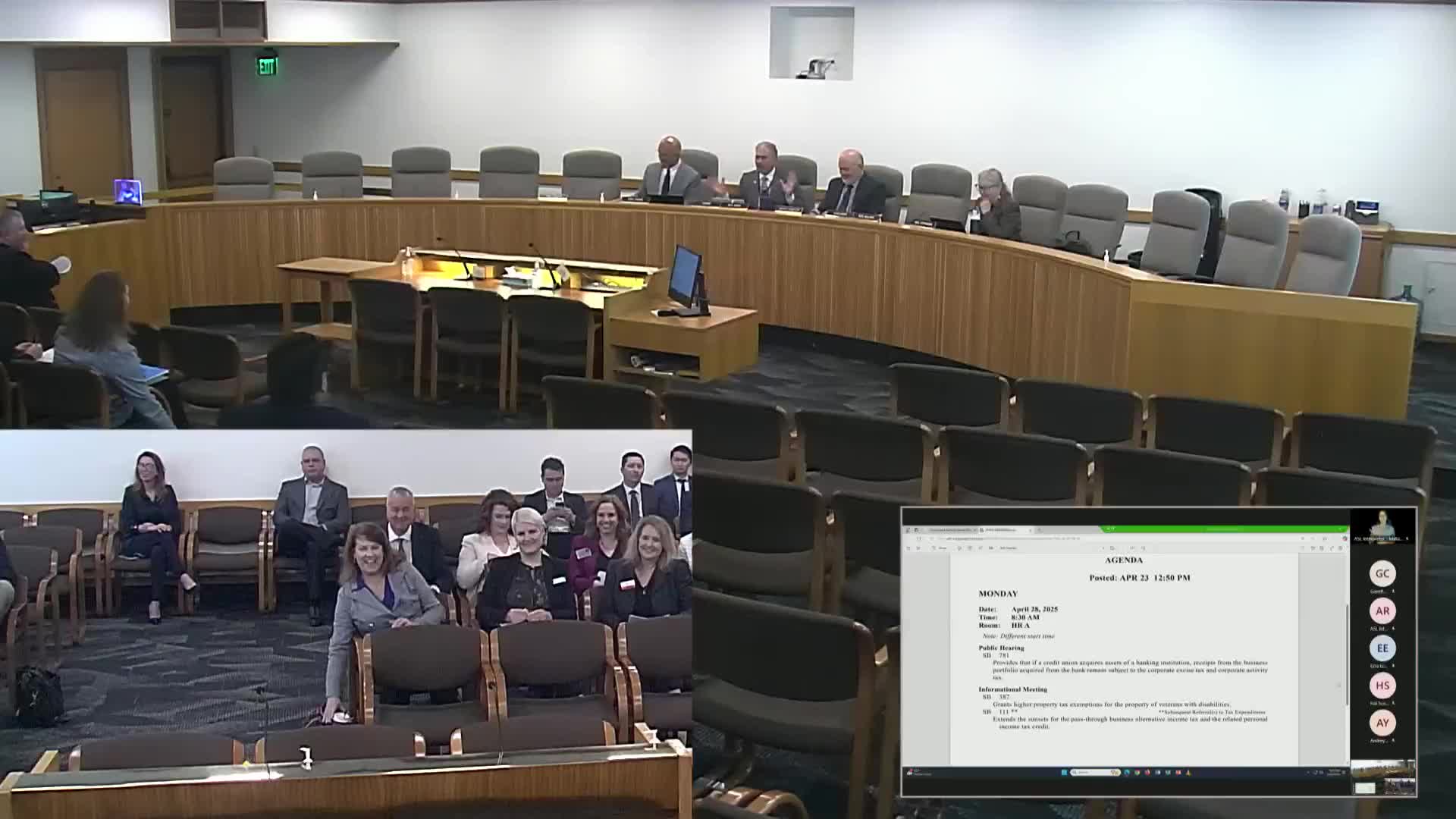
Summary
On April 28, 2025, the Senate Committee on Finance and Revenue opened a public hearing on Senate Bill 781, which would require Oregon‑chartered credit unions that acquire a bank's business portfolio to pay Oregon corporate excise tax and the corporate activity tax on receipts from that portfolio.
On April 28, 2025, the Senate Committee on Finance and Revenue opened a public hearing on Senate Bill 781, which would require Oregon‑chartered credit unions that acquire the business portfolios of banks to pay Oregon corporate excise tax and the corporate activity tax on receipts from those acquired portfolios.
The bill’s sponsors and backers said the change would preserve tax equity and protect community banks; credit unions and allied witnesses said the measure would discourage rare rescue transactions that preserve local services. The hearing included testimony from state lawmakers, banking groups, credit union executives, a national tax policy researcher and attorneys representing credit unions.
Senator Todd Nash (Senate District 29) said the bill grew out of recent purchases in Oregon and elsewhere and concerns that bank income could become permanently tax-exempt after a transfer to a credit union. "There was an announcement that Spokane Teachers Credit Union purchased Community Bank in Northeastern Oregon," Nash said, adding he wanted to ensure the tax burdens on bank portfolios did not disappear during transfers.
Representative Bobby Levy (House District representing Umatilla, Union and Wallowa counties) testified in favor of the bill, saying it "ensures that fairness is maintained in our tax system" by keeping receipts from acquired commercial business operations subject to Oregon's corporate excise and CAT taxes.
Speakers for Oregon banks argued the bill responds to a structural shift in the state’s financial sector. Scott Bruin, CEO of the Oregon Bankers Association, told the committee that Oregon now has 14 state‑chartered banks versus about 50 two decades ago and that "since 02/2007, not a single new bank has started in Oregon." He said credit unions have expanded into commercial lending and in some cases "look, smell, and operate just like commercial banks," creating a competitive mismatch because credit unions are tax‑exempt for core operations.
Trent Wright, director of government relations at Umpqua Bank, said credit unions can often pay higher all‑cash purchase prices than banks and that SB 781 would create a more level field for bank buyers. "There is an impossible scenario when a community bank is for sale for another bank to come in and match a credit union offer," Wright said, arguing the tax change would restore competition.
Credit union witnesses said these acquisitions are uncommon, often rescue transactions that preserve branches, jobs and services in communities losing bank options. Pam Levitt, representing Oregon credit unions and the Go West Credit Union Association, said credit unions serve roughly 2,300,000 Oregonians and employ about 6,500 people in the state. She cited a 2018 purchase by Mid Oregon Credit Union that acquired High Desert Bank (a single branch, about $13,000,000 in assets) to prevent branch closure and preserve service.
Ezra Eckhart, president and CEO of Spokane Teachers Credit Union, said SB 781 "would create a purchase related tax on not for profit credit unions ... as a penalty for acquiring a bank," and warned that the extra cost would be borne by members through higher rates or fees and could push credit unions to convert to federal charters, shifting oversight away from the state without producing additional tax revenue.
Rachel Pross, chief operations officer of MAPS Credit Union, which is under contract to acquire Lewis & Clark Bank, said the acquisition keeps services local, preserves nearly all employees and expands small‑business lending capacity. "Why would we want to discourage this by introducing a bill like SB 781?" she asked.
Other opponents emphasized the cooperative structure of credit unions. Hal Scoggins, an attorney representing the Go West association, said credit unions are not tax‑exempt because of size or product mix but because they do not have shareholders who receive dividends; he argued purchasing bank assets does not change that nonprofit structure.
A national perspective came from Andrei Yushkov of the Tax Foundation, who summarized data showing credit unions nationwide have grown and acquired more than 100 banks over the past decade and noted several states have recently taken steps to prevent revenue loss from similar transactions. Yushkov said state action to preserve corporate tax revenues was a reasonable policy response.
Testimony also included community benefit claims from credit unions: Rob Stewart, president and CEO of OnPoint Community Credit Union, said Oregon credit unions delivered $229,000,000 in direct benefits to members in 2023 and that OnPoint has expanded branch presence in recent years.
The committee did not take a vote. Chair Meek closed the public hearing and moved on to informational sessions on other bills.
What’s next: The committee record will include written testimony and the bill may be scheduled for further work sessions; no formal decision or vote was recorded during the hearing.