Get Full Government Meeting Transcripts, Videos, & Alerts Forever!
Get email alerts on the School Finance topic
No spam. Unsubscribe anytime.
Rowan County Schools previews budget with staff raises, Chromebook replacements and capital repairs
Summary
District staff presented a preliminary 2025–26 budget that would add recurring staff raises, fund instructional materials and technology replacements, and include a contingency reserve; the board moved into a closed session at the end of the meeting.
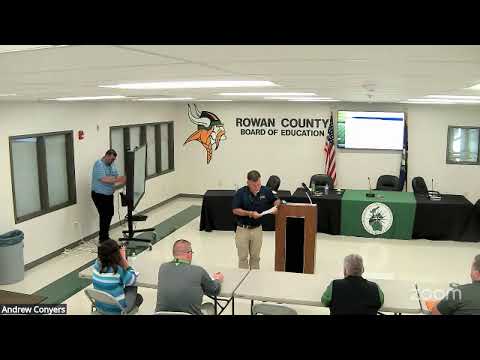
Rowan County School staff on Tuesday presented a preliminary 2025–26 budget that would fund across-the-board salary increases, replace aging Chromebooks on a five-year cycle, and set aside contingency and capital dollars for projects including lighting, parking and building repairs.
The proposed budget, shown to the Rowan County Board of Education for discussion, would maintain a contingency reserve the presentation described as substantially higher than the minimum statutory recommendation and include recurring salary increases targeted to certified and hourly staff while preserving built-in step increases in the district—s redesigned salary table.
District staff said the package is intended to sustain salary-table changes adopted last year and to be conservative about possible federal funding reductions. The presentation noted the district is relying on a 90 percent "hold harmless" expectation from federal-to-state education funding but said that the district is planning on a conservative revenue picture because state-level changes could still affect future allocations.
Key budget items and rationale
The draft budget presented lists total revenue in the range described by staff as about $37 million, with a beginning balance the presentation identified as roughly $3.2 million. Staff said that if estimated revenues and beginning balances materialize, the budget would result in a contingency reserve the presentation put at about $2.09 million (staff cautioned these are working figures).
Salaries: The plan continues the district—s restructured certified salary table adopted last year. Staff said certified employees would receive a $600 increase on top of the district—s built-in annual step increase; hourly employees would receive a 50-cent-per-hour net increase from the step schedule (a 25-cent automatic step plus an additional 25-cent increase proposed this year). The presentation emphasized these are recurring costs and noted last year—s rework of the salary schedule—s design to create predictable, comparable raises across experience levels.
Instructional materials and technology: The package includes a new general-fund project to track purchases of instructional materials and programs so those costs are clearly segregated from federal Title funds. Staff reported the district extended virtual-learning platform contracts using ESSER funds through the 2026–27 school year and has budgeted replacement Chromebooks on a five-year life cycle, estimating about 600 Chromebooks replaced per year.
Programs and vendor costs: The budget includes funds to reestablish an in-district rollout of the Leader in Me character-education program over three years; the presentation quoted a vendor figure of $270,000 for the full program rollout and stated the district—s immediate annual obligation would be $35,000 (staff described the $270,000 figure as the vendor package amount). The budget also includes ongoing subscriptions for literacy and math intervention platforms identified in the presentation as Lexia, EL (reading), and i-Ready (math) or similar programs.
Capital and facilities: Staff highlighted a list of capital needs that are either in the proposed budget or noted for future planning: replacement of aging PAC stage lighting with LED fixtures, repaving a student parking lot, new chemistry lab tables that were identified as a safety issue, roof and HVAC repairs at multiple buildings, replacement of gym bleachers and stage curtains, and a future bus garage build tied to electric-bus charging needs. Staff said some items would be paid from this year—s budget and others are candidates for future bonding.
Facility planning and bonding: Staff reviewed the state-mandated facility-planning process managed through the Kentucky Department of Education (KDE) and said Rowan County is on a four-year rotation. The presentation explained that the facility plan is required for bonding eligibility; projects not on the plan cannot be bonded. Staff also reported current estimated local bonding capacity growth and that the district—s share of statewide bonding allocations depends on the facility plan ranking.
Enrollment and special programs: Presenters described steady, slow growth in district enrollment over the past decades (staff noted approximate growth from about 2,700 students to roughly 3,200 students since the presenter—s tenure began). The district also described adding a complex-needs unit and the resulting need for reliable elevator service and adaptive playgrounds at certain schools; staff said those building adaptations and additional staffing needs are incorporated into the budget.
Other fiscal pressures: The draft includes a 20 percent contingency allowance for expected increases in workers— compensation and general-liability insurance, which staff said is a conservative estimate pending firm premium renewals.
Next steps and board action
Staff told the board the budget will be presented for formal approval at the upcoming main meeting and reminded members of the submission deadline in May. At the end of the public presentation the board voted to enter closed session pursuant to Kentucky statute referenced in the meeting (KRS 61) to discuss matters allowable under that statute; the motion passed by voice vote and staff said no formal action was anticipated while the board was in closed session.
Why this matters
If approved, the budget would add recurring salary costs and ongoing software and device replacement obligations that will become part of the district—s base spending. The combination of recurring raises and a commitment to device and program upkeep narrows future budget flexibility, while the contingency reserve and conservative revenue assumptions are intended to mitigate possible reductions in federal or state funding.
The presentation included project-level needs that could be addressed through a mix of pay-as-you-go dollars and future bonding; staff emphasized that large capital projects must be reflected on the KDE facility plan to qualify for state bonding assistance.