Get Full Government Meeting Transcripts, Videos, & Alerts Forever!
Get email alerts on the Land Use Rezoning topic
No spam. Unsubscribe anytime.
Whitfield County approves several rezoning requests, denies others after public comment
Summary
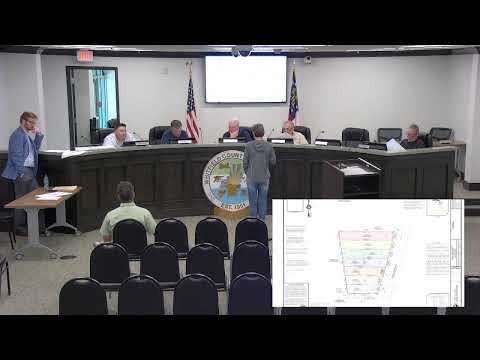
At a joint Whitfield County Board of Commissioners and Dalton-Varnell Whitfield Planning Commission meeting April 28, commissioners approved a mix of rezoning requests and denied others after staff presentations and public comment focused on lot sizes, rural character and potential for multifamily development.
Whitfield County — The Whitfield County Board of Commissioners, sitting jointly with the Dalton‑Varnell Whitfield Planning Commission, approved and denied a series of rezoning requests during a public hearing April 28, resolving eight docketed items (one was stricken) after staff presentations and public comment.
Staff and petitioners presented seven county rezoning requests and one city request. Commissioners and planning commissioners acted on each item after hearing neighbors’ concerns about density, lot size and impacts on rural character. Several petitions drew sustained public comment from adjacent landowners who said they had bought property for a rural lifestyle and worried larger or multifamily zoning would change that.
The meeting opened with Ethan Calhoun of the Northwest Georgia Regional Commission explaining public‑hearing procedures. Staff described each parcel, the requested zoning change and how the request fits the county’s comprehensive plan. Across items, staff recommendations varied: some rezones were recommended, others were not.
Key outcomes at the meeting included:
- Ronald Bates (4624 Wilson Road): Commissioners approved changing the parcel from GA (general agriculture) to SA (suburban agriculture) rather than the R5 the petitioner requested. Staff had recommended SA to preserve lot sizes while allowing family divisions; the petitioner said he wished to split the roughly 18‑acre tract to create lots for heirs. The motion to approve SA was made by Commissioner Brad and seconded by Commissioner Chris; outcome: approved by voice vote (ayes prevailed; numerical tally not specified). Opponents raised concern that R5 could allow multifamily development and reduce animal keeping; resident Sandra Williams said R5 “includes a multi family dwellings, which will, in my opinion, destroy the capacity of what our rural environment was meant to have.”
- McClain Properties (1170 New Hope Road): The request to change from R2 to R5 to allow up to two duplexes was denied. Staff recommended denial citing the existing single‑family character near New Hope schools. Commissioner Chris moved to deny; Commissioner Octavio seconded; outcome: denied by voice vote.
- Calvin Brandon Clark (390 Old Abeson Road): The commission approved rezoning from R5 to GA to allow a second dwelling or manufactured home on a 5.6‑acre parcel. Staff recommended approval because GA would permit two dwellings on the tract; motion by Commissioner Chris, seconded by Commissioner Brad; outcome: approved by voice vote.
- James Cobble Estate (2031 Lake Francis Road): The commission approved rezoning a 2.65‑acre tract from GA to R2 to allow division from the parent tract as part of settling an estate. Staff recommended approval; motion by Commissioner Kevin, seconded by Commissioner Chris; outcome: approved by voice vote. Neighbors confirmed the remainder of the original parcel will retain GA zoning.
- Mario Manana (Cleveland Highway): A request to change from R2 to SA for a roughly 24‑acre parcel to allow a family compound (staff said SA with 3‑acre minimums would fit the petitioner’s plan for four houses) was approved. Motion by Commissioner Octavia, seconded by Commissioner Chris; outcome: approved by voice vote.
- CMH Properties (Seaton Loop, 5 acres): After public comment and debate about lot sizes and rural farming operations, the commission ultimately approved rezoning from GA to R5 to allow the owner to split the 5‑acre tract into smaller tracts for manufactured homes. The petitioner’s representative, Eric Conley, described plans aimed at providing lower‑cost housing on two tracts; nearby property owners including Mark Cook and Matt Tipton urged keeping the area agricultural and cited odors from poultry operations and limited road access as concerns. A motion to approve carried by voice vote after initial motions both to deny and later to approve; the final maker and seconder for approval were recorded in the meeting minutes as Commissioner Bridal (recorded as “Bridal” in the transcript) with Octavio seconding; outcome: approved by voice vote. (Staff had recommended denial due to surrounding very large agricultural tracts.)
- Whitfield County parcel (Tunnel Hill‑Varnell Road): A small existing industrial property that was developed before zoning was adopted was rezoned from R5 to M2 (heavy manufacturing) to make the use conforming. Staff recommended approval; there was no public opposition recorded. Motion and second were made during the meeting and the rezoning was approved by voice vote.
- City of Dalton — Roberto Siler (1213 Hare/Harris Street): The city petition to change from R3 (medium density) to R6 (transitional residential) to divide a duplex lot and add a second duplex was approved. The petitioner said the building already appears as a duplex and the change formalizes dividing the structure; motion by Commissioner Octavia, seconded by Eric (recorded as the seconder); outcome: approved by voice vote.
Across the cases, commissioners generally used voice votes (“ayes have it”) and did not record numerical tallies on the audio transcript. Several petitions prompted neighbors to emphasize preservation of rural character, farm operations and concerns about road access and traffic; petitioners and developers described the practical limits of individual tracts (access easements, floodplain or bridges) and said some proposals aim to create more affordable housing or family compounds rather than large subdivisions.
The planning commission and board closed the public‑hearing portion after the city petition and moved on to their respective deliberations and final votes. The county and city actions finalize zoning for the parcels considered that evening; where approvals change a property’s zoning, further permitting or platting will be required before new construction, and some petitions will be subject to the county’s subdivision and building requirements.